

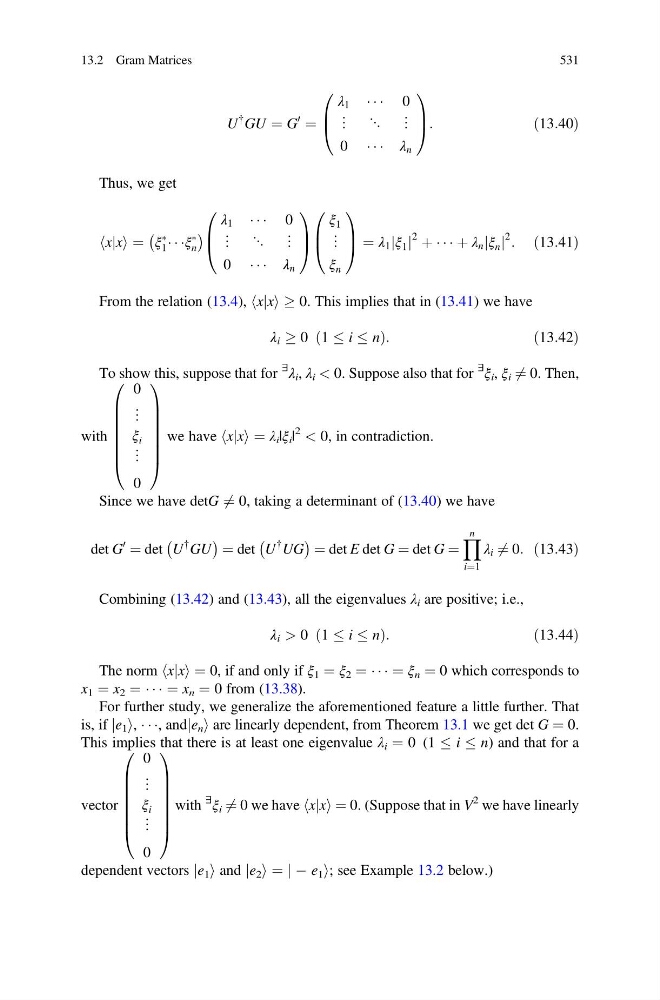
U
{ GU ¼ G
0
¼
λ 1 Á Á Á 0
⋮ ⋱ ⋮
0 Á Á Á λ n
0
B
@
1
C
A:
ð13:40Þ
Thus, we get
xjx
h i ¼ ξ
Ã
1 Á Á Áξ
Ã
n
À
Á
λ 1 Á Á Á 0
⋮ ⋱ ⋮
0 Á Á Á λ n
0
B
@
1
C
A
ξ 1
⋮
ξ n
0
B
@
1
C
A ¼ λ 1 ξ 1
j j
2 þ Á Á Á þ λ n ξ n
j j
2 : ð13:41Þ
From the relation (13.4), hxjxi ! 0. This implies that in (13.41) we have
λ i ! 0 1 i n
ð
Þ :
ð13:42Þ
To show this, suppose that for
∃
λ i , λ i < 0. Suppose also that for
∃
ξ i , ξ i 6 ¼ 0. Then,
with
0
⋮
ξ i
⋮
0
0
B
B
B
B
B
B
@
1
C
C
C
C
C
C
A
we have hxjxi ¼ λ i |ξ i |
2
< 0, in contradiction.
Since we have detG 6 ¼ 0, taking a determinant of (13.40) we have
det G
0
¼ det U
{ GU
À
Á ¼ det U
{ UG
À
Á ¼ det E det G ¼ det G ¼
Y n
i¼1
λ i 6 ¼ 0: ð13:43Þ
Combining (13.42) and (13.43), all the eigenvalues λ i are positive; i.e.,
λ i > 0 1 i n
ð
Þ :
ð13:44Þ
The norm hxjxi ¼ 0, if and only if ξ 1 ¼ ξ 2 ¼ Á Á Á ¼ ξ n ¼ 0 which corresponds to
x 1 ¼ x 2 ¼ Á Á Á ¼ x n ¼ 0 from (13.38).
For further study, we generalize the aforementioned feature a little further. That
is, if je 1 i, Á Á Á, andje n i are linearly dependent, from Theorem 13.1 we get det G ¼ 0.
This implies that there is at least one eigenvalue λ i ¼ 0 (1 i n) and that for a
vector
0
⋮
ξ i
⋮
0
0
B
B
B
B
B
B
@
1
C
C
C
C
C
C
A
with
∃
ξ i 6 ¼ 0 we have hxjxi ¼ 0. (Suppose that in V
2 we have linearly
dependent vectors je 1 i and je 2 i ¼ j À e 1 i; see Example 13.2 below.)
13.2 Gram Matrices
531
{ GU ¼ G
0
¼
λ 1 Á Á Á 0
⋮ ⋱ ⋮
0 Á Á Á λ n
0
B
@
1
C
A:
ð13:40Þ
Thus, we get
xjx
h i ¼ ξ
Ã
1 Á Á Áξ
Ã
n
À
Á
λ 1 Á Á Á 0
⋮ ⋱ ⋮
0 Á Á Á λ n
0
B
@
1
C
A
ξ 1
⋮
ξ n
0
B
@
1
C
A ¼ λ 1 ξ 1
j j
2 þ Á Á Á þ λ n ξ n
j j
2 : ð13:41Þ
From the relation (13.4), hxjxi ! 0. This implies that in (13.41) we have
λ i ! 0 1 i n
ð
Þ :
ð13:42Þ
To show this, suppose that for
∃
λ i , λ i < 0. Suppose also that for
∃
ξ i , ξ i 6 ¼ 0. Then,
with
0
⋮
ξ i
⋮
0
0
B
B
B
B
B
B
@
1
C
C
C
C
C
C
A
we have hxjxi ¼ λ i |ξ i |
2
< 0, in contradiction.
Since we have detG 6 ¼ 0, taking a determinant of (13.40) we have
det G
0
¼ det U
{ GU
À
Á ¼ det U
{ UG
À
Á ¼ det E det G ¼ det G ¼
Y n
i¼1
λ i 6 ¼ 0: ð13:43Þ
Combining (13.42) and (13.43), all the eigenvalues λ i are positive; i.e.,
λ i > 0 1 i n
ð
Þ :
ð13:44Þ
The norm hxjxi ¼ 0, if and only if ξ 1 ¼ ξ 2 ¼ Á Á Á ¼ ξ n ¼ 0 which corresponds to
x 1 ¼ x 2 ¼ Á Á Á ¼ x n ¼ 0 from (13.38).
For further study, we generalize the aforementioned feature a little further. That
is, if je 1 i, Á Á Á, andje n i are linearly dependent, from Theorem 13.1 we get det G ¼ 0.
This implies that there is at least one eigenvalue λ i ¼ 0 (1 i n) and that for a
vector
0
⋮
ξ i
⋮
0
0
B
B
B
B
B
B
@
1
C
C
C
C
C
C
A
with
∃
ξ i 6 ¼ 0 we have hxjxi ¼ 0. (Suppose that in V
2 we have linearly
dependent vectors je 1 i and je 2 i ¼ j À e 1 i; see Example 13.2 below.)
13.2 Gram Matrices
531