

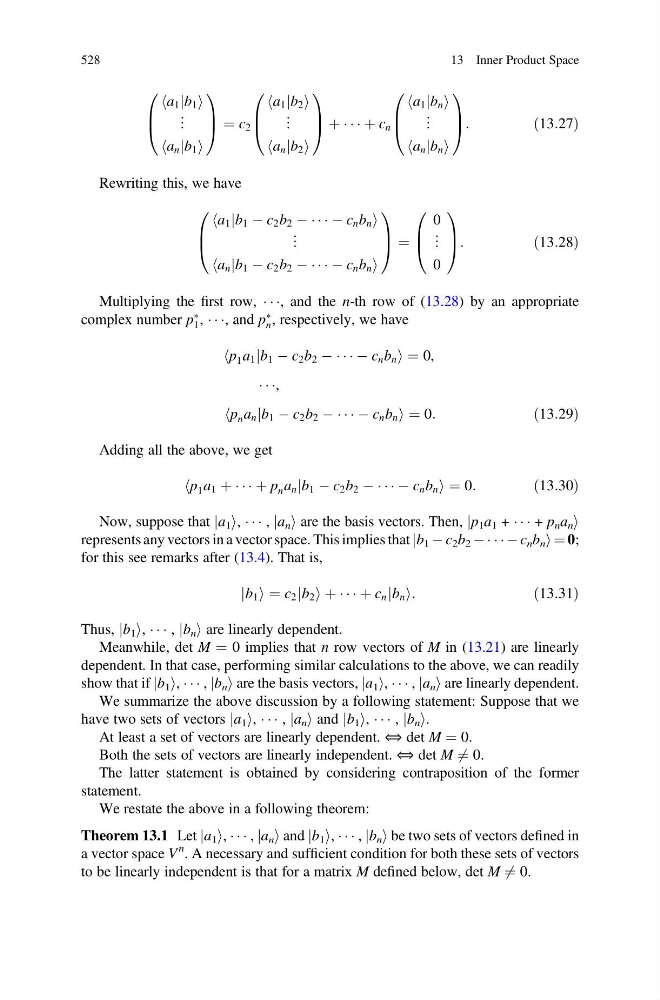
a 1 jb 1
h
i
⋮
a n jb 1
h
i
0
B
@
1
C
A ¼ c 2
a 1 jb 2
h
i
⋮
a n jb 2
h
i
0
B
@
1
C
A þ Á Á Á þ c n
a 1 jb n
h
i
⋮
a n jb n
h
i
0
B
@
1
C
A:
ð13:27Þ
Rewriting this, we have
a 1 jb 1 À c 2 b 2 À Á Á Á À c n b n
h
i
⋮
a n jb 1 À c 2 b 2 À Á Á Á À c n b n
h
i
0
B
@
1
C
A ¼
0
⋮
0
0
B
@
1
C
A:
ð13:28Þ
Multiplying the first row, Á Á Á, and the n-th row of (13.28) by an appropriate
complex number p
Ã
1 , Á Á Á, and p
Ã
n , respectively, we have
p 1 a 1 jb 1 À c 2 b 2 À Á Á Á À c n b n
h
i ¼ 0,
Á Á Á,
p n a n jb 1 À c 2 b 2 À Á Á Á À c n b n
h
i ¼ 0:
ð13:29Þ
Adding all the above, we get
p 1 a 1 þ Á Á Á þ p n a n jb 1 À c 2 b 2 À Á Á Á À c n b n
h
i ¼ 0:
ð13:30Þ
Now, suppose that ja 1 i, Á Á Á , ja n i are the basis vectors. Then, jp 1 a 1 + Á Á Á + p n a n i
represents any vectors in a vector space. This implies that jb 1 À c 2 b 2 À Á Á Á À c n b n i ¼ 0;
for this see remarks after (13.4). That is,
jb 1 i ¼ c 2 jb 2 i þ Á Á Á þ c n jb n i:
ð13:31Þ
Thus, jb 1 i, Á Á Á , jb n i are linearly dependent.
Meanwhile, det M ¼ 0 implies that n row vectors of M in (13.21) are linearly
dependent. In that case, performing similar calculations to the above, we can readily
show that if jb 1 i, Á Á Á , jb n i are the basis vectors, ja 1 i, Á Á Á , ja n i are linearly dependent.
We summarize the above discussion by a following statement: Suppose that we
have two sets of vectors ja 1 i, Á Á Á , ja n i and jb 1 i, Á Á Á , jb n i.
At least a set of vectors are linearly dependent. ⟺ det M ¼ 0.
Both the sets of vectors are linearly independent. ⟺ det M 6 ¼ 0.
The latter statement is obtained by considering contraposition of the former
statement.
We restate the above in a following theorem:
Theorem 13.1 Let ja 1 i, Á Á Á , ja n i and jb 1 i, Á Á Á , jb n i be two sets of vectors defined in
a vector space V
n . A necessary and sufficient condition for both these sets of vectors
to be linearly independent is that for a matrix M defined below, det M 6 ¼ 0.
528
13 Inner Product Space
h
i
⋮
a n jb 1
h
i
0
B
@
1
C
A ¼ c 2
a 1 jb 2
h
i
⋮
a n jb 2
h
i
0
B
@
1
C
A þ Á Á Á þ c n
a 1 jb n
h
i
⋮
a n jb n
h
i
0
B
@
1
C
A:
ð13:27Þ
Rewriting this, we have
a 1 jb 1 À c 2 b 2 À Á Á Á À c n b n
h
i
⋮
a n jb 1 À c 2 b 2 À Á Á Á À c n b n
h
i
0
B
@
1
C
A ¼
0
⋮
0
0
B
@
1
C
A:
ð13:28Þ
Multiplying the first row, Á Á Á, and the n-th row of (13.28) by an appropriate
complex number p
Ã
1 , Á Á Á, and p
Ã
n , respectively, we have
p 1 a 1 jb 1 À c 2 b 2 À Á Á Á À c n b n
h
i ¼ 0,
Á Á Á,
p n a n jb 1 À c 2 b 2 À Á Á Á À c n b n
h
i ¼ 0:
ð13:29Þ
Adding all the above, we get
p 1 a 1 þ Á Á Á þ p n a n jb 1 À c 2 b 2 À Á Á Á À c n b n
h
i ¼ 0:
ð13:30Þ
Now, suppose that ja 1 i, Á Á Á , ja n i are the basis vectors. Then, jp 1 a 1 + Á Á Á + p n a n i
represents any vectors in a vector space. This implies that jb 1 À c 2 b 2 À Á Á Á À c n b n i ¼ 0;
for this see remarks after (13.4). That is,
jb 1 i ¼ c 2 jb 2 i þ Á Á Á þ c n jb n i:
ð13:31Þ
Thus, jb 1 i, Á Á Á , jb n i are linearly dependent.
Meanwhile, det M ¼ 0 implies that n row vectors of M in (13.21) are linearly
dependent. In that case, performing similar calculations to the above, we can readily
show that if jb 1 i, Á Á Á , jb n i are the basis vectors, ja 1 i, Á Á Á , ja n i are linearly dependent.
We summarize the above discussion by a following statement: Suppose that we
have two sets of vectors ja 1 i, Á Á Á , ja n i and jb 1 i, Á Á Á , jb n i.
At least a set of vectors are linearly dependent. ⟺ det M ¼ 0.
Both the sets of vectors are linearly independent. ⟺ det M 6 ¼ 0.
The latter statement is obtained by considering contraposition of the former
statement.
We restate the above in a following theorem:
Theorem 13.1 Let ja 1 i, Á Á Á , ja n i and jb 1 i, Á Á Á , jb n i be two sets of vectors defined in
a vector space V
n . A necessary and sufficient condition for both these sets of vectors
to be linearly independent is that for a matrix M defined below, det M 6 ¼ 0.
528
13 Inner Product Space