

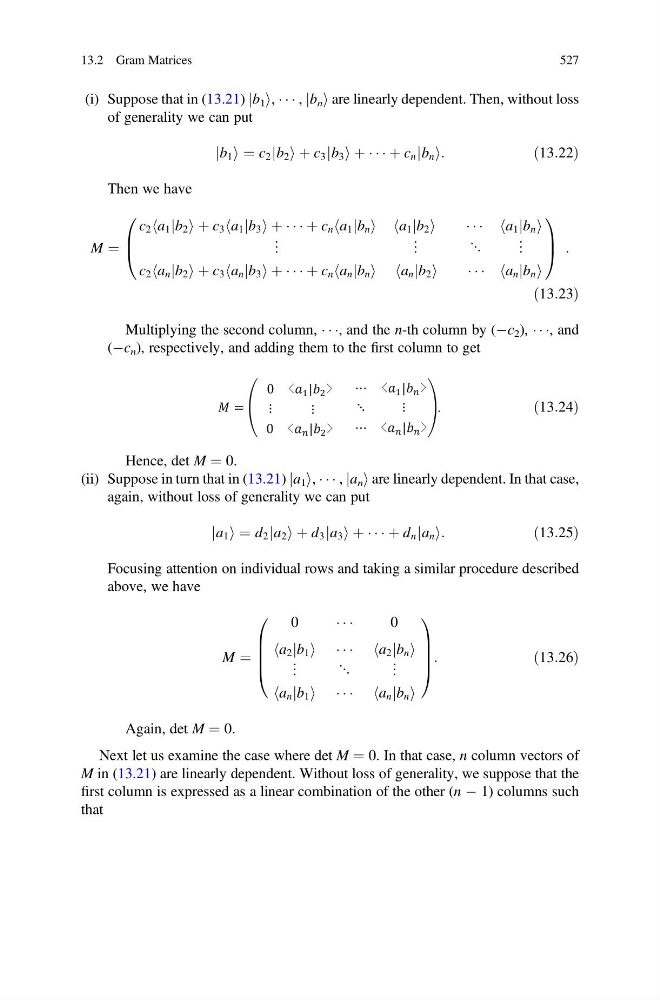
(i) Suppose that in (13.21) jb 1 i, Á Á Á , jb n i are linearly dependent. Then, without loss
of generality we can put
jb 1 i ¼ c 2 jb 2 i þ c 3 jb 3 i þ Á Á Á þ c n jb n i:
ð13:22Þ
Then we have
M ¼
c 2 a 1 b 2 i þ c 3 ha 1
j
j b 3
h
i þ Á Á Á þ c n a 1 jb n
h
i
a 1 jb 2
h
i
Á Á Á
a 1 jb n
h
i
⋮
⋮
⋱
⋮
c 2 a n b 2 i þ c 3 ha n
j
j b 3
h
i þ Á Á Á þ c n a n jb n
h
i
a n jb 2
h
i
Á Á Á a n jb n
h
i
0
B
@
1
C
A :
ð13:23Þ
Multiplying the second column, Á Á Á, and the n-th column by (Àc 2 ), Á Á Á, and
(Àc n ), respectively, and adding them to the first column to get
ð13:24Þ
Hence, det M ¼ 0.
(ii) Suppose in turn that in (13.21) ja 1 i, Á Á Á , ja n i are linearly dependent. In that case,
again, without loss of generality we can put
ja 1 i ¼ d 2 ja 2 i þ d 3 ja 3 i þ Á Á Á þ d n ja n i:
ð13:25Þ
Focusing attention on individual rows and taking a similar procedure described
above, we have
M ¼
0
a 2 jb 1
h
i
Á Á Á
Á Á Á
0
a 2 jb n
h
i
⋮
⋱
⋮
a n jb 1
h
i Á Á Á
a n jb n
h
i
0
B
B
B
@
1
C
C
C
A
:
ð13:26Þ
Again, det M ¼ 0.
Next let us examine the case where det M ¼ 0. In that case, n column vectors of
M in (13.21) are linearly dependent. Without loss of generality, we suppose that the
first column is expressed as a linear combination of the other (n À 1) columns such
that
13.2 Gram Matrices
527
of generality we can put
jb 1 i ¼ c 2 jb 2 i þ c 3 jb 3 i þ Á Á Á þ c n jb n i:
ð13:22Þ
Then we have
M ¼
c 2 a 1 b 2 i þ c 3 ha 1
j
j b 3
h
i þ Á Á Á þ c n a 1 jb n
h
i
a 1 jb 2
h
i
Á Á Á
a 1 jb n
h
i
⋮
⋮
⋱
⋮
c 2 a n b 2 i þ c 3 ha n
j
j b 3
h
i þ Á Á Á þ c n a n jb n
h
i
a n jb 2
h
i
Á Á Á a n jb n
h
i
0
B
@
1
C
A :
ð13:23Þ
Multiplying the second column, Á Á Á, and the n-th column by (Àc 2 ), Á Á Á, and
(Àc n ), respectively, and adding them to the first column to get
ð13:24Þ
Hence, det M ¼ 0.
(ii) Suppose in turn that in (13.21) ja 1 i, Á Á Á , ja n i are linearly dependent. In that case,
again, without loss of generality we can put
ja 1 i ¼ d 2 ja 2 i þ d 3 ja 3 i þ Á Á Á þ d n ja n i:
ð13:25Þ
Focusing attention on individual rows and taking a similar procedure described
above, we have
M ¼
0
a 2 jb 1
h
i
Á Á Á
Á Á Á
0
a 2 jb n
h
i
⋮
⋱
⋮
a n jb 1
h
i Á Á Á
a n jb n
h
i
0
B
B
B
@
1
C
C
C
A
:
ð13:26Þ
Again, det M ¼ 0.
Next let us examine the case where det M ¼ 0. In that case, n column vectors of
M in (13.21) are linearly dependent. Without loss of generality, we suppose that the
first column is expressed as a linear combination of the other (n À 1) columns such
that
13.2 Gram Matrices
527