

f A x
ð Þ ¼ f B x
ð Þ ¼ x À 3
ð
Þ x À 2
ð
Þ
2 ,
ð12:210Þ
with eigenvalues α 1 ¼ 3 and α 2 ¼ 2. Also we have f 1 (x) ¼ (x À 2)
2 and f 2 (x) ¼ x À 3.
Following the procedures of (12.85) and (12.86), we obtain
M 1 x
ð Þ ¼ x À 2 and M 2 x
ð Þ ¼ Àx
2
þ 3x À 3:
Therefore, we have
M 1 x
ð Þf 1 x
ð Þ ¼ x À 2
ð
Þ
3 , M 2 x
ð Þf 2 x
ð Þ ¼ x À 3
ð
Þ Àx
2
þ 3x À 3
À
Á :
ð12:211Þ
Hence, we get
A 1 M 1 A
ð Þf 1 A
ð Þ ¼ A À 2E
ð
Þ
3 ,
A 2 M 2 A
ð Þf 2 A
ð Þ ¼ A À 3E
ð
Þ ÀA
2
þ 3A À 3E
À
Á :
ð12:212Þ
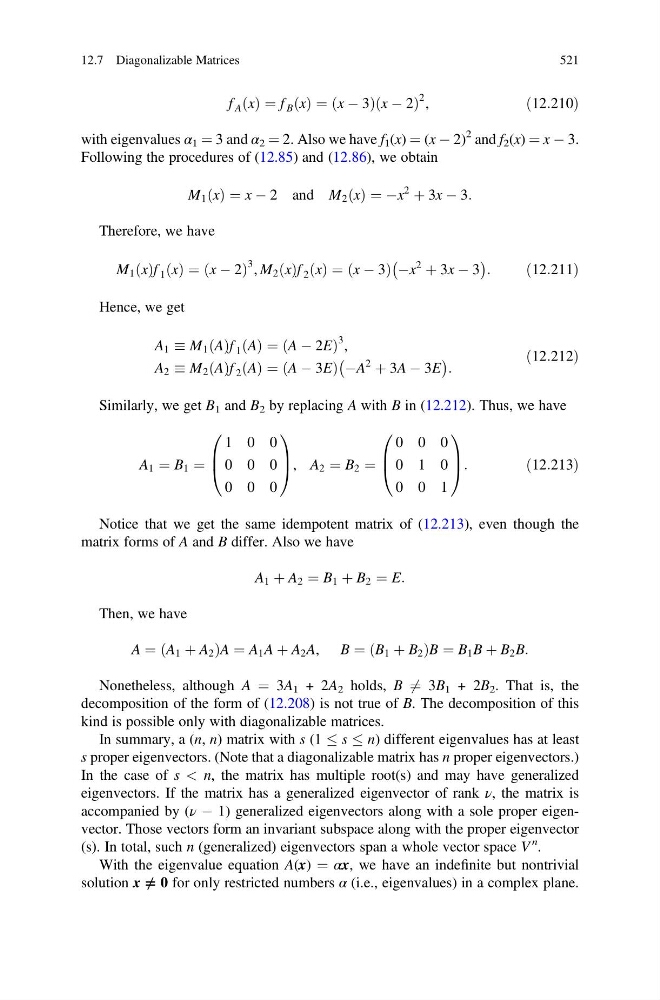
Similarly, we get B 1 and B 2 by replacing A with B in (12.212). Thus, we have
A 1 ¼ B 1 ¼
1 0 0
0 0 0
0 0 0
0
B
@
1
C
A, A 2 ¼ B 2 ¼
0 0 0
0 1 0
0 0 1
0
B
@
1
C
A:
ð12:213Þ
Notice that we get the same idempotent matrix of (12.213), even though the
matrix forms of A and B differ. Also we have
A 1 þ A 2 ¼ B 1 þ B 2 ¼ E:
Then, we have
A ¼ A 1 þ A 2
ð
Þ A ¼ A 1 A þ A 2 A, B ¼ B 1 þ B 2
ð
Þ B ¼ B 1 B þ B 2 B:
Nonetheless, although A ¼ 3A 1 + 2A 2 holds, B 6 ¼ 3B 1 + 2B 2 . That is, the
decomposition of the form of (12.208) is not true of B. The decomposition of this
kind is possible only with diagonalizable matrices.
In summary, a (n, n) matrix with s (1 s n) different eigenvalues has at least
s proper eigenvectors. (Note that a diagonalizable matrix has n proper eigenvectors.)
In the case of s < n, the matrix has multiple root(s) and may have generalized
eigenvectors. If the matrix has a generalized eigenvector of rank ν, the matrix is
accompanied by (ν À 1) generalized eigenvectors along with a sole proper eigenvector. Those vectors form an invariant subspace along with the proper eigenvector
(s). In total, such n (generalized) eigenvectors span a whole vector space V
n .
With the eigenvalue equation A(x) ¼ αx, we have an indefinite but nontrivial
solution x ≠ 0 for only restricted numbers α (i.e., eigenvalues) in a complex plane.
12.7 Diagonalizable Matrices
521
ð Þ ¼ f B x
ð Þ ¼ x À 3
ð
Þ x À 2
ð
Þ
2 ,
ð12:210Þ
with eigenvalues α 1 ¼ 3 and α 2 ¼ 2. Also we have f 1 (x) ¼ (x À 2)
2 and f 2 (x) ¼ x À 3.
Following the procedures of (12.85) and (12.86), we obtain
M 1 x
ð Þ ¼ x À 2 and M 2 x
ð Þ ¼ Àx
2
þ 3x À 3:
Therefore, we have
M 1 x
ð Þf 1 x
ð Þ ¼ x À 2
ð
Þ
3 , M 2 x
ð Þf 2 x
ð Þ ¼ x À 3
ð
Þ Àx
2
þ 3x À 3
À
Á :
ð12:211Þ
Hence, we get
A 1 M 1 A
ð Þf 1 A
ð Þ ¼ A À 2E
ð
Þ
3 ,
A 2 M 2 A
ð Þf 2 A
ð Þ ¼ A À 3E
ð
Þ ÀA
2
þ 3A À 3E
À
Á :
ð12:212Þ
Similarly, we get B 1 and B 2 by replacing A with B in (12.212). Thus, we have
A 1 ¼ B 1 ¼
1 0 0
0 0 0
0 0 0
0
B
@
1
C
A, A 2 ¼ B 2 ¼
0 0 0
0 1 0
0 0 1
0
B
@
1
C
A:
ð12:213Þ
Notice that we get the same idempotent matrix of (12.213), even though the
matrix forms of A and B differ. Also we have
A 1 þ A 2 ¼ B 1 þ B 2 ¼ E:
Then, we have
A ¼ A 1 þ A 2
ð
Þ A ¼ A 1 A þ A 2 A, B ¼ B 1 þ B 2
ð
Þ B ¼ B 1 B þ B 2 B:
Nonetheless, although A ¼ 3A 1 + 2A 2 holds, B 6 ¼ 3B 1 + 2B 2 . That is, the
decomposition of the form of (12.208) is not true of B. The decomposition of this
kind is possible only with diagonalizable matrices.
In summary, a (n, n) matrix with s (1 s n) different eigenvalues has at least
s proper eigenvectors. (Note that a diagonalizable matrix has n proper eigenvectors.)
In the case of s < n, the matrix has multiple root(s) and may have generalized
eigenvectors. If the matrix has a generalized eigenvector of rank ν, the matrix is
accompanied by (ν À 1) generalized eigenvectors along with a sole proper eigenvector. Those vectors form an invariant subspace along with the proper eigenvector
(s). In total, such n (generalized) eigenvectors span a whole vector space V
n .
With the eigenvalue equation A(x) ¼ αx, we have an indefinite but nontrivial
solution x ≠ 0 for only restricted numbers α (i.e., eigenvalues) in a complex plane.
12.7 Diagonalizable Matrices
521