

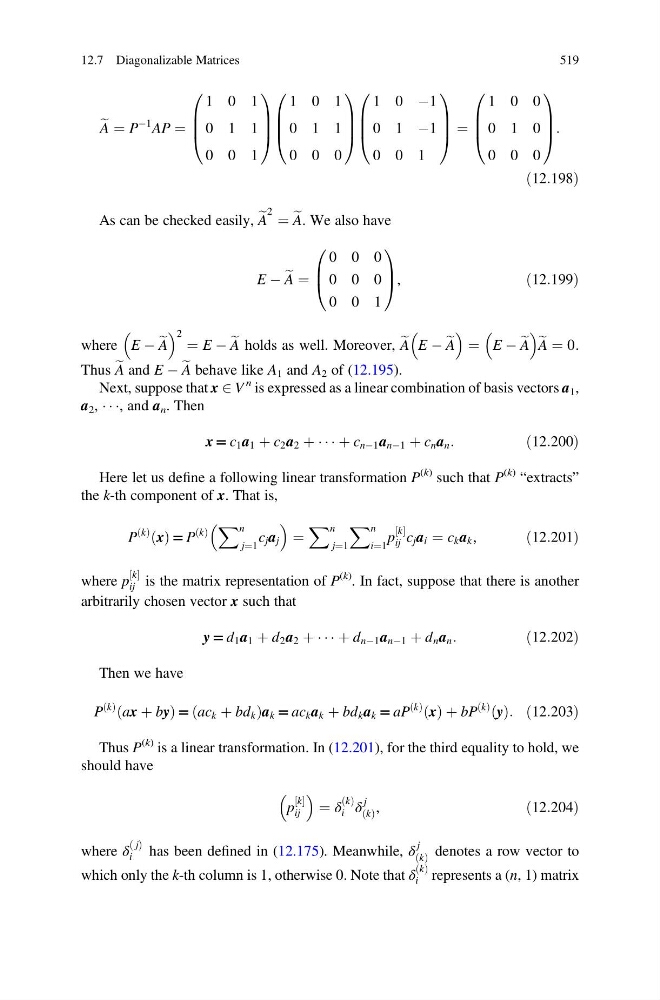
e
A ¼ P
À1 AP ¼
1 0 1
0 1 1
0 0 1
0
B
B
@
1
C
C
A
1 0 1
0 1 1
0 0 0
0
B
B
@
1
C
C
A
1 0 À1
0 1 À1
0 0 1
0
B
B
@
1
C
C
A ¼
1 0 0
0 1 0
0 0 0
0
B
B
@
1
C
C
A :
ð12:198Þ
As can be checked easily, e
A
2 ¼ e
A. We also have
E À e
A ¼
0 0 0
0 0 0
0 0 1
0
B
@
1
C
A,
ð12:199Þ
where E À e
A
2 ¼ E À e
A holds as well. Moreover, e
A E À e
A
¼ E À e
A
e
A ¼ 0.
Thus e
A and E À e
A behave like A 1 and A 2 of (12.195).
Next, suppose that x 2 V
n is expressed as a linear combination of basis vectors a 1 ,
a 2 , Á Á Á, and a n . Then
x = c 1 a 1 þ c 2 a 2 þ Á Á Á þ c nÀ1 a nÀ1 þ c n a n :
ð12:200Þ
Here let us define a following linear transformation P
(k) such that P
(k)
“extracts”
the k-th component of x. That is,
P
k
ð Þ x
ð Þ = P
k
ð Þ
X n
j¼1
c j a j
¼
X n
j¼1
X n
i¼1
p
k
½
ij c j a i ¼ c k a k ,
ð12:201Þ
where p
k
½
ij is the matrix representation of P
(k)
. In fact, suppose that there is another
arbitrarily chosen vector x such that
y = d 1 a 1 þ d 2 a 2 þ Á Á Á þ d nÀ1 a nÀ1 þ d n a n :
ð12:202Þ
Then we have
P
k
ð Þ ax þ by
ð
Þ= ac k þ bd k
ð
Þ a k = ac k a k þ bd k a k = aP
k
ð Þ x
ð Þ þ bP
k
ð Þ y
ð Þ: ð12:203Þ
Thus P
(k) is a linear transformation. In (12.201), for the third equality to hold, we
should have
p
k
½
ij
¼ δ
k
ð Þ
i δ
j
k
ð Þ ,
ð12:204Þ
where δ
j
ð Þ
i
has been defined in (12.175). Meanwhile, δ
j
k
ð Þ denotes a row vector to
which only the k-th column is 1, otherwise 0. Note that δ
k
ð Þ
i represents a (n, 1) matrix
12.7 Diagonalizable Matrices
519
A ¼ P
À1 AP ¼
1 0 1
0 1 1
0 0 1
0
B
B
@
1
C
C
A
1 0 1
0 1 1
0 0 0
0
B
B
@
1
C
C
A
1 0 À1
0 1 À1
0 0 1
0
B
B
@
1
C
C
A ¼
1 0 0
0 1 0
0 0 0
0
B
B
@
1
C
C
A :
ð12:198Þ
As can be checked easily, e
A
2 ¼ e
A. We also have
E À e
A ¼
0 0 0
0 0 0
0 0 1
0
B
@
1
C
A,
ð12:199Þ
where E À e
A
2 ¼ E À e
A holds as well. Moreover, e
A E À e
A
¼ E À e
A
e
A ¼ 0.
Thus e
A and E À e
A behave like A 1 and A 2 of (12.195).
Next, suppose that x 2 V
n is expressed as a linear combination of basis vectors a 1 ,
a 2 , Á Á Á, and a n . Then
x = c 1 a 1 þ c 2 a 2 þ Á Á Á þ c nÀ1 a nÀ1 þ c n a n :
ð12:200Þ
Here let us define a following linear transformation P
(k) such that P
(k)
“extracts”
the k-th component of x. That is,
P
k
ð Þ x
ð Þ = P
k
ð Þ
X n
j¼1
c j a j
¼
X n
j¼1
X n
i¼1
p
k
½
ij c j a i ¼ c k a k ,
ð12:201Þ
where p
k
½
ij is the matrix representation of P
(k)
. In fact, suppose that there is another
arbitrarily chosen vector x such that
y = d 1 a 1 þ d 2 a 2 þ Á Á Á þ d nÀ1 a nÀ1 þ d n a n :
ð12:202Þ
Then we have
P
k
ð Þ ax þ by
ð
Þ= ac k þ bd k
ð
Þ a k = ac k a k þ bd k a k = aP
k
ð Þ x
ð Þ þ bP
k
ð Þ y
ð Þ: ð12:203Þ
Thus P
(k) is a linear transformation. In (12.201), for the third equality to hold, we
should have
p
k
½
ij
¼ δ
k
ð Þ
i δ
j
k
ð Þ ,
ð12:204Þ
where δ
j
ð Þ
i
has been defined in (12.175). Meanwhile, δ
j
k
ð Þ denotes a row vector to
which only the k-th column is 1, otherwise 0. Note that δ
k
ð Þ
i represents a (n, 1) matrix
12.7 Diagonalizable Matrices
519