

i
ð Þ x ¼ 4:
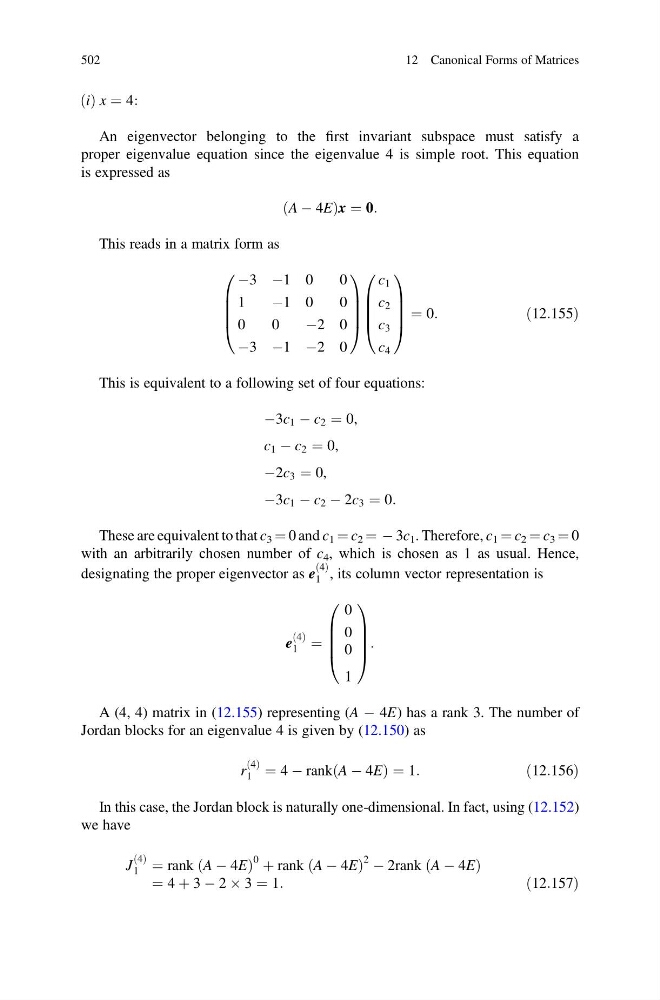
An eigenvector belonging to the first invariant subspace must satisfy a
proper eigenvalue equation since the eigenvalue 4 is simple root. This equation
is expressed as
A À 4E
ð
Þx ¼ 0:
This reads in a matrix form as
À3 À1 0
0
1
À1 0
0
0
0
À2 0
À3 À1 À2 0
0
B
B
B
@
1
C
C
C
A
c 1
c 2
c 3
c 4
0
B
B
B
@
1
C
C
C
A
¼ 0:
ð12:155Þ
This is equivalent to a following set of four equations:
À3c 1 À c 2 ¼ 0,
c 1 À c 2 ¼ 0,
À2c 3 ¼ 0,
À3c 1 À c 2 À 2c 3 ¼ 0:
These are equivalent to that c 3 ¼ 0 and c 1 ¼ c 2 ¼ À 3c 1 . Therefore, c 1 ¼ c 2 ¼ c 3 ¼ 0
with an arbitrarily chosen number of c 4 , which is chosen as 1 as usual. Hence,
designating the proper eigenvector as e
4
ð Þ
1 , its column vector representation is
e
4
ð Þ
1 ¼
0
0
0
1
0
B
B
B
@
1
C
C
C
A
:
A (4, 4) matrix in (12.155) representing (A À 4E) has a rank 3. The number of
Jordan blocks for an eigenvalue 4 is given by (12.150) as
r
4
ð Þ
1 ¼ 4 À rank A À 4E
ð
Þ¼1:
ð12:156Þ
In this case, the Jordan block is naturally one-dimensional. In fact, using (12.152)
we have
J
4
ð Þ
1 ¼ rank A À 4E
ð
Þ
0 þ rank A À 4E
ð
Þ
2 À 2rank A À 4E
ð
Þ
¼ 4 þ 3 À 2 Â 3 ¼ 1:
ð12:157Þ
502
12 Canonical Forms of Matrices
ð Þ x ¼ 4:
An eigenvector belonging to the first invariant subspace must satisfy a
proper eigenvalue equation since the eigenvalue 4 is simple root. This equation
is expressed as
A À 4E
ð
Þx ¼ 0:
This reads in a matrix form as
À3 À1 0
0
1
À1 0
0
0
0
À2 0
À3 À1 À2 0
0
B
B
B
@
1
C
C
C
A
c 1
c 2
c 3
c 4
0
B
B
B
@
1
C
C
C
A
¼ 0:
ð12:155Þ
This is equivalent to a following set of four equations:
À3c 1 À c 2 ¼ 0,
c 1 À c 2 ¼ 0,
À2c 3 ¼ 0,
À3c 1 À c 2 À 2c 3 ¼ 0:
These are equivalent to that c 3 ¼ 0 and c 1 ¼ c 2 ¼ À 3c 1 . Therefore, c 1 ¼ c 2 ¼ c 3 ¼ 0
with an arbitrarily chosen number of c 4 , which is chosen as 1 as usual. Hence,
designating the proper eigenvector as e
4
ð Þ
1 , its column vector representation is
e
4
ð Þ
1 ¼
0
0
0
1
0
B
B
B
@
1
C
C
C
A
:
A (4, 4) matrix in (12.155) representing (A À 4E) has a rank 3. The number of
Jordan blocks for an eigenvalue 4 is given by (12.150) as
r
4
ð Þ
1 ¼ 4 À rank A À 4E
ð
Þ¼1:
ð12:156Þ
In this case, the Jordan block is naturally one-dimensional. In fact, using (12.152)
we have
J
4
ð Þ
1 ¼ rank A À 4E
ð
Þ
0 þ rank A À 4E
ð
Þ
2 À 2rank A À 4E
ð
Þ
¼ 4 þ 3 À 2 Â 3 ¼ 1:
ð12:157Þ
502
12 Canonical Forms of Matrices