

where we define J
i
ð Þ
q as the number of the q-th order Jordan blocks within A
(i) . Note
that these blocks are expressed as (q, q) matrices. Meanwhile, using (12.148) J
i
ð Þ
q is
expressed as
J
i
ð Þ
q ¼ rank A À α i E
ð
Þ
qÀ1 þ rank A À α i E
ð
Þ
qþ1 À 2rank A À α i E
ð
Þ
q : ð12:152Þ
This relation can be obtained by replacing k in (12.148) with q À 1, q + 1, and q,
respectively, and deleting n and n i from these three relations. This enables us to gain
access to a whole structure of the linear transformation represented by the (n, n)
matrix A without reducing it to subspaces.
To enrich our understanding of Jordan canonical forms, a following tangible
example will be beneficial.
12.6.3 Example of Jordan Canonical Form
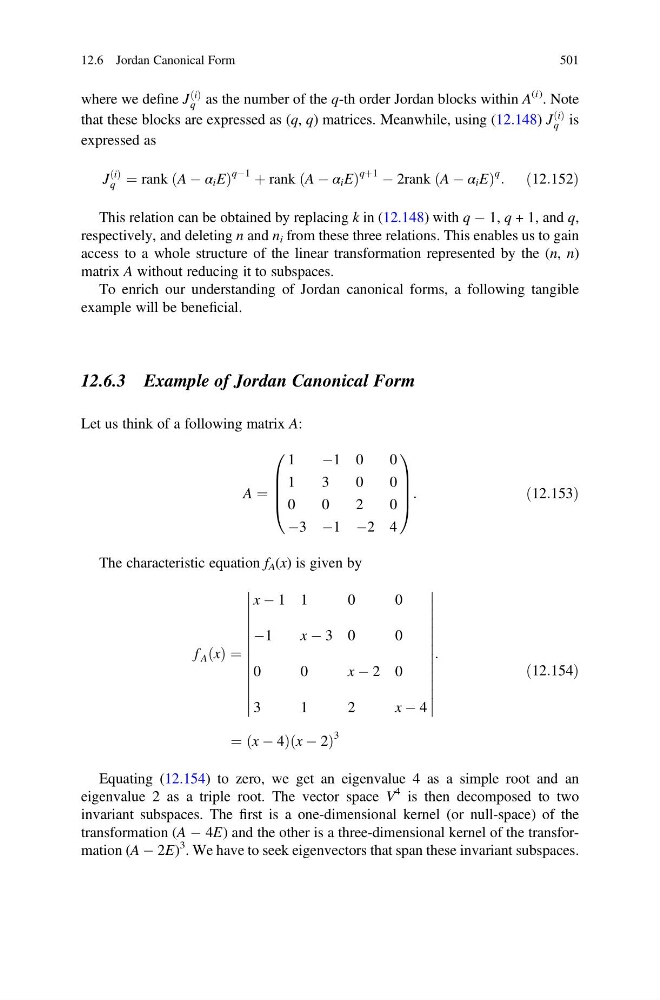
Let us think of a following matrix A:
A ¼
1
À1 0
0
1
3
0
0
0
0
2
0
À3 À1 À2 4
0
B
B
B
@
1
C
C
C
A
:
ð12:153Þ
The characteristic equation f A (x) is given by
f A x
ð Þ ¼
x À 1 1
0
0
À1
x À 3 0
0
0
0
x À 2 0
3
1
2
x À 4
:
¼ x À 4
ð
Þ x À 2
ð
Þ
3
ð12:154Þ
Equating (12.154) to zero, we get an eigenvalue 4 as a simple root and an
eigenvalue 2 as a triple root. The vector space V
4 is then decomposed to two
invariant subspaces. The first is a one-dimensional kernel (or null-space) of the
transformation (A À 4E) and the other is a three-dimensional kernel of the transformation (A À 2E)
3 . We have to seek eigenvectors that span these invariant subspaces.
12.6 Jordan Canonical Form
501
i
ð Þ
q as the number of the q-th order Jordan blocks within A
(i) . Note
that these blocks are expressed as (q, q) matrices. Meanwhile, using (12.148) J
i
ð Þ
q is
expressed as
J
i
ð Þ
q ¼ rank A À α i E
ð
Þ
qÀ1 þ rank A À α i E
ð
Þ
qþ1 À 2rank A À α i E
ð
Þ
q : ð12:152Þ
This relation can be obtained by replacing k in (12.148) with q À 1, q + 1, and q,
respectively, and deleting n and n i from these three relations. This enables us to gain
access to a whole structure of the linear transformation represented by the (n, n)
matrix A without reducing it to subspaces.
To enrich our understanding of Jordan canonical forms, a following tangible
example will be beneficial.
12.6.3 Example of Jordan Canonical Form
Let us think of a following matrix A:
A ¼
1
À1 0
0
1
3
0
0
0
0
2
0
À3 À1 À2 4
0
B
B
B
@
1
C
C
C
A
:
ð12:153Þ
The characteristic equation f A (x) is given by
f A x
ð Þ ¼
x À 1 1
0
0
À1
x À 3 0
0
0
0
x À 2 0
3
1
2
x À 4
:
¼ x À 4
ð
Þ x À 2
ð
Þ
3
ð12:154Þ
Equating (12.154) to zero, we get an eigenvalue 4 as a simple root and an
eigenvalue 2 as a triple root. The vector space V
4 is then decomposed to two
invariant subspaces. The first is a one-dimensional kernel (or null-space) of the
transformation (A À 4E) and the other is a three-dimensional kernel of the transformation (A À 2E)
3 . We have to seek eigenvectors that span these invariant subspaces.
12.6 Jordan Canonical Form
501