

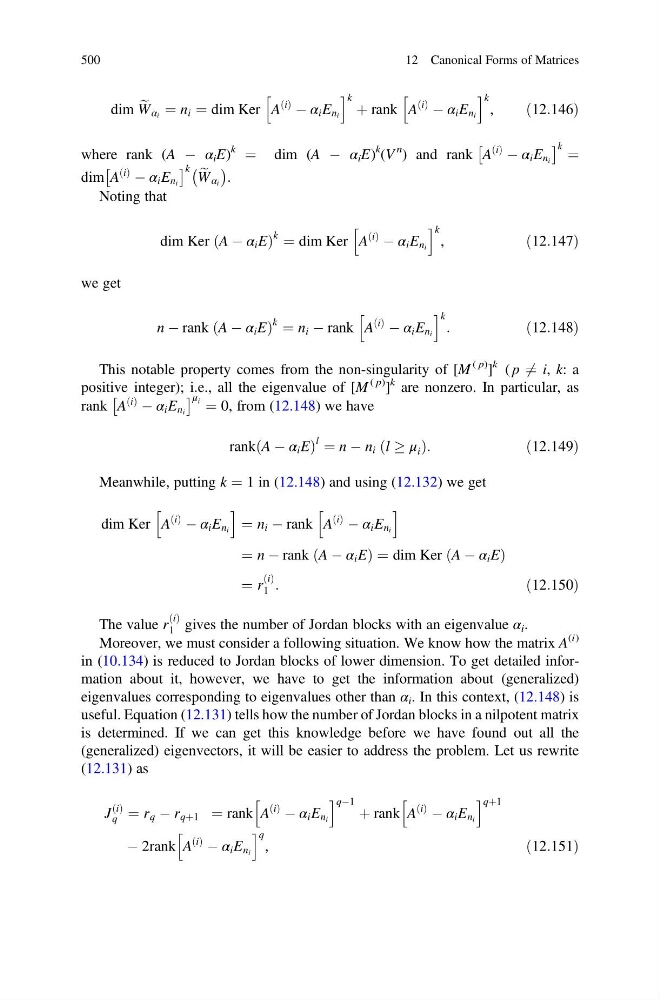
dim e
W α i ¼ n i ¼ dim Ker A
i
ð Þ
À α i E n i
h
i k þ rank A
i
ð Þ
À α i E n i
h
i k
,
ð12:146Þ
where rank (A À α i E)
k
¼ dim (A À α i E)
k (V
n ) and rank A
i
ð Þ
À α i E n i
Â
à k ¼
dim A
i
ð Þ
À α i E n i
Â
à k e
W α i
À
Á
.
Noting that
dim Ker A À α i E
ð
Þ
k ¼ dim Ker A
i
ð Þ
À α i E n i
h
i k
,
ð12:147Þ
we get
n À rank A À α i E
ð
Þ
k ¼ n i À rank A
i
ð Þ
À α i E n i
h
i k :
ð12:148Þ
This notable property comes from the non-singularity of [M
( p) ]
k ( p 6 ¼ i, k: a
positive integer); i.e., all the eigenvalue of [M
( p) ]
k are nonzero. In particular, as
rank A
i
ð Þ
À α i E n i
Â
à μ i ¼ 0, from (12.148) we have
rank A À α i E
ð
Þ
l ¼ n À n i l ! μ i
ð
Þ:
ð12:149Þ
Meanwhile, putting k ¼ 1 in (12.148) and using (12.132) we get
dim Ker A
i
ð Þ
À α i E n i
h
i
¼ n i À rank A
i
ð Þ
À α i E n i
h
i
¼ n À rank A À α i E
ð
Þ¼dim Ker A À α i E
ð
Þ
¼ r
i
ð Þ
1 :
ð12:150Þ
The value r
i
ð Þ
1 gives the number of Jordan blocks with an eigenvalue α i .
Moreover, we must consider a following situation. We know how the matrix A
(i)
in (10.134) is reduced to Jordan blocks of lower dimension. To get detailed information about it, however, we have to get the information about (generalized)
eigenvalues corresponding to eigenvalues other than α i . In this context, (12.148) is
useful. Equation (12.131) tells how the number of Jordan blocks in a nilpotent matrix
is determined. If we can get this knowledge before we have found out all the
(generalized) eigenvectors, it will be easier to address the problem. Let us rewrite
(12.131) as
J
i
ð Þ
q ¼ r q À r qþ1 ¼ rank A
i
ð Þ
À α i E n i
h
i qÀ1 þ rank A
i
ð Þ
À α i E n i
h
i qþ1
À 2rank A
i
ð Þ
À α i E n i
h
i q
,
ð12:151Þ
500
12 Canonical Forms of Matrices
W α i ¼ n i ¼ dim Ker A
i
ð Þ
À α i E n i
h
i k þ rank A
i
ð Þ
À α i E n i
h
i k
,
ð12:146Þ
where rank (A À α i E)
k
¼ dim (A À α i E)
k (V
n ) and rank A
i
ð Þ
À α i E n i
Â
à k ¼
dim A
i
ð Þ
À α i E n i
Â
à k e
W α i
À
Á
.
Noting that
dim Ker A À α i E
ð
Þ
k ¼ dim Ker A
i
ð Þ
À α i E n i
h
i k
,
ð12:147Þ
we get
n À rank A À α i E
ð
Þ
k ¼ n i À rank A
i
ð Þ
À α i E n i
h
i k :
ð12:148Þ
This notable property comes from the non-singularity of [M
( p) ]
k ( p 6 ¼ i, k: a
positive integer); i.e., all the eigenvalue of [M
( p) ]
k are nonzero. In particular, as
rank A
i
ð Þ
À α i E n i
Â
à μ i ¼ 0, from (12.148) we have
rank A À α i E
ð
Þ
l ¼ n À n i l ! μ i
ð
Þ:
ð12:149Þ
Meanwhile, putting k ¼ 1 in (12.148) and using (12.132) we get
dim Ker A
i
ð Þ
À α i E n i
h
i
¼ n i À rank A
i
ð Þ
À α i E n i
h
i
¼ n À rank A À α i E
ð
Þ¼dim Ker A À α i E
ð
Þ
¼ r
i
ð Þ
1 :
ð12:150Þ
The value r
i
ð Þ
1 gives the number of Jordan blocks with an eigenvalue α i .
Moreover, we must consider a following situation. We know how the matrix A
(i)
in (10.134) is reduced to Jordan blocks of lower dimension. To get detailed information about it, however, we have to get the information about (generalized)
eigenvalues corresponding to eigenvalues other than α i . In this context, (12.148) is
useful. Equation (12.131) tells how the number of Jordan blocks in a nilpotent matrix
is determined. If we can get this knowledge before we have found out all the
(generalized) eigenvectors, it will be easier to address the problem. Let us rewrite
(12.131) as
J
i
ð Þ
q ¼ r q À r qþ1 ¼ rank A
i
ð Þ
À α i E n i
h
i qÀ1 þ rank A
i
ð Þ
À α i E n i
h
i qþ1
À 2rank A
i
ð Þ
À α i E n i
h
i q
,
ð12:151Þ
500
12 Canonical Forms of Matrices