

In (12.157), J
4
ð Þ
1
gives the number of the first-order Jordan blocks for an
eigenvalue 4. We used
A À 4E
ð
Þ
2 ¼
8
4 0 0
À4 0 0 0
0
0 4 0
8
4 4 0
0
B
B
B
@
1
C
C
C
A
ð12:158Þ
and confirmed that rank (A À 4E)
2
¼ 3.
ii
ð Þ x ¼ 2 :
The eigenvalue 2 has a triple root. Therefore, we must examine how the invariant
subspaces can further be decomposed to subspaces of lower dimension. To this end
we first start with a secular equation expressed as
A À 2E
ð
Þx ¼ 0:
ð12:159Þ
The matrix representation is
À1 À1 0
0
1
1
0
0
0
0
0
0
À3 À1 À2 2
0
B
B
B
@
1
C
C
C
A
c 1
c 2
c 3
c 4
0
B
B
B
@
1
C
C
C
A
¼ 0:
This is equivalent to a following set of two equations:
c 1 þ c 2 ¼ 0,
À3c 1 À c 2 À 2c 3 þ 2c 4 ¼ 0:
From the above, we can put c 1 ¼ c 2 ¼ 0 and c 3 ¼ c 4 (¼1). The equations allow the
existence of another proper eigenvector. For this we have c 1 ¼ À c 2 ¼ 1, c 3 ¼ 0, and
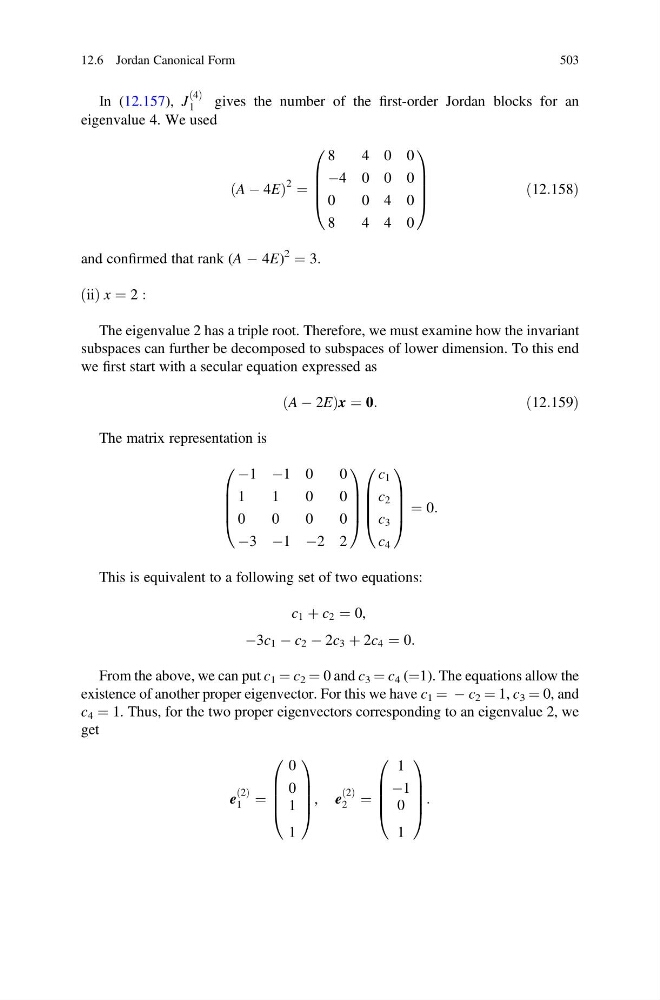
c 4 ¼ 1. Thus, for the two proper eigenvectors corresponding to an eigenvalue 2, we
get
e
2
ð Þ
1 ¼
0
0
1
1
0
B
B
B
@
1
C
C
C
A
, e
2
ð Þ
2 ¼
1
À1
0
1
0
B
B
B
@
1
C
C
C
A
:
12.6 Jordan Canonical Form
503
4
ð Þ
1
gives the number of the first-order Jordan blocks for an
eigenvalue 4. We used
A À 4E
ð
Þ
2 ¼
8
4 0 0
À4 0 0 0
0
0 4 0
8
4 4 0
0
B
B
B
@
1
C
C
C
A
ð12:158Þ
and confirmed that rank (A À 4E)
2
¼ 3.
ii
ð Þ x ¼ 2 :
The eigenvalue 2 has a triple root. Therefore, we must examine how the invariant
subspaces can further be decomposed to subspaces of lower dimension. To this end
we first start with a secular equation expressed as
A À 2E
ð
Þx ¼ 0:
ð12:159Þ
The matrix representation is
À1 À1 0
0
1
1
0
0
0
0
0
0
À3 À1 À2 2
0
B
B
B
@
1
C
C
C
A
c 1
c 2
c 3
c 4
0
B
B
B
@
1
C
C
C
A
¼ 0:
This is equivalent to a following set of two equations:
c 1 þ c 2 ¼ 0,
À3c 1 À c 2 À 2c 3 þ 2c 4 ¼ 0:
From the above, we can put c 1 ¼ c 2 ¼ 0 and c 3 ¼ c 4 (¼1). The equations allow the
existence of another proper eigenvector. For this we have c 1 ¼ À c 2 ¼ 1, c 3 ¼ 0, and
c 4 ¼ 1. Thus, for the two proper eigenvectors corresponding to an eigenvalue 2, we
get
e
2
ð Þ
1 ¼
0
0
1
1
0
B
B
B
@
1
C
C
C
A
, e
2
ð Þ
2 ¼
1
À1
0
1
0
B
B
B
@
1
C
C
C
A
:
12.6 Jordan Canonical Form
503