

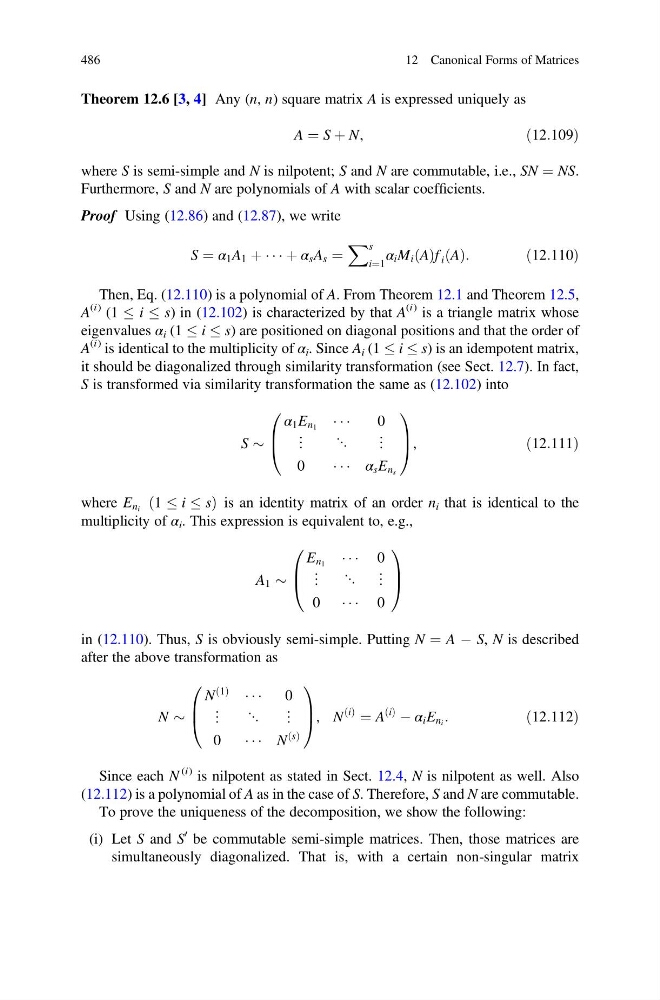
Theorem 12.6 [3, 4] Any (n, n) square matrix A is expressed uniquely as
A ¼ S þ N,
ð12:109Þ
where S is semi-simple and N is nilpotent; S and N are commutable, i.e., SN ¼ NS.
Furthermore, S and N are polynomials of A with scalar coefficients.
Proof Using (12.86) and (12.87), we write
S ¼ α 1 A 1 þ Á Á Á þ α s A s ¼
X s
i¼1
α i M i A
ð Þf i A
ð Þ:
ð12:110Þ
Then, Eq. (12.110) is a polynomial of A. From Theorem 12.1 and Theorem 12.5,
A
(i) (1 i s) in (12.102) is characterized by that A
(i) is a triangle matrix whose
eigenvalues α i (1 i s) are positioned on diagonal positions and that the order of
A
(i) is identical to the multiplicity of α i . Since A i (1 i s) is an idempotent matrix,
it should be diagonalized through similarity transformation (see Sect. 12.7). In fact,
S is transformed via similarity transformation the same as (12.102) into
S $
α 1 E n 1 Á Á Á
0
⋮
⋱
⋮
0
Á Á Á α s E n s
0
B
@
1
C
A,
ð12:111Þ
where E n i 1 i s
ð
Þis an identity matrix of an order n i that is identical to the
multiplicity of α i . This expression is equivalent to, e.g.,
A 1 $
E n 1 Á Á Á 0
⋮ ⋱ ⋮
0 Á Á Á 0
0
B
@
1
C
A
in (12.110). Thus, S is obviously semi-simple. Putting N ¼ A À S, N is described
after the above transformation as
N $
N
1
ð Þ
Á Á Á
0
⋮ ⋱ ⋮
0
Á Á Á N
s
ð Þ
0
B
@
1
C
A, N
i
ð Þ
¼ A
i
ð Þ
À α i E n i :
ð12:112Þ
Since each N
(i) is nilpotent as stated in Sect. 12.4, N is nilpotent as well. Also
(12.112) is a polynomial of A as in the case of S. Therefore, S and N are commutable.
To prove the uniqueness of the decomposition, we show the following:
(i) Let S and S
0 be commutable semi-simple matrices. Then, those matrices are
simultaneously diagonalized. That is, with a certain non-singular matrix
486
12 Canonical Forms of Matrices
A ¼ S þ N,
ð12:109Þ
where S is semi-simple and N is nilpotent; S and N are commutable, i.e., SN ¼ NS.
Furthermore, S and N are polynomials of A with scalar coefficients.
Proof Using (12.86) and (12.87), we write
S ¼ α 1 A 1 þ Á Á Á þ α s A s ¼
X s
i¼1
α i M i A
ð Þf i A
ð Þ:
ð12:110Þ
Then, Eq. (12.110) is a polynomial of A. From Theorem 12.1 and Theorem 12.5,
A
(i) (1 i s) in (12.102) is characterized by that A
(i) is a triangle matrix whose
eigenvalues α i (1 i s) are positioned on diagonal positions and that the order of
A
(i) is identical to the multiplicity of α i . Since A i (1 i s) is an idempotent matrix,
it should be diagonalized through similarity transformation (see Sect. 12.7). In fact,
S is transformed via similarity transformation the same as (12.102) into
S $
α 1 E n 1 Á Á Á
0
⋮
⋱
⋮
0
Á Á Á α s E n s
0
B
@
1
C
A,
ð12:111Þ
where E n i 1 i s
ð
Þis an identity matrix of an order n i that is identical to the
multiplicity of α i . This expression is equivalent to, e.g.,
A 1 $
E n 1 Á Á Á 0
⋮ ⋱ ⋮
0 Á Á Á 0
0
B
@
1
C
A
in (12.110). Thus, S is obviously semi-simple. Putting N ¼ A À S, N is described
after the above transformation as
N $
N
1
ð Þ
Á Á Á
0
⋮ ⋱ ⋮
0
Á Á Á N
s
ð Þ
0
B
@
1
C
A, N
i
ð Þ
¼ A
i
ð Þ
À α i E n i :
ð12:112Þ
Since each N
(i) is nilpotent as stated in Sect. 12.4, N is nilpotent as well. Also
(12.112) is a polynomial of A as in the case of S. Therefore, S and N are commutable.
To prove the uniqueness of the decomposition, we show the following:
(i) Let S and S
0 be commutable semi-simple matrices. Then, those matrices are
simultaneously diagonalized. That is, with a certain non-singular matrix
486
12 Canonical Forms of Matrices