

P, P
À1 SP and P
À1 S
0 P are diagonalized at once. Hence, S Æ S
0 is semi-simple
as well.
(ii) Let N and N
0 be commutable nilpotent matrices. Then, N Æ N
0 is nilpotent
as well.
(iii) A matrix both semi-simple and nilpotent is zero matrix.
(i) Let different eigenvalues of S be α 1 , Á Á Á, α s . Then, since S is semi-simple, a
vector space V
n is decomposed into a direct sum of eigenspaces
W α i 1 i s
ð
Þ . That is, we have
V
n
¼ W α 1 È Á Á Á È W α s :
Since S and S
0
are commutable, with
∃ x 2 W α i
we have
SS
0 x ¼ S
0
Sx = S
0 (α i x) ¼ α i S
0
x. Hence, we have S
0 x 2 W α i . Namely, W α i is S
0 -
invariant. Therefore, if we adopt the basis vectors {a 1 , Á Á Á, a n } with respect to
the direct sum decomposition, we get
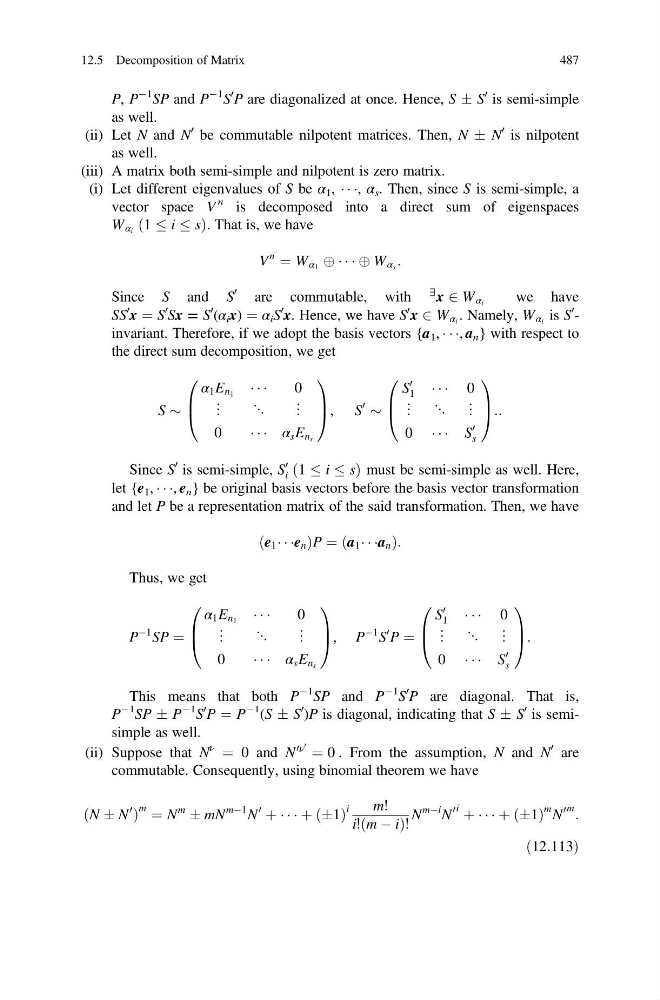
S $
α 1 E n 1 Á Á Á
0
⋮
⋱
⋮
0
Á Á Á α s E n s
0
B
@
1
C
A, S
0
$
S
0
1
Á Á Á 0
⋮ ⋱ ⋮
0 Á Á Á S
0
s
0
B
@
1
C
A::
Since S
0 is semi-simple, S
0
i 1 i s
ð
Þmust be semi-simple as well. Here,
let {e 1 , Á Á Á, e n } be original basis vectors before the basis vector transformation
and let P be a representation matrix of the said transformation. Then, we have
e 1 Á Á Áe n
ð
ÞP ¼ a 1 Á Á Áa n
ð
Þ:
Thus, we get
P
À1 SP ¼
α 1 E n 1 Á Á Á
0
⋮
⋱
⋮
0
Á Á Á α s E n s
0
B
@
1
C
A, P
À1 S
0 P ¼
S
0
1
Á Á Á 0
⋮ ⋱ ⋮
0 Á Á Á S
0
s
0
B
@
1
C
A:
This means that both P
À1 SP and P
À1 S
0
P are diagonal. That is,
P
À1 SP Æ P
À1 S
0 P ¼ P
À1 (S Æ S
0 )P is diagonal, indicating that S Æ S
0 is semisimple as well.
(ii) Suppose that N
ν
¼ 0 and N
0ν
0 ¼ 0 . From the assumption, N and N
0 are
commutable. Consequently, using binomial theorem we have
N Æ N
0
ð
Þ
m ¼ N
m
Æ mN
mÀ1 N
0
þ Á Á Á þ Æ1
ð Þ
i
m!
i! m À i
ð
Þ!
N
mÀi N
0 i þ Á Á Á þ Æ1
ð Þ
m N
0 m :
ð12:113Þ
12.5 Decomposition of Matrix
487
À1 SP and P
À1 S
0 P are diagonalized at once. Hence, S Æ S
0 is semi-simple
as well.
(ii) Let N and N
0 be commutable nilpotent matrices. Then, N Æ N
0 is nilpotent
as well.
(iii) A matrix both semi-simple and nilpotent is zero matrix.
(i) Let different eigenvalues of S be α 1 , Á Á Á, α s . Then, since S is semi-simple, a
vector space V
n is decomposed into a direct sum of eigenspaces
W α i 1 i s
ð
Þ . That is, we have
V
n
¼ W α 1 È Á Á Á È W α s :
Since S and S
0
are commutable, with
∃ x 2 W α i
we have
SS
0 x ¼ S
0
Sx = S
0 (α i x) ¼ α i S
0
x. Hence, we have S
0 x 2 W α i . Namely, W α i is S
0 -
invariant. Therefore, if we adopt the basis vectors {a 1 , Á Á Á, a n } with respect to
the direct sum decomposition, we get
S $
α 1 E n 1 Á Á Á
0
⋮
⋱
⋮
0
Á Á Á α s E n s
0
B
@
1
C
A, S
0
$
S
0
1
Á Á Á 0
⋮ ⋱ ⋮
0 Á Á Á S
0
s
0
B
@
1
C
A::
Since S
0 is semi-simple, S
0
i 1 i s
ð
Þmust be semi-simple as well. Here,
let {e 1 , Á Á Á, e n } be original basis vectors before the basis vector transformation
and let P be a representation matrix of the said transformation. Then, we have
e 1 Á Á Áe n
ð
ÞP ¼ a 1 Á Á Áa n
ð
Þ:
Thus, we get
P
À1 SP ¼
α 1 E n 1 Á Á Á
0
⋮
⋱
⋮
0
Á Á Á α s E n s
0
B
@
1
C
A, P
À1 S
0 P ¼
S
0
1
Á Á Á 0
⋮ ⋱ ⋮
0 Á Á Á S
0
s
0
B
@
1
C
A:
This means that both P
À1 SP and P
À1 S
0
P are diagonal. That is,
P
À1 SP Æ P
À1 S
0 P ¼ P
À1 (S Æ S
0 )P is diagonal, indicating that S Æ S
0 is semisimple as well.
(ii) Suppose that N
ν
¼ 0 and N
0ν
0 ¼ 0 . From the assumption, N and N
0 are
commutable. Consequently, using binomial theorem we have
N Æ N
0
ð
Þ
m ¼ N
m
Æ mN
mÀ1 N
0
þ Á Á Á þ Æ1
ð Þ
i
m!
i! m À i
ð
Þ!
N
mÀi N
0 i þ Á Á Á þ Æ1
ð Þ
m N
0 m :
ð12:113Þ
12.5 Decomposition of Matrix
487