

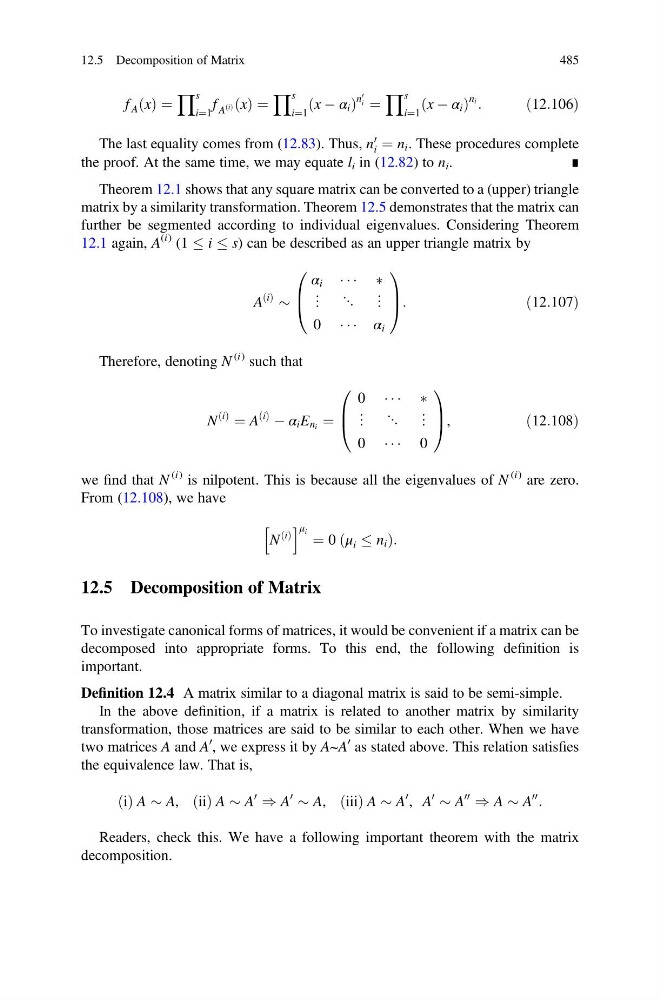
f A x
ð Þ ¼
Y s
i¼1
f A
i
ð Þ x
ð Þ ¼
Y s
i¼1
x À α i
ð
Þ
n
0
i
¼
Y s
i¼1
x À α i
ð
Þ
n i
:
ð12:106Þ
The last equality comes from (12.83). Thus, n
0
i ¼ n i . These procedures complete
the proof. At the same time, we may equate l i in (12.82) to n i .
∎
Theorem 12.1 shows that any square matrix can be converted to a (upper) triangle
matrix by a similarity transformation. Theorem 12.5 demonstrates that the matrix can
further be segmented according to individual eigenvalues. Considering Theorem
12.1 again, A
(i) (1 i s) can be described as an upper triangle matrix by
A
i
ð Þ
$
α i Á Á Á Ã
⋮ ⋱ ⋮
0 Á Á Á α i
0
B
@
1
C
A:
ð12:107Þ
Therefore, denoting N
(i) such that
N
i
ð Þ
¼ A
i
ð Þ
À α i E n i ¼
0 Á Á Á Ã
⋮ ⋱ ⋮
0 Á Á Á 0
0
B
@
1
C
A,
ð12:108Þ
we find that N
(i) is nilpotent. This is because all the eigenvalues of N
(i) are zero.
From (12.108), we have
N
i
ð Þ
h
i μ i ¼ 0 μ i n i
ð
Þ:
12.5 Decomposition of Matrix
To investigate canonical forms of matrices, it would be convenient if a matrix can be
decomposed into appropriate forms. To this end, the following definition is
important.
Definition 12.4 A matrix similar to a diagonal matrix is said to be semi-simple.
In the above definition, if a matrix is related to another matrix by similarity
transformation, those matrices are said to be similar to each other. When we have
two matrices A and A
0
, we express it by A~A
0 as stated above. This relation satisfies
the equivalence law. That is,
i
ð Þ A $ A, ii
ð Þ A $ A
0
) A
0
$ A, iii
ð Þ A $ A
0 , A
0
$ A
00
) A $ A
00
:
Readers, check this. We have a following important theorem with the matrix
decomposition.
12.5 Decomposition of Matrix
485
ð Þ ¼
Y s
i¼1
f A
i
ð Þ x
ð Þ ¼
Y s
i¼1
x À α i
ð
Þ
n
0
i
¼
Y s
i¼1
x À α i
ð
Þ
n i
:
ð12:106Þ
The last equality comes from (12.83). Thus, n
0
i ¼ n i . These procedures complete
the proof. At the same time, we may equate l i in (12.82) to n i .
∎
Theorem 12.1 shows that any square matrix can be converted to a (upper) triangle
matrix by a similarity transformation. Theorem 12.5 demonstrates that the matrix can
further be segmented according to individual eigenvalues. Considering Theorem
12.1 again, A
(i) (1 i s) can be described as an upper triangle matrix by
A
i
ð Þ
$
α i Á Á Á Ã
⋮ ⋱ ⋮
0 Á Á Á α i
0
B
@
1
C
A:
ð12:107Þ
Therefore, denoting N
(i) such that
N
i
ð Þ
¼ A
i
ð Þ
À α i E n i ¼
0 Á Á Á Ã
⋮ ⋱ ⋮
0 Á Á Á 0
0
B
@
1
C
A,
ð12:108Þ
we find that N
(i) is nilpotent. This is because all the eigenvalues of N
(i) are zero.
From (12.108), we have
N
i
ð Þ
h
i μ i ¼ 0 μ i n i
ð
Þ:
12.5 Decomposition of Matrix
To investigate canonical forms of matrices, it would be convenient if a matrix can be
decomposed into appropriate forms. To this end, the following definition is
important.
Definition 12.4 A matrix similar to a diagonal matrix is said to be semi-simple.
In the above definition, if a matrix is related to another matrix by similarity
transformation, those matrices are said to be similar to each other. When we have
two matrices A and A
0
, we express it by A~A
0 as stated above. This relation satisfies
the equivalence law. That is,
i
ð Þ A $ A, ii
ð Þ A $ A
0
) A
0
$ A, iii
ð Þ A $ A
0 , A
0
$ A
00
) A $ A
00
:
Readers, check this. We have a following important theorem with the matrix
decomposition.
12.5 Decomposition of Matrix
485