

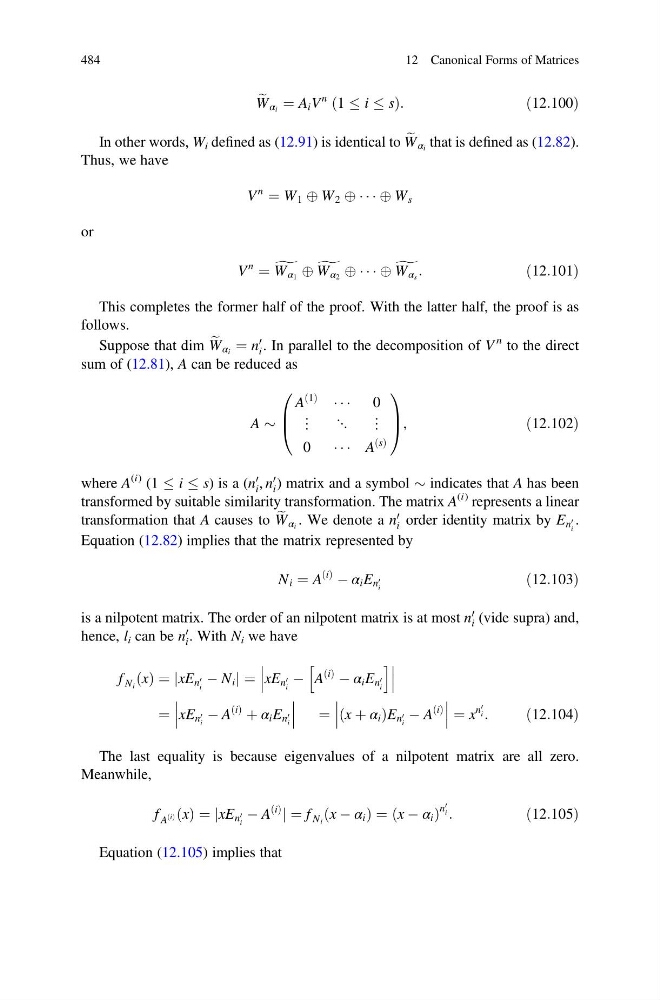
e
W α i ¼ A i V
n 1 i s
ð
Þ :
ð12:100Þ
In other words, W i defined as (12.91) is identical to e
W α i that is defined as (12.82).
Thus, we have
V
n
¼ W 1 È W 2 È Á Á Á È W s
or
V
n
¼ g
W α 1 È g
W α 2 È Á Á Á È g
W α s :
ð12:101Þ
This completes the former half of the proof. With the latter half, the proof is as
follows.
Suppose that dim e
W α i ¼ n
0
i . In parallel to the decomposition of V
n to the direct
sum of (12.81), A can be reduced as
A $
A
1
ð Þ
Á Á Á 0
⋮ ⋱ ⋮
0
Á Á Á A
s
ð Þ
0
B
@
1
C
A,
ð12:102Þ
where A
(i) (1 i s) is a (n
0
i , n
0
i ) matrix and a symbol $ indicates that A has been
transformed by suitable similarity transformation. The matrix A
(i) represents a linear
transformation that A causes to e
W α i . We denote a n
0
i order identity matrix by E n 0
i
.
Equation (12.82) implies that the matrix represented by
N i ¼ A
i
ð Þ
À α i E n 0
i
ð12:103Þ
is a nilpotent matrix. The order of an nilpotent matrix is at most n
0
i (vide supra) and,
hence, l i can be n
0
i . With N i we have
f N i x
ð Þ ¼ jxE n 0
i
À N i j ¼ xE n 0
i
À A
i
ð Þ
À α i E n 0
i
h
i
¼ xE n 0
i
À A
i
ð Þ
þ α i E n 0
i
¼ x þ α i
ð
ÞE n 0
i
À A
i
ð Þ
¼ x
n
0
i :
ð12:104Þ
The last equality is because eigenvalues of a nilpotent matrix are all zero.
Meanwhile,
f A
i
ð Þ x
ð Þ ¼ jxE n 0
i
À A
i
ð Þ
j ¼ f N i x À α i
ð
Þ¼ x À α i
ð
Þ
n
0
i
:
ð12:105Þ
Equation (12.105) implies that
484
12 Canonical Forms of Matrices
W α i ¼ A i V
n 1 i s
ð
Þ :
ð12:100Þ
In other words, W i defined as (12.91) is identical to e
W α i that is defined as (12.82).
Thus, we have
V
n
¼ W 1 È W 2 È Á Á Á È W s
or
V
n
¼ g
W α 1 È g
W α 2 È Á Á Á È g
W α s :
ð12:101Þ
This completes the former half of the proof. With the latter half, the proof is as
follows.
Suppose that dim e
W α i ¼ n
0
i . In parallel to the decomposition of V
n to the direct
sum of (12.81), A can be reduced as
A $
A
1
ð Þ
Á Á Á 0
⋮ ⋱ ⋮
0
Á Á Á A
s
ð Þ
0
B
@
1
C
A,
ð12:102Þ
where A
(i) (1 i s) is a (n
0
i , n
0
i ) matrix and a symbol $ indicates that A has been
transformed by suitable similarity transformation. The matrix A
(i) represents a linear
transformation that A causes to e
W α i . We denote a n
0
i order identity matrix by E n 0
i
.
Equation (12.82) implies that the matrix represented by
N i ¼ A
i
ð Þ
À α i E n 0
i
ð12:103Þ
is a nilpotent matrix. The order of an nilpotent matrix is at most n
0
i (vide supra) and,
hence, l i can be n
0
i . With N i we have
f N i x
ð Þ ¼ jxE n 0
i
À N i j ¼ xE n 0
i
À A
i
ð Þ
À α i E n 0
i
h
i
¼ xE n 0
i
À A
i
ð Þ
þ α i E n 0
i
¼ x þ α i
ð
ÞE n 0
i
À A
i
ð Þ
¼ x
n
0
i :
ð12:104Þ
The last equality is because eigenvalues of a nilpotent matrix are all zero.
Meanwhile,
f A
i
ð Þ x
ð Þ ¼ jxE n 0
i
À A
i
ð Þ
j ¼ f N i x À α i
ð
Þ¼ x À α i
ð
Þ
n
0
i
:
ð12:105Þ
Equation (12.105) implies that
484
12 Canonical Forms of Matrices