

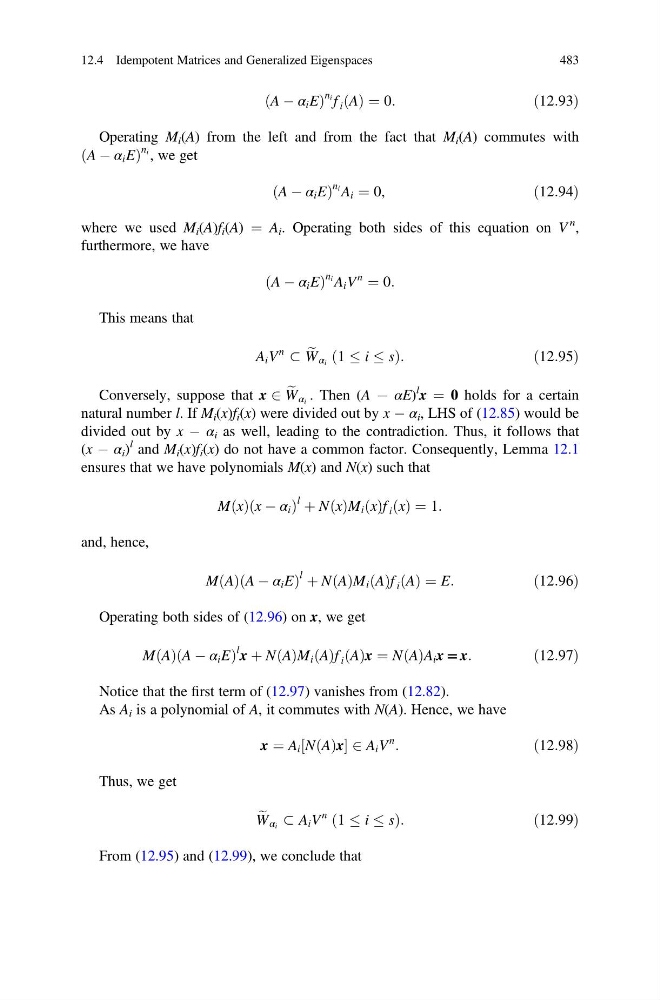
A À α i E
ð
Þ
n i f i A
ð Þ ¼ 0:
ð12:93Þ
Operating M i (A) from the left and from the fact that M i (A) commutes with
A À α i E
ð
Þ
n i , we get
A À α i E
ð
Þ
n i A i ¼ 0,
ð12:94Þ
where we used M i (A)f i (A) ¼ A i . Operating both sides of this equation on V
n ,
furthermore, we have
A À α i E
ð
Þ
n i A i V
n
¼ 0:
This means that
A i V
n
⊂ e
W α i 1 i s
ð
Þ :
ð12:95Þ
Conversely, suppose that x 2 e
W α i . Then (A À αE)
l x ¼ 0 holds for a certain
natural number l. If M i (x)f i (x) were divided out by x À α i , LHS of (12.85) would be
divided out by x À α i as well, leading to the contradiction. Thus, it follows that
(x À α i )
l and M i (x)f i (x) do not have a common factor. Consequently, Lemma 12.1
ensures that we have polynomials M(x) and N(x) such that
M x
ð Þ x À α i
ð
Þ
l þ N x
ð ÞM i x
ð Þf i x
ð Þ ¼ 1:
and, hence,
M A
ð Þ A À α i E
ð
Þ
l þ N A
ð ÞM i A
ð Þf i A
ð Þ ¼ E:
ð12:96Þ
Operating both sides of (12.96) on x, we get
M A
ð Þ A À α i E
ð
Þ
l x þ N A
ð ÞM i A
ð Þf i A
ð Þx ¼ N A
ð ÞA i x = x:
ð12:97Þ
Notice that the first term of (12.97) vanishes from (12.82).
As A i is a polynomial of A, it commutes with N(A). Hence, we have
x ¼ A i N A
ð Þx
½
2A i V
n
:
ð12:98Þ
Thus, we get
e
W α i ⊂ A i V
n 1 i s
ð
Þ :
ð12:99Þ
From (12.95) and (12.99), we conclude that
12.4 Idempotent Matrices and Generalized Eigenspaces
483
ð
Þ
n i f i A
ð Þ ¼ 0:
ð12:93Þ
Operating M i (A) from the left and from the fact that M i (A) commutes with
A À α i E
ð
Þ
n i , we get
A À α i E
ð
Þ
n i A i ¼ 0,
ð12:94Þ
where we used M i (A)f i (A) ¼ A i . Operating both sides of this equation on V
n ,
furthermore, we have
A À α i E
ð
Þ
n i A i V
n
¼ 0:
This means that
A i V
n
⊂ e
W α i 1 i s
ð
Þ :
ð12:95Þ
Conversely, suppose that x 2 e
W α i . Then (A À αE)
l x ¼ 0 holds for a certain
natural number l. If M i (x)f i (x) were divided out by x À α i , LHS of (12.85) would be
divided out by x À α i as well, leading to the contradiction. Thus, it follows that
(x À α i )
l and M i (x)f i (x) do not have a common factor. Consequently, Lemma 12.1
ensures that we have polynomials M(x) and N(x) such that
M x
ð Þ x À α i
ð
Þ
l þ N x
ð ÞM i x
ð Þf i x
ð Þ ¼ 1:
and, hence,
M A
ð Þ A À α i E
ð
Þ
l þ N A
ð ÞM i A
ð Þf i A
ð Þ ¼ E:
ð12:96Þ
Operating both sides of (12.96) on x, we get
M A
ð Þ A À α i E
ð
Þ
l x þ N A
ð ÞM i A
ð Þf i A
ð Þx ¼ N A
ð ÞA i x = x:
ð12:97Þ
Notice that the first term of (12.97) vanishes from (12.82).
As A i is a polynomial of A, it commutes with N(A). Hence, we have
x ¼ A i N A
ð Þx
½
2A i V
n
:
ð12:98Þ
Thus, we get
e
W α i ⊂ A i V
n 1 i s
ð
Þ :
ð12:99Þ
From (12.95) and (12.99), we conclude that
12.4 Idempotent Matrices and Generalized Eigenspaces
483