

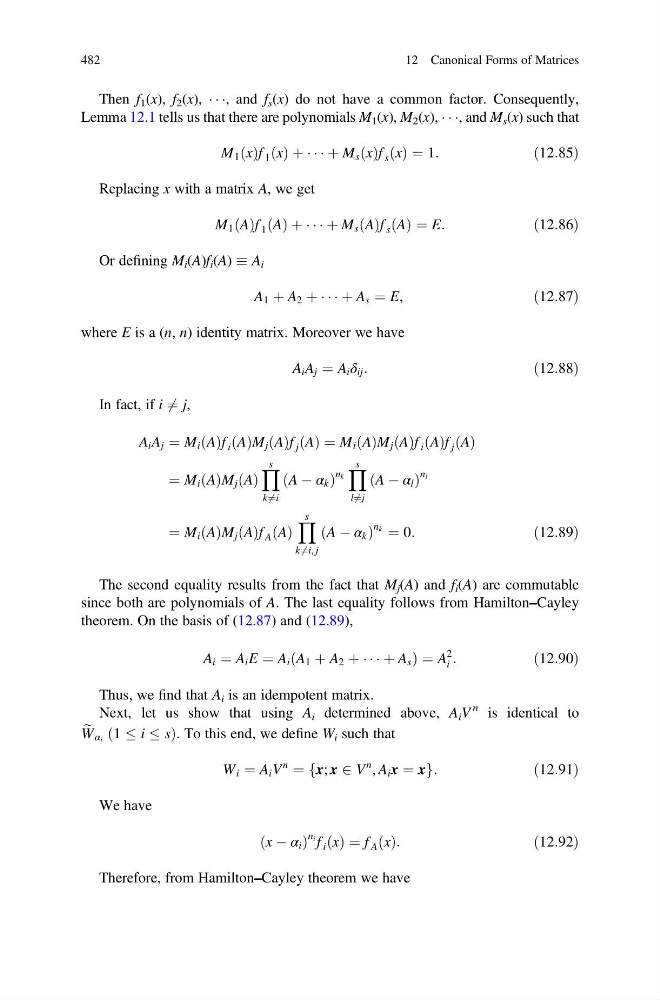
Then f 1 (x), f 2 (x), Á Á Á, and f s (x) do not have a common factor. Consequently,
Lemma 12.1 tells us that there are polynomials M 1 (x), M 2 (x), Á Á Á, and M s (x) such that
M 1 x
ð Þf 1 x
ð Þ þ Á Á Á þ M s x
ð Þf s x
ð Þ ¼ 1:
ð12:85Þ
Replacing x with a matrix A, we get
M 1 A
ð Þf 1 A
ð Þ þ Á Á Á þ M s A
ð Þf s A
ð Þ ¼ E:
ð12:86Þ
Or defining M i (A)f i (A) A i
A 1 þ A 2 þ Á Á Á þ A s ¼ E,
ð12:87Þ
where E is a (n, n) identity matrix. Moreover we have
A i A j ¼ A i δ ij :
ð12:88Þ
In fact, if i 6 ¼ j,
A i A j ¼ M i A
ð Þf i A
ð ÞM j A
ð Þf j A
ð Þ ¼ M i A
ð ÞM j A
ð Þf i A
ð Þf j A
ð Þ
¼ M i A
ð ÞM j A
ð Þ
Y s
k6 ¼i
A À α k
ð
Þ
n k
Y s
l6 ¼j
A À α l
ð
Þ
n l
¼ M i A
ð ÞM j A
ð Þf A A
ð Þ
Y s
k6 ¼i, j
A À α k
ð
Þ
n k
¼ 0:
ð12:89Þ
The second equality results from the fact that M j (A) and f i (A) are commutable
since both are polynomials of A. The last equality follows from Hamilton–Cayley
theorem. On the basis of (12.87) and (12.89),
A i ¼ A i E ¼ A i A 1 þ A 2 þ Á Á Á þ A s
ð
Þ ¼ A
2
i :
ð12:90Þ
Thus, we find that A i is an idempotent matrix.
Next, let us show that using A i determined above, A i V
n is identical to
e
W α i 1 i s
ð
Þ . To this end, we define W i such that
W i ¼ A i V
n
¼ x; x 2 V
n , A i x ¼ x
f
g :
ð12:91Þ
We have
x À α i
ð
Þ
n i f i x
ð Þ ¼ f A x
ð Þ:
ð12:92Þ
Therefore, from Hamilton–Cayley theorem we have
482
12 Canonical Forms of Matrices
Lemma 12.1 tells us that there are polynomials M 1 (x), M 2 (x), Á Á Á, and M s (x) such that
M 1 x
ð Þf 1 x
ð Þ þ Á Á Á þ M s x
ð Þf s x
ð Þ ¼ 1:
ð12:85Þ
Replacing x with a matrix A, we get
M 1 A
ð Þf 1 A
ð Þ þ Á Á Á þ M s A
ð Þf s A
ð Þ ¼ E:
ð12:86Þ
Or defining M i (A)f i (A) A i
A 1 þ A 2 þ Á Á Á þ A s ¼ E,
ð12:87Þ
where E is a (n, n) identity matrix. Moreover we have
A i A j ¼ A i δ ij :
ð12:88Þ
In fact, if i 6 ¼ j,
A i A j ¼ M i A
ð Þf i A
ð ÞM j A
ð Þf j A
ð Þ ¼ M i A
ð ÞM j A
ð Þf i A
ð Þf j A
ð Þ
¼ M i A
ð ÞM j A
ð Þ
Y s
k6 ¼i
A À α k
ð
Þ
n k
Y s
l6 ¼j
A À α l
ð
Þ
n l
¼ M i A
ð ÞM j A
ð Þf A A
ð Þ
Y s
k6 ¼i, j
A À α k
ð
Þ
n k
¼ 0:
ð12:89Þ
The second equality results from the fact that M j (A) and f i (A) are commutable
since both are polynomials of A. The last equality follows from Hamilton–Cayley
theorem. On the basis of (12.87) and (12.89),
A i ¼ A i E ¼ A i A 1 þ A 2 þ Á Á Á þ A s
ð
Þ ¼ A
2
i :
ð12:90Þ
Thus, we find that A i is an idempotent matrix.
Next, let us show that using A i determined above, A i V
n is identical to
e
W α i 1 i s
ð
Þ . To this end, we define W i such that
W i ¼ A i V
n
¼ x; x 2 V
n , A i x ¼ x
f
g :
ð12:91Þ
We have
x À α i
ð
Þ
n i f i x
ð Þ ¼ f A x
ð Þ:
ð12:92Þ
Therefore, from Hamilton–Cayley theorem we have
482
12 Canonical Forms of Matrices