

e 1 e 2 e 3 e 4
ð
ÞE À A
ð
Þ¼ e 1 e 2 e 3 e 4
ð
Þ
0 0 0 0
0 0 0 0
0 0 1 0
0 0 0 1
0
B
B
B
@
1
C
C
C
A
¼ 0 0 e 3 e 4
ð
Þ :
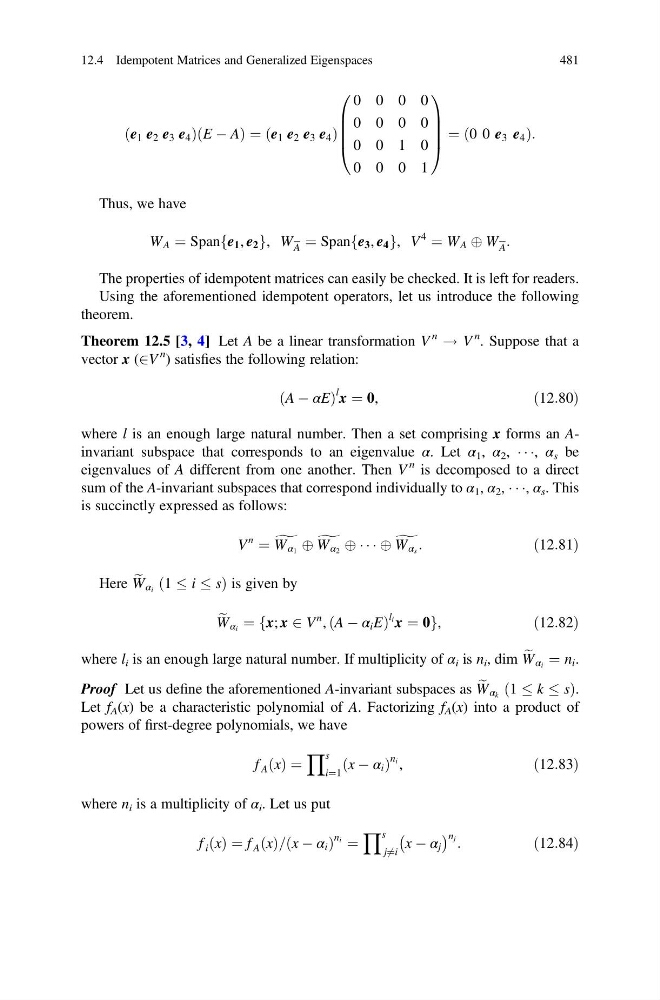
Thus, we have
W A ¼ Span e 1 , e 2
f
g, W A ¼ Span e 3 , e 4
f
g, V
4
¼ W A È W A :
The properties of idempotent matrices can easily be checked. It is left for readers.
Using the aforementioned idempotent operators, let us introduce the following
theorem.
Theorem 12.5 [3, 4] Let A be a linear transformation V
n
! V
n . Suppose that a
vector x (2V
n ) satisfies the following relation:
A À αE
ð
Þ
l x ¼ 0,
ð12:80Þ
where l is an enough large natural number. Then a set comprising x forms an Ainvariant subspace that corresponds to an eigenvalue α. Let α 1 , α 2 , Á Á Á, α s be
eigenvalues of A different from one another. Then V
n is decomposed to a direct
sum of the A-invariant subspaces that correspond individually to α 1 , α 2 , Á Á Á, α s . This
is succinctly expressed as follows:
V
n
¼ g
W α 1 È g
W α 2 È Á Á Á È g
W α s :
ð12:81Þ
Here e
W α i 1 i s
ð
Þis given by
e
W α i ¼ fx; x 2 V
n , A À α i E
ð
Þ
l i x ¼ 0g,
ð12:82Þ
where l i is an enough large natural number. If multiplicity of α i is n i , dim e
W α i ¼ n i .
Proof Let us define the aforementioned A-invariant subspaces as e
W α k 1 k s
ð
Þ .
Let f A (x) be a characteristic polynomial of A. Factorizing f A (x) into a product of
powers of first-degree polynomials, we have
f A x
ð Þ ¼
Y s
i¼1
x À α i
ð
Þ
n i ,
ð12:83Þ
where n i is a multiplicity of α i . Let us put
f i x
ð Þ ¼ f A x
ð Þ= x À α i
ð
Þ
n i
¼
Y s
j6 ¼i
x À α j
À
Á n j :
ð12:84Þ
12.4 Idempotent Matrices and Generalized Eigenspaces
481
ð
ÞE À A
ð
Þ¼ e 1 e 2 e 3 e 4
ð
Þ
0 0 0 0
0 0 0 0
0 0 1 0
0 0 0 1
0
B
B
B
@
1
C
C
C
A
¼ 0 0 e 3 e 4
ð
Þ :
Thus, we have
W A ¼ Span e 1 , e 2
f
g, W A ¼ Span e 3 , e 4
f
g, V
4
¼ W A È W A :
The properties of idempotent matrices can easily be checked. It is left for readers.
Using the aforementioned idempotent operators, let us introduce the following
theorem.
Theorem 12.5 [3, 4] Let A be a linear transformation V
n
! V
n . Suppose that a
vector x (2V
n ) satisfies the following relation:
A À αE
ð
Þ
l x ¼ 0,
ð12:80Þ
where l is an enough large natural number. Then a set comprising x forms an Ainvariant subspace that corresponds to an eigenvalue α. Let α 1 , α 2 , Á Á Á, α s be
eigenvalues of A different from one another. Then V
n is decomposed to a direct
sum of the A-invariant subspaces that correspond individually to α 1 , α 2 , Á Á Á, α s . This
is succinctly expressed as follows:
V
n
¼ g
W α 1 È g
W α 2 È Á Á Á È g
W α s :
ð12:81Þ
Here e
W α i 1 i s
ð
Þis given by
e
W α i ¼ fx; x 2 V
n , A À α i E
ð
Þ
l i x ¼ 0g,
ð12:82Þ
where l i is an enough large natural number. If multiplicity of α i is n i , dim e
W α i ¼ n i .
Proof Let us define the aforementioned A-invariant subspaces as e
W α k 1 k s
ð
Þ .
Let f A (x) be a characteristic polynomial of A. Factorizing f A (x) into a product of
powers of first-degree polynomials, we have
f A x
ð Þ ¼
Y s
i¼1
x À α i
ð
Þ
n i ,
ð12:83Þ
where n i is a multiplicity of α i . Let us put
f i x
ð Þ ¼ f A x
ð Þ= x À α i
ð
Þ
n i
¼
Y s
j6 ¼i
x À α j
À
Á n j :
ð12:84Þ
12.4 Idempotent Matrices and Generalized Eigenspaces
481