

g
À
xE À AÞ
T xE À A
ð
Þ¼ xE À A
ð
Þ g
À
xE À AÞ
T
¼ xE À A
j
jE ¼ f A A
ð ÞE,
ð12:51Þ
where g
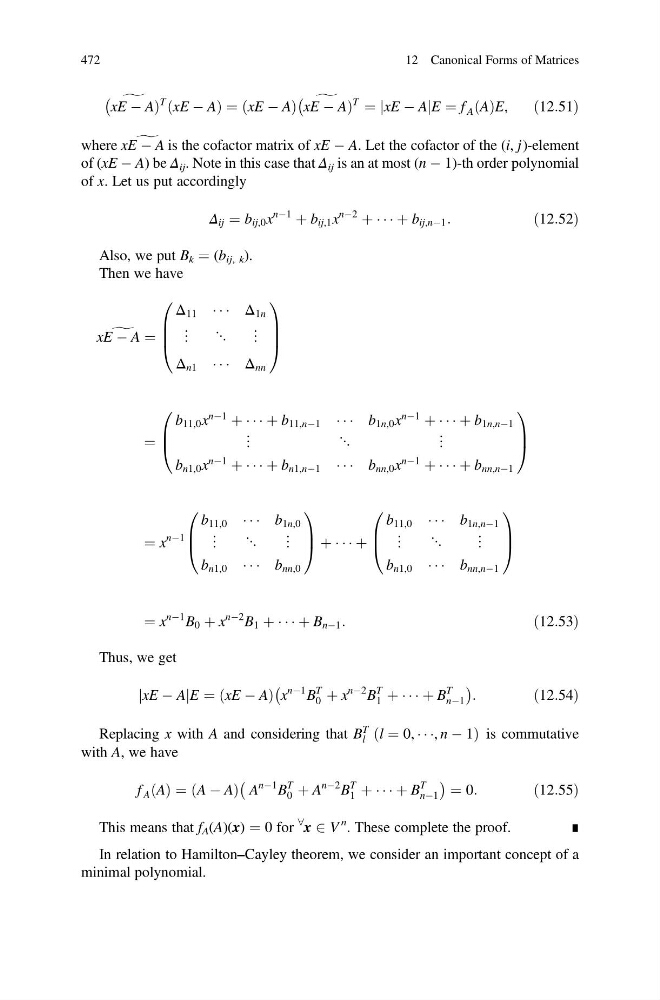
xE À A is the cofactor matrix of xE À A. Let the cofactor of the (i, j)-element
of (xE À A) be Δ ij . Note in this case that Δ ij is an at most (n À 1)-th order polynomial
of x. Let us put accordingly
Δ ij ¼ b ij,0 x
nÀ1
þ b ij,1 x
nÀ2
þ Á Á Á þ b ij,nÀ1 :
ð12:52Þ
Also, we put B k ¼ (b ij, k ).
Then we have
g
xE À A ¼
Δ 11 Á Á Á Δ 1n
⋮ ⋱ ⋮
Δ n1 Á Á Á Δ nn
0
B
B
@
1
C
C
A
¼
b 11,0 x
nÀ1
þ Á Á Á þ b 11,nÀ1 Á Á Á b 1n,0 x
nÀ1
þ Á Á Á þ b 1n,nÀ1
⋮
⋱
⋮
b n1,0 x
nÀ1
þ Á Á Á þ b n1,nÀ1 Á Á Á b nn,0 x
nÀ1
þ Á Á Á þ b nn,nÀ1
0
B
@
1
C
A
¼ x
nÀ1
b 11,0 Á Á Á b 1n,0
⋮ ⋱ ⋮
b n1,0 Á Á Á b nn,0
0
B
@
1
C
A þ Á Á Á þ
b 11,0 Á Á Á b 1n,nÀ1
⋮ ⋱
⋮
b n1,0 Á Á Á b nn,nÀ1
0
B
@
1
C
A
¼ x
nÀ1 B 0 þ x
nÀ2 B 1 þ Á Á Á þ B nÀ1 :
ð12:53Þ
Thus, we get
xE À A
j
jE ¼ xE À A
ð
Þ x
nÀ1 B
T
0 þ x
nÀ2 B
T
1 þ Á Á Á þ B
T
nÀ1
À
Á :
ð12:54Þ
Replacing x with A and considering that B
T
l l ¼ 0, Á Á Á, n À 1
ð
Þis commutative
with A, we have
f A A
ð Þ ¼ A À A
ð
Þ A
nÀ1 B
T
0 þ A
nÀ2 B
T
1 þ Á Á Á þ B
T
nÀ1
À
Á ¼ 0:
ð12:55Þ
This means that f A (A)(x) ¼ 0 for
8 x 2 V
n . These complete the proof.
∎
In relation to Hamilton–Cayley theorem, we consider an important concept of a
minimal polynomial.
472
12 Canonical Forms of Matrices
À
xE À AÞ
T xE À A
ð
Þ¼ xE À A
ð
Þ g
À
xE À AÞ
T
¼ xE À A
j
jE ¼ f A A
ð ÞE,
ð12:51Þ
where g
xE À A is the cofactor matrix of xE À A. Let the cofactor of the (i, j)-element
of (xE À A) be Δ ij . Note in this case that Δ ij is an at most (n À 1)-th order polynomial
of x. Let us put accordingly
Δ ij ¼ b ij,0 x
nÀ1
þ b ij,1 x
nÀ2
þ Á Á Á þ b ij,nÀ1 :
ð12:52Þ
Also, we put B k ¼ (b ij, k ).
Then we have
g
xE À A ¼
Δ 11 Á Á Á Δ 1n
⋮ ⋱ ⋮
Δ n1 Á Á Á Δ nn
0
B
B
@
1
C
C
A
¼
b 11,0 x
nÀ1
þ Á Á Á þ b 11,nÀ1 Á Á Á b 1n,0 x
nÀ1
þ Á Á Á þ b 1n,nÀ1
⋮
⋱
⋮
b n1,0 x
nÀ1
þ Á Á Á þ b n1,nÀ1 Á Á Á b nn,0 x
nÀ1
þ Á Á Á þ b nn,nÀ1
0
B
@
1
C
A
¼ x
nÀ1
b 11,0 Á Á Á b 1n,0
⋮ ⋱ ⋮
b n1,0 Á Á Á b nn,0
0
B
@
1
C
A þ Á Á Á þ
b 11,0 Á Á Á b 1n,nÀ1
⋮ ⋱
⋮
b n1,0 Á Á Á b nn,nÀ1
0
B
@
1
C
A
¼ x
nÀ1 B 0 þ x
nÀ2 B 1 þ Á Á Á þ B nÀ1 :
ð12:53Þ
Thus, we get
xE À A
j
jE ¼ xE À A
ð
Þ x
nÀ1 B
T
0 þ x
nÀ2 B
T
1 þ Á Á Á þ B
T
nÀ1
À
Á :
ð12:54Þ
Replacing x with A and considering that B
T
l l ¼ 0, Á Á Á, n À 1
ð
Þis commutative
with A, we have
f A A
ð Þ ¼ A À A
ð
Þ A
nÀ1 B
T
0 þ A
nÀ2 B
T
1 þ Á Á Á þ B
T
nÀ1
À
Á ¼ 0:
ð12:55Þ
This means that f A (A)(x) ¼ 0 for
8 x 2 V
n . These complete the proof.
∎
In relation to Hamilton–Cayley theorem, we consider an important concept of a
minimal polynomial.
472
12 Canonical Forms of Matrices