

where A n À m is a (n À m, n À m) square matrix and “zero” denotes either a
(n À m, m) or (m, n À m) zero matrix. Alternatively, we denote
A ¼ A m È A nÀm :
In this situation, the matrix A is said to be reducible.
As stated above, A causes a linear transformation within both W 1 and W 2 . In other
words, A m and A n À m cause a linear transformation within W 1 and W 2 in reference to
a 1 , a 2 , Á Á Á, a m and a m + 1 , a m + 2 , Á Á Á, a n , respectively. In this case V
n can be
represented as a direct sum of W 1 and W 2 such that
V
n
¼ W 1 È W 2 ¼ Span a 1 , a 2 , Á Á Á, a m
f
g È Span a mþ1 , a mþ2 , Á Á Á, a n
f
g : ð12:49Þ
This is because Span{a 1 , a 2 , Á Á Á, a m } \ Span{a m + 1 , a m + 2 , Á Á Á, a n } ¼ {0}. In fact,
if the two subspaces possess x ( ≠ 0) in common, a 1 , a 2 , Á Á Á, a n become linearly
dependent, in contradiction.
The vector space V
n may well further be decomposed into subspaces with a lower
dimension. For further discussion we need a following theorem and a concept of a
generalized eigenvector and generalized eigenspace.
Theorem 12.3: Hamilton–Cayley Theorem [3, 4] Let f A (x) be the characteristic
polynomial pertinent to a linear transformation A: V
n
! V
n . Then f A (A)(x) ¼ 0 for
8 x 2 V
n . That is, Ker f A (A) ¼ V
n .
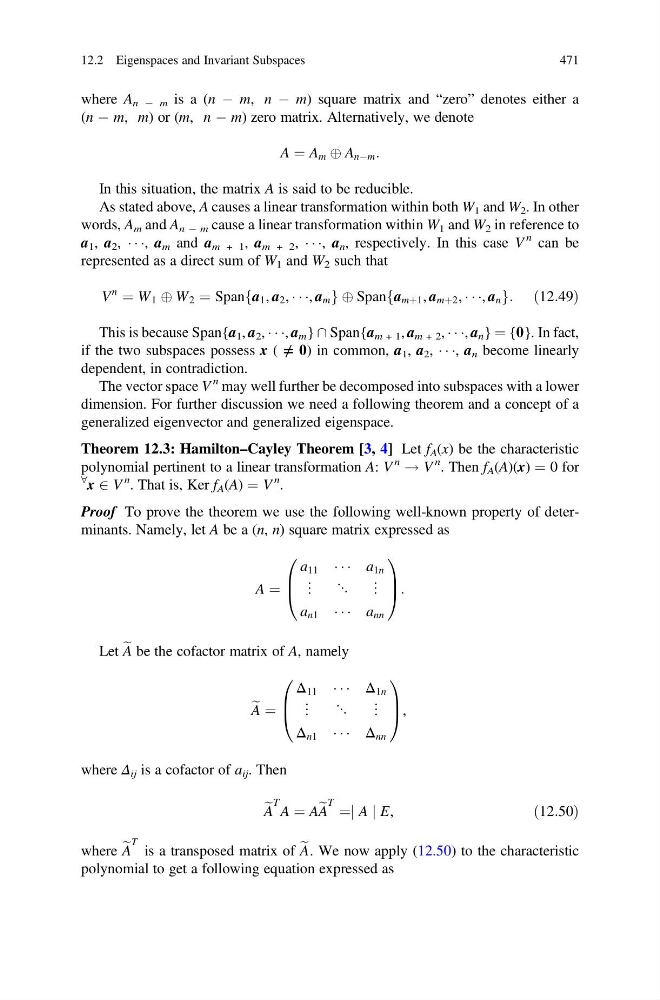
Proof To prove the theorem we use the following well-known property of determinants. Namely, let A be a (n, n) square matrix expressed as
A ¼
a 11 Á Á Á a 1n
⋮ ⋱ ⋮
a n1 Á Á Á a nn
0
B
@
1
C
A:
Let e
A be the cofactor matrix of A, namely
e
A ¼
Δ 11 Á Á Á Δ 1n
⋮ ⋱ ⋮
Δ n1 Á Á Á Δ nn
0
B
@
1
C
A,
where Δ ij is a cofactor of a ij . Then
e
A
T A ¼ A e
A
T ¼j A j E,
ð12:50Þ
where e
A
T is a transposed matrix of e
A. We now apply (12.50) to the characteristic
polynomial to get a following equation expressed as
12.2 Eigenspaces and Invariant Subspaces
471
(n À m, m) or (m, n À m) zero matrix. Alternatively, we denote
A ¼ A m È A nÀm :
In this situation, the matrix A is said to be reducible.
As stated above, A causes a linear transformation within both W 1 and W 2 . In other
words, A m and A n À m cause a linear transformation within W 1 and W 2 in reference to
a 1 , a 2 , Á Á Á, a m and a m + 1 , a m + 2 , Á Á Á, a n , respectively. In this case V
n can be
represented as a direct sum of W 1 and W 2 such that
V
n
¼ W 1 È W 2 ¼ Span a 1 , a 2 , Á Á Á, a m
f
g È Span a mþ1 , a mþ2 , Á Á Á, a n
f
g : ð12:49Þ
This is because Span{a 1 , a 2 , Á Á Á, a m } \ Span{a m + 1 , a m + 2 , Á Á Á, a n } ¼ {0}. In fact,
if the two subspaces possess x ( ≠ 0) in common, a 1 , a 2 , Á Á Á, a n become linearly
dependent, in contradiction.
The vector space V
n may well further be decomposed into subspaces with a lower
dimension. For further discussion we need a following theorem and a concept of a
generalized eigenvector and generalized eigenspace.
Theorem 12.3: Hamilton–Cayley Theorem [3, 4] Let f A (x) be the characteristic
polynomial pertinent to a linear transformation A: V
n
! V
n . Then f A (A)(x) ¼ 0 for
8 x 2 V
n . That is, Ker f A (A) ¼ V
n .
Proof To prove the theorem we use the following well-known property of determinants. Namely, let A be a (n, n) square matrix expressed as
A ¼
a 11 Á Á Á a 1n
⋮ ⋱ ⋮
a n1 Á Á Á a nn
0
B
@
1
C
A:
Let e
A be the cofactor matrix of A, namely
e
A ¼
Δ 11 Á Á Á Δ 1n
⋮ ⋱ ⋮
Δ n1 Á Á Á Δ nn
0
B
@
1
C
A,
where Δ ij is a cofactor of a ij . Then
e
A
T A ¼ A e
A
T ¼j A j E,
ð12:50Þ
where e
A
T is a transposed matrix of e
A. We now apply (12.50) to the characteristic
polynomial to get a following equation expressed as
12.2 Eigenspaces and Invariant Subspaces
471