

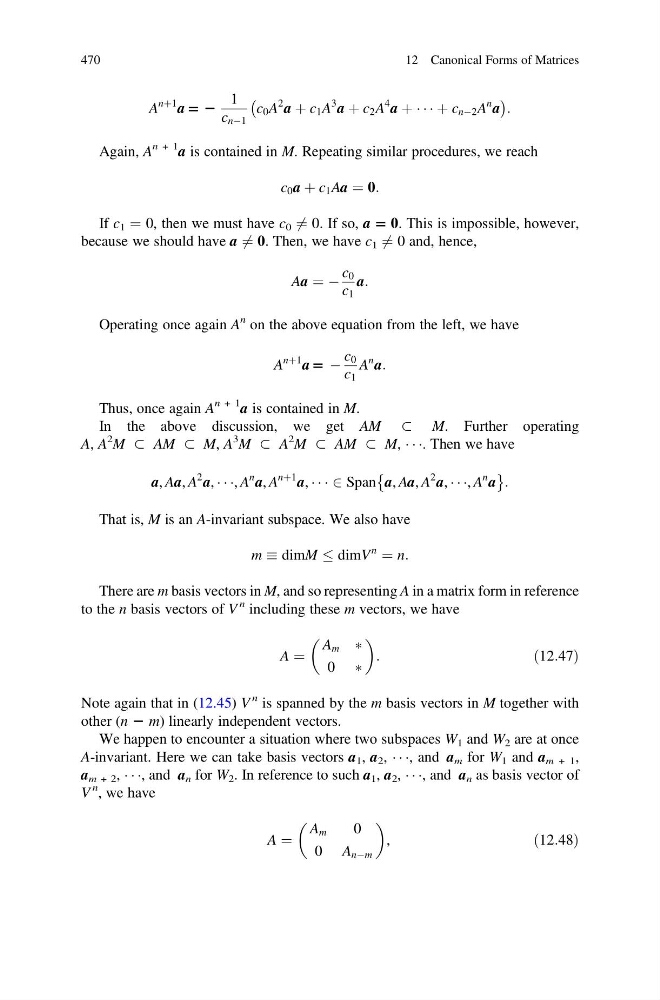
A
nþ1 a = 2
1
c nÀ1
c 0 A
2 a þ c 1 A
3 a þ c 2 A
4 a þ Á Á Á þ c nÀ2 A
n a
À
Á :
Again, A
n + 1 a is contained in M. Repeating similar procedures, we reach
c 0 a þ c 1 Aa ¼ 0:
If c 1 ¼ 0, then we must have c 0 6 ¼ 0. If so, a = 0. This is impossible, however,
because we should have a 6 ¼ 0. Then, we have c 1 6 ¼ 0 and, hence,
Aa ¼ À
c 0
c 1
a:
Operating once again A
n on the above equation from the left, we have
A
nþ1 a = À
c 0
c 1
A
n a:
Thus, once again A
n + 1 a is contained in M.
In the above discussion, we get AM ⊂ M. Further operating
A, A
2 M ⊂ AM ⊂ M, A
3 M ⊂ A
2 M ⊂ AM ⊂ M, Á Á Á. Then we have
a, Aa, A
2 a, Á Á Á, A
n a, A
nþ1 a, Á Á Á 2 Span a, Aa, A
2 a, Á Á Á, A
n a
È
É :
That is, M is an A-invariant subspace. We also have
m dimM dimV
n
¼ n:
There are m basis vectors in M, and so representing A in a matrix form in reference
to the n basis vectors of V
n including these m vectors, we have
A ¼
A m Ã
0 Ã
:
ð12:47Þ
Note again that in (12.45) V
n is spanned by the m basis vectors in M together with
other (n 2 m) linearly independent vectors.
We happen to encounter a situation where two subspaces W 1 and W 2 are at once
A-invariant. Here we can take basis vectors a 1 , a 2 , Á Á Á, and a m for W 1 and a m + 1 ,
a m + 2 , Á Á Á, and a n for W 2 . In reference to such a 1 , a 2 , Á Á Á, and a n as basis vector of
V
n , we have
A ¼
A m
0
0 A nÀm
,
ð12:48Þ
470
12 Canonical Forms of Matrices
nþ1 a = 2
1
c nÀ1
c 0 A
2 a þ c 1 A
3 a þ c 2 A
4 a þ Á Á Á þ c nÀ2 A
n a
À
Á :
Again, A
n + 1 a is contained in M. Repeating similar procedures, we reach
c 0 a þ c 1 Aa ¼ 0:
If c 1 ¼ 0, then we must have c 0 6 ¼ 0. If so, a = 0. This is impossible, however,
because we should have a 6 ¼ 0. Then, we have c 1 6 ¼ 0 and, hence,
Aa ¼ À
c 0
c 1
a:
Operating once again A
n on the above equation from the left, we have
A
nþ1 a = À
c 0
c 1
A
n a:
Thus, once again A
n + 1 a is contained in M.
In the above discussion, we get AM ⊂ M. Further operating
A, A
2 M ⊂ AM ⊂ M, A
3 M ⊂ A
2 M ⊂ AM ⊂ M, Á Á Á. Then we have
a, Aa, A
2 a, Á Á Á, A
n a, A
nþ1 a, Á Á Á 2 Span a, Aa, A
2 a, Á Á Á, A
n a
È
É :
That is, M is an A-invariant subspace. We also have
m dimM dimV
n
¼ n:
There are m basis vectors in M, and so representing A in a matrix form in reference
to the n basis vectors of V
n including these m vectors, we have
A ¼
A m Ã
0 Ã
:
ð12:47Þ
Note again that in (12.45) V
n is spanned by the m basis vectors in M together with
other (n 2 m) linearly independent vectors.
We happen to encounter a situation where two subspaces W 1 and W 2 are at once
A-invariant. Here we can take basis vectors a 1 , a 2 , Á Á Á, and a m for W 1 and a m + 1 ,
a m + 2 , Á Á Á, and a n for W 2 . In reference to such a 1 , a 2 , Á Á Á, and a n as basis vector of
V
n , we have
A ¼
A m
0
0 A nÀm
,
ð12:48Þ
470
12 Canonical Forms of Matrices