

a 1 a 2 Á Á Áa m a mþ1 Á Á Áa n
ð
Þ A ¼ a 1 a 2 Á Á Áa m a mþ1 Á Á Áa n
ð
Þ
A m Ã
0 Ã
,
ð12:45Þ
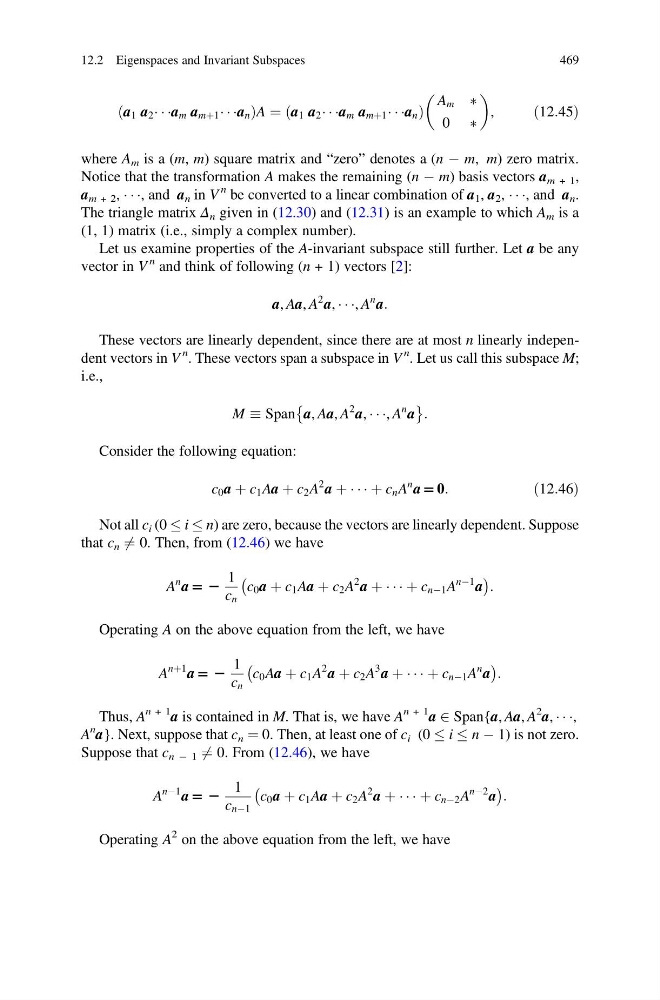
where A m is a (m, m) square matrix and “zero” denotes a (n À m, m) zero matrix.
Notice that the transformation A makes the remaining (n À m) basis vectors a m + 1 ,
a m + 2 , Á Á Á, and a n in V
n be converted to a linear combination of a 1 , a 2 , Á Á Á, and a n .
The triangle matrix Δ n given in (12.30) and (12.31) is an example to which A m is a
(1, 1) matrix (i.e., simply a complex number).
Let us examine properties of the A-invariant subspace still further. Let a be any
vector in V
n and think of following (n + 1) vectors [2]:
a, Aa, A
2 a, Á Á Á, A
n a:
These vectors are linearly dependent, since there are at most n linearly independent vectors in V
n . These vectors span a subspace in V
n . Let us call this subspace M;
i.e.,
M Span a, Aa, A
2 a, Á Á Á, A
n a
È
É :
Consider the following equation:
c 0 a þ c 1 Aa þ c 2 A
2 a þ Á Á Á þ c n A
n a = 0:
ð12:46Þ
Not all c i (0 i n) are zero, because the vectors are linearly dependent. Suppose
that c n 6 ¼ 0. Then, from (12.46) we have
A
n a = 2
1
c n
c 0 a þ c 1 Aa þ c 2 A
2 a þ Á Á Á þ c nÀ1 A
nÀ1 a
À
Á
:
Operating A on the above equation from the left, we have
A
nþ1 a = 2
1
c n
c 0 Aa þ c 1 A
2 a þ c 2 A
3 a þ Á Á Á þ c nÀ1 A
n a
À
Á :
Thus, A
n + 1 a is contained in M. That is, we have A
n + 1 a 2 Span{a, Aa, A
2 a, Á Á Á,
A
n a}. Next, suppose that c n ¼ 0. Then, at least one of c i (0 i n À 1) is not zero.
Suppose that c n À 1 6 ¼ 0. From (12.46), we have
A
nÀ1 a = 2
1
c nÀ1
c 0 a þ c 1 Aa þ c 2 A
2 a þ Á Á Á þ c nÀ2 A
nÀ2 a
À
Á :
Operating A
2 on the above equation from the left, we have
12.2 Eigenspaces and Invariant Subspaces
469
ð
Þ A ¼ a 1 a 2 Á Á Áa m a mþ1 Á Á Áa n
ð
Þ
A m Ã
0 Ã
,
ð12:45Þ
where A m is a (m, m) square matrix and “zero” denotes a (n À m, m) zero matrix.
Notice that the transformation A makes the remaining (n À m) basis vectors a m + 1 ,
a m + 2 , Á Á Á, and a n in V
n be converted to a linear combination of a 1 , a 2 , Á Á Á, and a n .
The triangle matrix Δ n given in (12.30) and (12.31) is an example to which A m is a
(1, 1) matrix (i.e., simply a complex number).
Let us examine properties of the A-invariant subspace still further. Let a be any
vector in V
n and think of following (n + 1) vectors [2]:
a, Aa, A
2 a, Á Á Á, A
n a:
These vectors are linearly dependent, since there are at most n linearly independent vectors in V
n . These vectors span a subspace in V
n . Let us call this subspace M;
i.e.,
M Span a, Aa, A
2 a, Á Á Á, A
n a
È
É :
Consider the following equation:
c 0 a þ c 1 Aa þ c 2 A
2 a þ Á Á Á þ c n A
n a = 0:
ð12:46Þ
Not all c i (0 i n) are zero, because the vectors are linearly dependent. Suppose
that c n 6 ¼ 0. Then, from (12.46) we have
A
n a = 2
1
c n
c 0 a þ c 1 Aa þ c 2 A
2 a þ Á Á Á þ c nÀ1 A
nÀ1 a
À
Á
:
Operating A on the above equation from the left, we have
A
nþ1 a = 2
1
c n
c 0 Aa þ c 1 A
2 a þ c 2 A
3 a þ Á Á Á þ c nÀ1 A
n a
À
Á :
Thus, A
n + 1 a is contained in M. That is, we have A
n + 1 a 2 Span{a, Aa, A
2 a, Á Á Á,
A
n a}. Next, suppose that c n ¼ 0. Then, at least one of c i (0 i n À 1) is not zero.
Suppose that c n À 1 6 ¼ 0. From (12.46), we have
A
nÀ1 a = 2
1
c nÀ1
c 0 a þ c 1 Aa þ c 2 A
2 a þ Á Á Á þ c nÀ2 A
nÀ2 a
À
Á :
Operating A
2 on the above equation from the left, we have
12.2 Eigenspaces and Invariant Subspaces
469