

0 0 0
/
.
P nѸ1 Δ nѸ1
P nѸ1
Δ nѸ1
ð12:27Þ
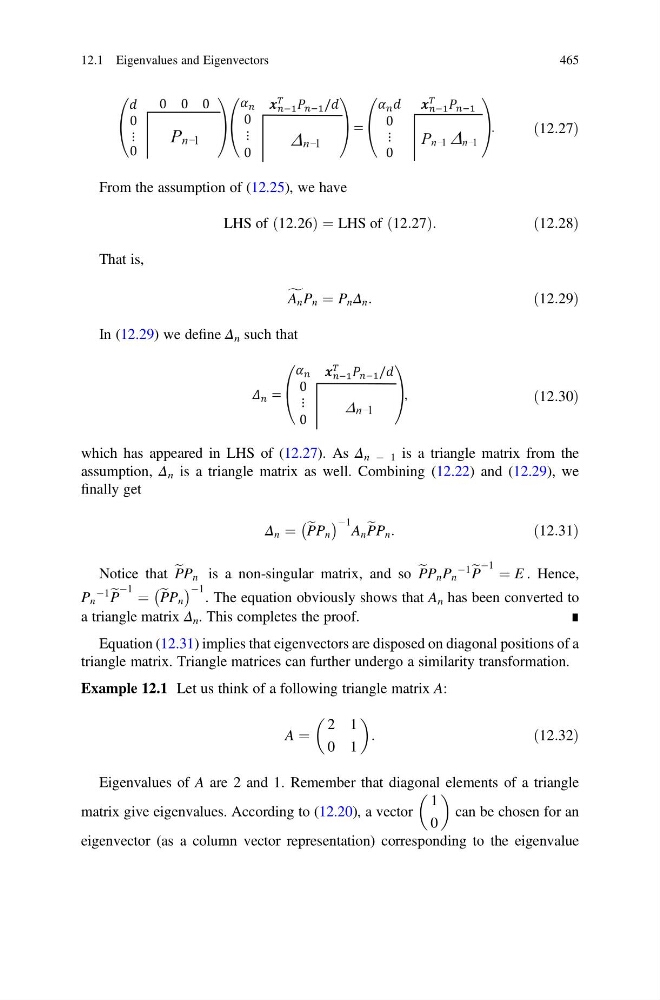
From the assumption of (12.25), we have
LHS of 12:26
ð
Þ¼LHS of 12:27
ð
Þ:
ð12:28Þ
That is,
f A n P n ¼ P n Δ n :
ð12:29Þ
In (12.29) we define Δ n such that
/
,
Δ nѸ1
ð12:30Þ
which has appeared in LHS of (12.27). As Δ n À 1 is a triangle matrix from the
assumption, Δ n is a triangle matrix as well. Combining (12.22) and (12.29), we
finally get
Δ n ¼ e
PP n
À
Á À1 A n e
PP n :
ð12:31Þ
Notice that e
PP n is a non-singular matrix, and so e
PP n P n
À1 e
P
À1 ¼ E . Hence,
P n
À1 e
P
À1 ¼ e
PP n
À
Á À1 . The equation obviously shows that A n has been converted to
a triangle matrix Δ n . This completes the proof.
∎
Equation (12.31) implies that eigenvectors are disposed on diagonal positions of a
triangle matrix. Triangle matrices can further undergo a similarity transformation.
Example 12.1 Let us think of a following triangle matrix A:
A ¼
2 1
0 1
:
ð12:32Þ
Eigenvalues of A are 2 and 1. Remember that diagonal elements of a triangle
matrix give eigenvalues. According to (12.20), a vector
1
0
can be chosen for an
eigenvector (as a column vector representation) corresponding to the eigenvalue
12.1 Eigenvalues and Eigenvectors
465
/
.
P nѸ1 Δ nѸ1
P nѸ1
Δ nѸ1
ð12:27Þ
From the assumption of (12.25), we have
LHS of 12:26
ð
Þ¼LHS of 12:27
ð
Þ:
ð12:28Þ
That is,
f A n P n ¼ P n Δ n :
ð12:29Þ
In (12.29) we define Δ n such that
/
,
Δ nѸ1
ð12:30Þ
which has appeared in LHS of (12.27). As Δ n À 1 is a triangle matrix from the
assumption, Δ n is a triangle matrix as well. Combining (12.22) and (12.29), we
finally get
Δ n ¼ e
PP n
À
Á À1 A n e
PP n :
ð12:31Þ
Notice that e
PP n is a non-singular matrix, and so e
PP n P n
À1 e
P
À1 ¼ E . Hence,
P n
À1 e
P
À1 ¼ e
PP n
À
Á À1 . The equation obviously shows that A n has been converted to
a triangle matrix Δ n . This completes the proof.
∎
Equation (12.31) implies that eigenvectors are disposed on diagonal positions of a
triangle matrix. Triangle matrices can further undergo a similarity transformation.
Example 12.1 Let us think of a following triangle matrix A:
A ¼
2 1
0 1
:
ð12:32Þ
Eigenvalues of A are 2 and 1. Remember that diagonal elements of a triangle
matrix give eigenvalues. According to (12.20), a vector
1
0
can be chosen for an
eigenvector (as a column vector representation) corresponding to the eigenvalue
12.1 Eigenvalues and Eigenvectors
465