

a n ¼ a n p 1 p 2 Á Á Áp nÀ1
ð
Þ
1
0
0
⋮
0
0
B
B
B
B
B
B
@
1
C
C
C
C
C
C
A
¼ e
P
1
0
0
⋮
0
0
B
B
B
B
B
B
@
1
C
C
C
C
C
C
A
:
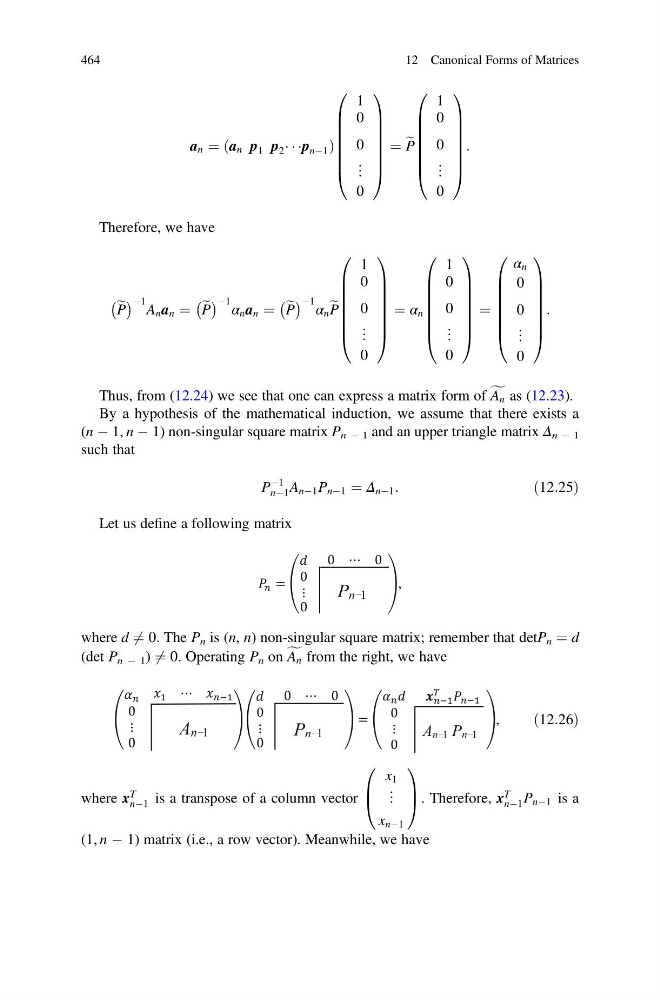
Therefore, we have
e
P
À Á À1 A n a n ¼ e
P
À Á À1 α n a n ¼ e
P
À Á À1 α n e
P
1
0
0
⋮
0
0
B
B
B
B
B
B
@
1
C
C
C
C
C
C
A
¼ α n
1
0
0
⋮
0
0
B
B
B
B
B
B
@
1
C
C
C
C
C
C
A
¼
α n
0
0
⋮
0
0
B
B
B
B
B
B
@
1
C
C
C
C
C
C
A
:
Thus, from (12.24) we see that one can express a matrix form of f
A n as (12.23).
By a hypothesis of the mathematical induction, we assume that there exists a
(n À 1, n À 1) non-singular square matrix P n À 1 and an upper triangle matrix Δ n À 1
such that
P
À1
nÀ1 A nÀ1 P nÀ1 ¼ Δ nÀ1 :
ð12:25Þ
Let us define a following matrix
0
0 ⋯ 0
,
P nѸ1
where d 6 ¼ 0. The P n is (n, n) non-singular square matrix; remember that detP n ¼ d
(det P n À 1 ) 6 ¼ 0. Operating P n on f
A n from the right, we have
⋯
0 ⋯ 0
,
A nѸ1 P nѸ1
A nѸ1
P nѸ1
ð12:26Þ
where x
T
nÀ1 is a transpose of a column vector
x 1
⋮
x nÀ1
0
B
@
1
C
A. Therefore, x
T
nÀ1 P nÀ1 is a
(1, n À 1) matrix (i.e., a row vector). Meanwhile, we have
464
12 Canonical Forms of Matrices
ð
Þ
1
0
0
⋮
0
0
B
B
B
B
B
B
@
1
C
C
C
C
C
C
A
¼ e
P
1
0
0
⋮
0
0
B
B
B
B
B
B
@
1
C
C
C
C
C
C
A
:
Therefore, we have
e
P
À Á À1 A n a n ¼ e
P
À Á À1 α n a n ¼ e
P
À Á À1 α n e
P
1
0
0
⋮
0
0
B
B
B
B
B
B
@
1
C
C
C
C
C
C
A
¼ α n
1
0
0
⋮
0
0
B
B
B
B
B
B
@
1
C
C
C
C
C
C
A
¼
α n
0
0
⋮
0
0
B
B
B
B
B
B
@
1
C
C
C
C
C
C
A
:
Thus, from (12.24) we see that one can express a matrix form of f
A n as (12.23).
By a hypothesis of the mathematical induction, we assume that there exists a
(n À 1, n À 1) non-singular square matrix P n À 1 and an upper triangle matrix Δ n À 1
such that
P
À1
nÀ1 A nÀ1 P nÀ1 ¼ Δ nÀ1 :
ð12:25Þ
Let us define a following matrix
0
0 ⋯ 0
,
P nѸ1
where d 6 ¼ 0. The P n is (n, n) non-singular square matrix; remember that detP n ¼ d
(det P n À 1 ) 6 ¼ 0. Operating P n on f
A n from the right, we have
⋯
0 ⋯ 0
,
A nѸ1 P nѸ1
A nѸ1
P nѸ1
ð12:26Þ
where x
T
nÀ1 is a transpose of a column vector
x 1
⋮
x nÀ1
0
B
@
1
C
A. Therefore, x
T
nÀ1 P nÀ1 is a
(1, n À 1) matrix (i.e., a row vector). Meanwhile, we have
464
12 Canonical Forms of Matrices