

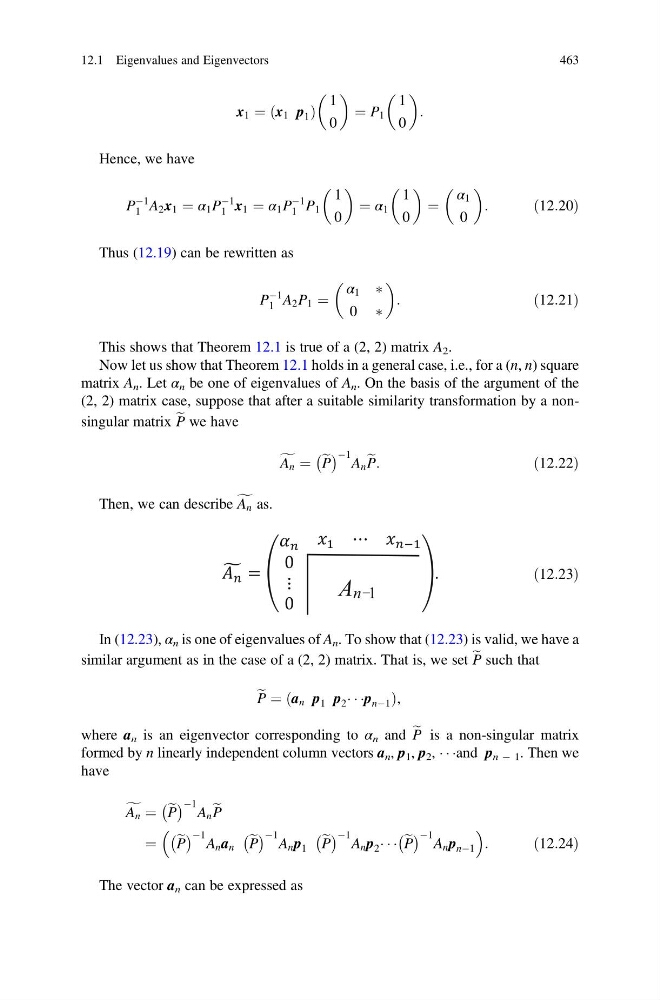
x 1 ¼ x 1 p 1
ð
Þ
1
0
¼ P 1
1
0
:
Hence, we have
P
À1
1 A 2 x 1 ¼ α 1 P
À1
1 x 1 ¼ α 1 P
À1
1 P 1
1
0
¼ α 1
1
0
¼
α 1
0
:
ð12:20Þ
Thus (12.19) can be rewritten as
P
À1
1 A 2 P 1 ¼
α 1 Ã
0 Ã
:
ð12:21Þ
This shows that Theorem 12.1 is true of a (2, 2) matrix A 2 .
Now let us show that Theorem 12.1 holds in a general case, i.e., for a (n, n) square
matrix A n . Let α n be one of eigenvalues of A n . On the basis of the argument of the
(2, 2) matrix case, suppose that after a suitable similarity transformation by a nonsingular matrix e
P we have
f A n ¼ e
P
À Á À1 A n e
P:
ð12:22Þ
Then, we can describe f
A n as.
0
.
A nѸ1
ð12:23Þ
In (12.23), α n is one of eigenvalues of A n . To show that (12.23) is valid, we have a
similar argument as in the case of a (2, 2) matrix. That is, we set e
P such that
e
P ¼ a n p 1 p 2 Á Á Áp nÀ1
ð
Þ ,
where a n is an eigenvector corresponding to α n and e
P is a non-singular matrix
formed by n linearly independent column vectors a n , p 1 , p 2 , Á Á Áand p n À 1 . Then we
have
f
A n ¼ e
P
À Á À1 A n e
P
¼ e
P
À Á À1 A n a n e
P
À Á À1 A n p 1 e
P
À Á À1 A n p 2 Á Á Á e
P
À Á À1 A n p nÀ1
:
ð12:24Þ
The vector a n can be expressed as
12.1 Eigenvalues and Eigenvectors
463
ð
Þ
1
0
¼ P 1
1
0
:
Hence, we have
P
À1
1 A 2 x 1 ¼ α 1 P
À1
1 x 1 ¼ α 1 P
À1
1 P 1
1
0
¼ α 1
1
0
¼
α 1
0
:
ð12:20Þ
Thus (12.19) can be rewritten as
P
À1
1 A 2 P 1 ¼
α 1 Ã
0 Ã
:
ð12:21Þ
This shows that Theorem 12.1 is true of a (2, 2) matrix A 2 .
Now let us show that Theorem 12.1 holds in a general case, i.e., for a (n, n) square
matrix A n . Let α n be one of eigenvalues of A n . On the basis of the argument of the
(2, 2) matrix case, suppose that after a suitable similarity transformation by a nonsingular matrix e
P we have
f A n ¼ e
P
À Á À1 A n e
P:
ð12:22Þ
Then, we can describe f
A n as.
0
.
A nѸ1
ð12:23Þ
In (12.23), α n is one of eigenvalues of A n . To show that (12.23) is valid, we have a
similar argument as in the case of a (2, 2) matrix. That is, we set e
P such that
e
P ¼ a n p 1 p 2 Á Á Áp nÀ1
ð
Þ ,
where a n is an eigenvector corresponding to α n and e
P is a non-singular matrix
formed by n linearly independent column vectors a n , p 1 , p 2 , Á Á Áand p n À 1 . Then we
have
f
A n ¼ e
P
À Á À1 A n e
P
¼ e
P
À Á À1 A n a n e
P
À Á À1 A n p 1 e
P
À Á À1 A n p 2 Á Á Á e
P
À Á À1 A n p nÀ1
:
ð12:24Þ
The vector a n can be expressed as
12.1 Eigenvalues and Eigenvectors
463