

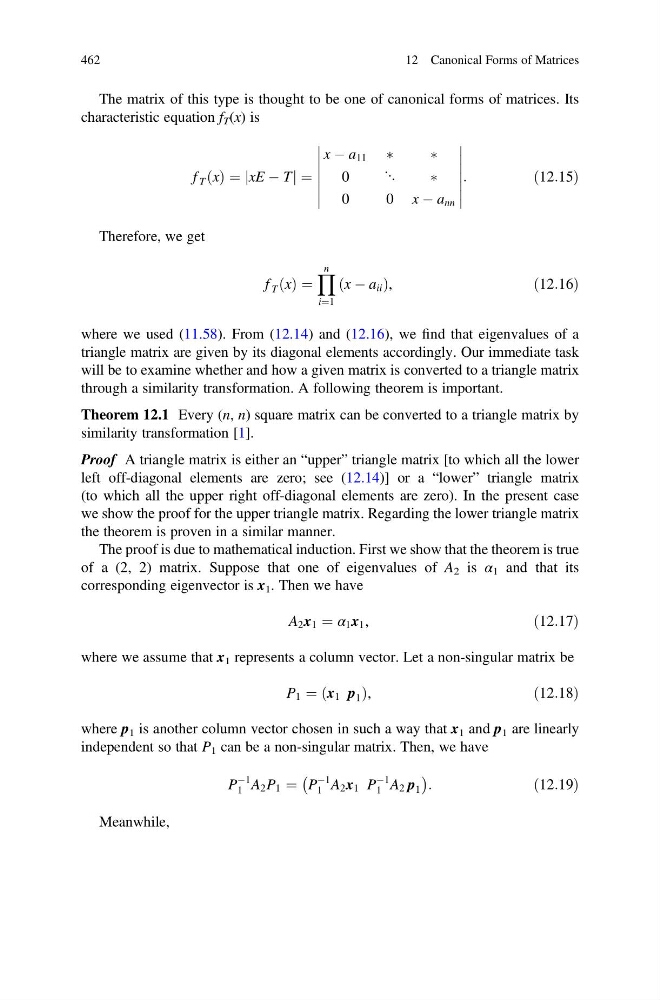
The matrix of this type is thought to be one of canonical forms of matrices. Its
characteristic equation f T (x) is
f T x
ð Þ ¼ xE À T
j
j¼
x À a 11 Ã
Ã
0
⋱
Ã
0
0 x À a nn
:
ð12:15Þ
Therefore, we get
f T x
ð Þ ¼
Y n
i¼1
x À a ii
ð
Þ,
ð12:16Þ
where we used (11.58). From (12.14) and (12.16), we find that eigenvalues of a
triangle matrix are given by its diagonal elements accordingly. Our immediate task
will be to examine whether and how a given matrix is converted to a triangle matrix
through a similarity transformation. A following theorem is important.
Theorem 12.1 Every (n, n) square matrix can be converted to a triangle matrix by
similarity transformation [1].
Proof A triangle matrix is either an “upper” triangle matrix [to which all the lower
left off-diagonal elements are zero; see (12.14)] or a “lower” triangle matrix
(to which all the upper right off-diagonal elements are zero). In the present case
we show the proof for the upper triangle matrix. Regarding the lower triangle matrix
the theorem is proven in a similar manner.
The proof is due to mathematical induction. First we show that the theorem is true
of a (2, 2) matrix. Suppose that one of eigenvalues of A 2 is α 1 and that its
corresponding eigenvector is x 1 . Then we have
A 2 x 1 ¼ α 1 x 1 ,
ð12:17Þ
where we assume that x 1 represents a column vector. Let a non-singular matrix be
P 1 ¼ x 1 p 1
ð
Þ,
ð12:18Þ
where p 1 is another column vector chosen in such a way that x 1 and p 1 are linearly
independent so that P 1 can be a non-singular matrix. Then, we have
P
À1
1 A 2 P 1 ¼ P
À1
1 A 2 x 1 P
À1
1 A 2 p 1
À
Á :
ð12:19Þ
Meanwhile,
462
12 Canonical Forms of Matrices
characteristic equation f T (x) is
f T x
ð Þ ¼ xE À T
j
j¼
x À a 11 Ã
Ã
0
⋱
Ã
0
0 x À a nn
:
ð12:15Þ
Therefore, we get
f T x
ð Þ ¼
Y n
i¼1
x À a ii
ð
Þ,
ð12:16Þ
where we used (11.58). From (12.14) and (12.16), we find that eigenvalues of a
triangle matrix are given by its diagonal elements accordingly. Our immediate task
will be to examine whether and how a given matrix is converted to a triangle matrix
through a similarity transformation. A following theorem is important.
Theorem 12.1 Every (n, n) square matrix can be converted to a triangle matrix by
similarity transformation [1].
Proof A triangle matrix is either an “upper” triangle matrix [to which all the lower
left off-diagonal elements are zero; see (12.14)] or a “lower” triangle matrix
(to which all the upper right off-diagonal elements are zero). In the present case
we show the proof for the upper triangle matrix. Regarding the lower triangle matrix
the theorem is proven in a similar manner.
The proof is due to mathematical induction. First we show that the theorem is true
of a (2, 2) matrix. Suppose that one of eigenvalues of A 2 is α 1 and that its
corresponding eigenvector is x 1 . Then we have
A 2 x 1 ¼ α 1 x 1 ,
ð12:17Þ
where we assume that x 1 represents a column vector. Let a non-singular matrix be
P 1 ¼ x 1 p 1
ð
Þ,
ð12:18Þ
where p 1 is another column vector chosen in such a way that x 1 and p 1 are linearly
independent so that P 1 can be a non-singular matrix. Then, we have
P
À1
1 A 2 P 1 ¼ P
À1
1 A 2 x 1 P
À1
1 A 2 p 1
À
Á :
ð12:19Þ
Meanwhile,
462
12 Canonical Forms of Matrices