

A necessary and sufficient condition for α to be an eigenvalue is that α is a root of
f A (x) ¼ 0. The function f A (x) is said to be a characteristic polynomial and we call
f A (x) ¼ 0 a characteristic equation. This is an n-th order polynomial. Putting
f A x
ð Þ ¼ x
n
þ a 1 x
nÀ1
þ Á Á Á þ a n ,
ð12:6Þ
we have
a 1 ¼ À a 11 þ a 22 þ Á Á Á þ a nn
ð
Þ À TrA,
ð12:7Þ
where Tr stands for “trace” that is a summation of diagonal elements. Moreover,
a n ¼ À1
ð Þ
n j A j :
ð12:8Þ
The characteristic equation f A (x) ¼ 0 has n roots including possible multiple roots.
Let those roots be α 1 , Á Á Á, α n (some of them may be identical). Then we have
f A x
ð Þ ¼
Y n
i¼1
x À α i
ð
Þ:
ð12:9Þ
Furthermore, according to relations between roots and coefficients we get
α 1 þ Á Á Á þ α n ¼ Àa 1 ¼ TrA,
ð12:10Þ
α 1 Á Á Áα n ¼ À1
ð Þ
n a n ¼ A
j j:
ð12:11Þ
The characteristic equation f A (x) is invariant under a similarity transformation.
In fact,
f P
À1 AP x
ð Þ ¼ xE À P
À1 AP
¼ P
À1 xE À A
ð
ÞP
a ¼ P
j j
À1 xE À A
j
jP j j ¼ xE À A
j
j¼ f A x
ð Þ:
ð12:12Þ
This leads to invariance of the trace under a similarity transformation. That is,
Tr P
À1 AP
À
Á ¼ TrA:
ð12:13Þ
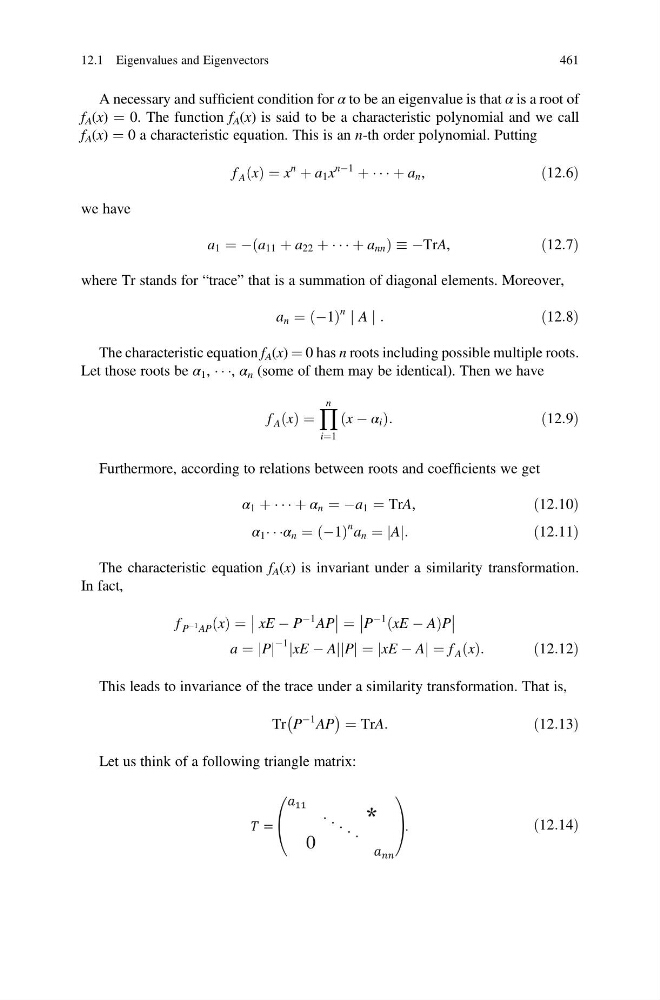
Let us think of a following triangle matrix:
=
.
*
0
ð12:14Þ
12.1 Eigenvalues and Eigenvectors
461
f A (x) ¼ 0. The function f A (x) is said to be a characteristic polynomial and we call
f A (x) ¼ 0 a characteristic equation. This is an n-th order polynomial. Putting
f A x
ð Þ ¼ x
n
þ a 1 x
nÀ1
þ Á Á Á þ a n ,
ð12:6Þ
we have
a 1 ¼ À a 11 þ a 22 þ Á Á Á þ a nn
ð
Þ À TrA,
ð12:7Þ
where Tr stands for “trace” that is a summation of diagonal elements. Moreover,
a n ¼ À1
ð Þ
n j A j :
ð12:8Þ
The characteristic equation f A (x) ¼ 0 has n roots including possible multiple roots.
Let those roots be α 1 , Á Á Á, α n (some of them may be identical). Then we have
f A x
ð Þ ¼
Y n
i¼1
x À α i
ð
Þ:
ð12:9Þ
Furthermore, according to relations between roots and coefficients we get
α 1 þ Á Á Á þ α n ¼ Àa 1 ¼ TrA,
ð12:10Þ
α 1 Á Á Áα n ¼ À1
ð Þ
n a n ¼ A
j j:
ð12:11Þ
The characteristic equation f A (x) is invariant under a similarity transformation.
In fact,
f P
À1 AP x
ð Þ ¼ xE À P
À1 AP
¼ P
À1 xE À A
ð
ÞP
a ¼ P
j j
À1 xE À A
j
jP j j ¼ xE À A
j
j¼ f A x
ð Þ:
ð12:12Þ
This leads to invariance of the trace under a similarity transformation. That is,
Tr P
À1 AP
À
Á ¼ TrA:
ð12:13Þ
Let us think of a following triangle matrix:
=
.
*
0
ð12:14Þ
12.1 Eigenvalues and Eigenvectors
461