

and e
0
1 , e
0
2 , and e
0
n are linearly dependent, and vice versa. In case det A 6 ¼ 0, an inverse
matrix A
À1 exists, and so we have
e 1 Á Á Áe n
ð
Þ¼ e
0
1 Á Á Áe
0
n
À
Á
A
À1
:
ð11:72Þ
In the previous steps we see how the linear transformation (and the corresponding
matrix representation) converts a set of basis vectors (e 1 Á Á Áe n ) to another set of basis
vectors e
0
1 Á Á Áe
0
n
À
Á
. Is this possible then to find a suitable transformation between two
sets of arbitrarily chosen basis vectors? The answer is yes. This is because any vector
can be expressed uniquely by a linear combination of any set of basis vectors. A
whole array of such linear combinations uniquely define a transformation matrix
between the two sets of basis vectors as expressed in (11.69) and (11.72). The matrix
has nonzero determinant and has an inverse matrix. A concept of the transformation
between basis vectors is important and very often used in various fields of natural
science.
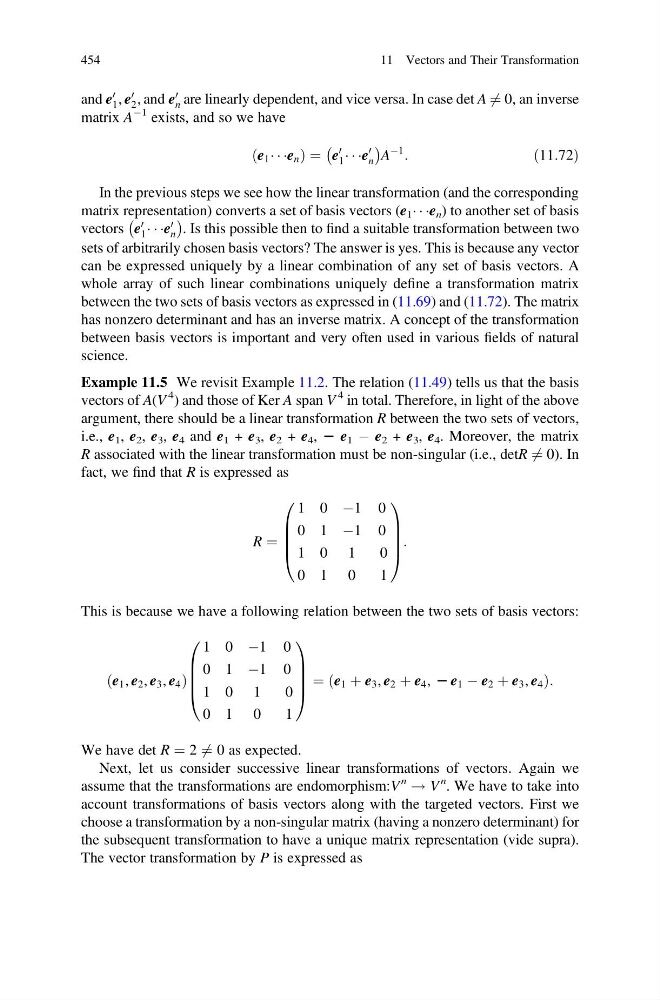
Example 11.5 We revisit Example 11.2. The relation (11.49) tells us that the basis
vectors of A(V
4 ) and those of Ker A span V
4 in total. Therefore, in light of the above
argument, there should be a linear transformation R between the two sets of vectors,
i.e., e 1 , e 2 , e 3 , e 4 and e 1 + e 3 , e 2 + e 4 , 2 e 1 À e 2 + e 3 , e 4 . Moreover, the matrix
R associated with the linear transformation must be non-singular (i.e., detR 6 ¼ 0). In
fact, we find that R is expressed as
R ¼
1 0 À1 0
0 1 À1 0
1 0 1
0
0 1 0
1
0
B
B
B
@
1
C
C
C
A
:
This is because we have a following relation between the two sets of basis vectors:
e 1 , e 2 , e 3 , e 4
ð
Þ
1 0 À1 0
0 1 À1 0
1 0 1
0
0 1 0
1
0
B
B
B
@
1
C
C
C
A
¼ e 1 þ e 3 , e 2 þ e 4 , 2 e 1 À e 2 þ e 3 , e 4
ð
Þ :
We have det R ¼ 2 6 ¼ 0 as expected.
Next, let us consider successive linear transformations of vectors. Again we
assume that the transformations are endomorphism:V
n
! V
n . We have to take into
account transformations of basis vectors along with the targeted vectors. First we
choose a transformation by a non-singular matrix (having a nonzero determinant) for
the subsequent transformation to have a unique matrix representation (vide supra).
The vector transformation by P is expressed as
454
11 Vectors and Their Transformation
0
1 , e
0
2 , and e
0
n are linearly dependent, and vice versa. In case det A 6 ¼ 0, an inverse
matrix A
À1 exists, and so we have
e 1 Á Á Áe n
ð
Þ¼ e
0
1 Á Á Áe
0
n
À
Á
A
À1
:
ð11:72Þ
In the previous steps we see how the linear transformation (and the corresponding
matrix representation) converts a set of basis vectors (e 1 Á Á Áe n ) to another set of basis
vectors e
0
1 Á Á Áe
0
n
À
Á
. Is this possible then to find a suitable transformation between two
sets of arbitrarily chosen basis vectors? The answer is yes. This is because any vector
can be expressed uniquely by a linear combination of any set of basis vectors. A
whole array of such linear combinations uniquely define a transformation matrix
between the two sets of basis vectors as expressed in (11.69) and (11.72). The matrix
has nonzero determinant and has an inverse matrix. A concept of the transformation
between basis vectors is important and very often used in various fields of natural
science.
Example 11.5 We revisit Example 11.2. The relation (11.49) tells us that the basis
vectors of A(V
4 ) and those of Ker A span V
4 in total. Therefore, in light of the above
argument, there should be a linear transformation R between the two sets of vectors,
i.e., e 1 , e 2 , e 3 , e 4 and e 1 + e 3 , e 2 + e 4 , 2 e 1 À e 2 + e 3 , e 4 . Moreover, the matrix
R associated with the linear transformation must be non-singular (i.e., detR 6 ¼ 0). In
fact, we find that R is expressed as
R ¼
1 0 À1 0
0 1 À1 0
1 0 1
0
0 1 0
1
0
B
B
B
@
1
C
C
C
A
:
This is because we have a following relation between the two sets of basis vectors:
e 1 , e 2 , e 3 , e 4
ð
Þ
1 0 À1 0
0 1 À1 0
1 0 1
0
0 1 0
1
0
B
B
B
@
1
C
C
C
A
¼ e 1 þ e 3 , e 2 þ e 4 , 2 e 1 À e 2 þ e 3 , e 4
ð
Þ :
We have det R ¼ 2 6 ¼ 0 as expected.
Next, let us consider successive linear transformations of vectors. Again we
assume that the transformations are endomorphism:V
n
! V
n . We have to take into
account transformations of basis vectors along with the targeted vectors. First we
choose a transformation by a non-singular matrix (having a nonzero determinant) for
the subsequent transformation to have a unique matrix representation (vide supra).
The vector transformation by P is expressed as
454
11 Vectors and Their Transformation