

A ¼
a 11 Á Á Á a 1n
⋮ ⋱ ⋮
a n1 Á Á Á a nn
0
B
@
1
C
A:
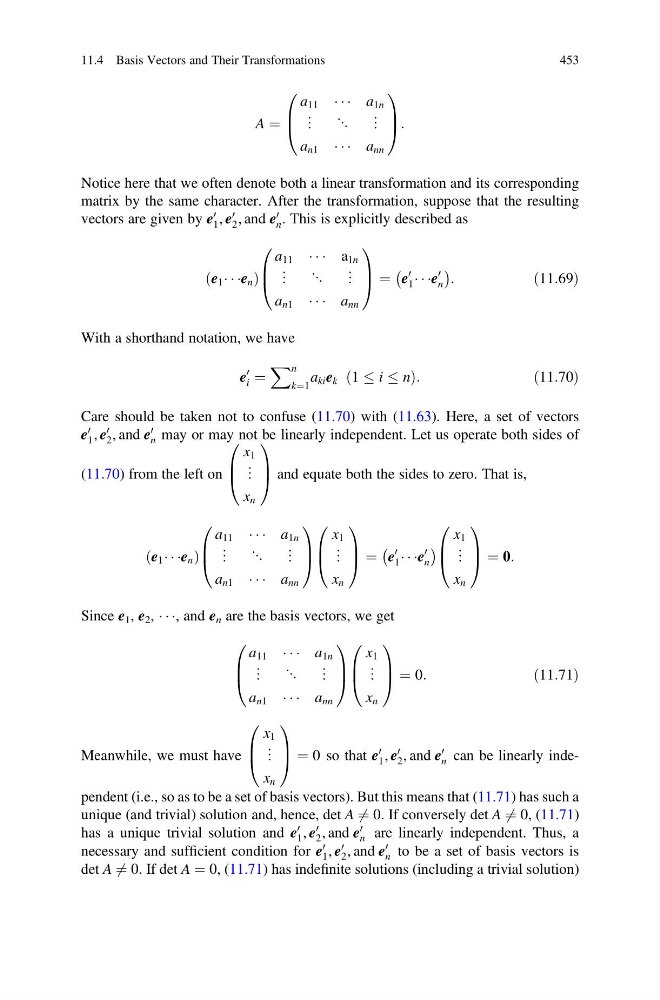
Notice here that we often denote both a linear transformation and its corresponding
matrix by the same character. After the transformation, suppose that the resulting
vectors are given by e
0
1 , e
0
2 , and e
0
n . This is explicitly described as
e 1 Á Á Áe n
ð
Þ
a 11 Á Á Á a 1n
⋮ ⋱ ⋮
a n1 Á Á Á a nn
0
B
@
1
C
A ¼ e
0
1 Á Á Áe
0
n
À
Á :
ð11:69Þ
With a shorthand notation, we have
e
0
i ¼
X n
k¼1
a ki e k 1 i n
ð
Þ :
ð11:70Þ
Care should be taken not to confuse (11.70) with (11.63). Here, a set of vectors
e
0
1 , e
0
2 , and e
0
n may or may not be linearly independent. Let us operate both sides of
(11.70) from the left on
x 1
⋮
x n
0
B
@
1
C
A and equate both the sides to zero. That is,
e 1 Á Á Áe n
ð
Þ
a 11 Á Á Á a 1n
⋮ ⋱ ⋮
a n1 Á Á Á a nn
0
B
@
1
C
A
x 1
⋮
x n
0
B
@
1
C
A ¼ e
0
1 Á Á Áe
0
n
À
Á
x 1
⋮
x n
0
B
@
1
C
A ¼ 0:
Since e 1 , e 2 , Á Á Á, and e n are the basis vectors, we get
a 11 Á Á Á a 1n
⋮ ⋱ ⋮
a n1 Á Á Á a nn
0
B
@
1
C
A
x 1
⋮
x n
0
B
@
1
C
A ¼ 0:
ð11:71Þ
Meanwhile, we must have
x 1
⋮
x n
0
B
@
1
C
A ¼ 0 so that e
0
1 , e
0
2 , and e
0
n can be linearly independent (i.e., so as to be a set of basis vectors). But this means that (11.71) has such a
unique (and trivial) solution and, hence, det A 6 ¼ 0. If conversely det A 6 ¼ 0, (11.71)
has a unique trivial solution and e
0
1 , e
0
2 , and e
0
n are linearly independent. Thus, a
necessary and sufficient condition for e
0
1 , e
0
2 , and e
0
n to be a set of basis vectors is
det A 6 ¼ 0. If det A ¼ 0, (11.71) has indefinite solutions (including a trivial solution)
11.4 Basis Vectors and Their Transformations
453
a 11 Á Á Á a 1n
⋮ ⋱ ⋮
a n1 Á Á Á a nn
0
B
@
1
C
A:
Notice here that we often denote both a linear transformation and its corresponding
matrix by the same character. After the transformation, suppose that the resulting
vectors are given by e
0
1 , e
0
2 , and e
0
n . This is explicitly described as
e 1 Á Á Áe n
ð
Þ
a 11 Á Á Á a 1n
⋮ ⋱ ⋮
a n1 Á Á Á a nn
0
B
@
1
C
A ¼ e
0
1 Á Á Áe
0
n
À
Á :
ð11:69Þ
With a shorthand notation, we have
e
0
i ¼
X n
k¼1
a ki e k 1 i n
ð
Þ :
ð11:70Þ
Care should be taken not to confuse (11.70) with (11.63). Here, a set of vectors
e
0
1 , e
0
2 , and e
0
n may or may not be linearly independent. Let us operate both sides of
(11.70) from the left on
x 1
⋮
x n
0
B
@
1
C
A and equate both the sides to zero. That is,
e 1 Á Á Áe n
ð
Þ
a 11 Á Á Á a 1n
⋮ ⋱ ⋮
a n1 Á Á Á a nn
0
B
@
1
C
A
x 1
⋮
x n
0
B
@
1
C
A ¼ e
0
1 Á Á Áe
0
n
À
Á
x 1
⋮
x n
0
B
@
1
C
A ¼ 0:
Since e 1 , e 2 , Á Á Á, and e n are the basis vectors, we get
a 11 Á Á Á a 1n
⋮ ⋱ ⋮
a n1 Á Á Á a nn
0
B
@
1
C
A
x 1
⋮
x n
0
B
@
1
C
A ¼ 0:
ð11:71Þ
Meanwhile, we must have
x 1
⋮
x n
0
B
@
1
C
A ¼ 0 so that e
0
1 , e
0
2 , and e
0
n can be linearly independent (i.e., so as to be a set of basis vectors). But this means that (11.71) has such a
unique (and trivial) solution and, hence, det A 6 ¼ 0. If conversely det A 6 ¼ 0, (11.71)
has a unique trivial solution and e
0
1 , e
0
2 , and e
0
n are linearly independent. Thus, a
necessary and sufficient condition for e
0
1 , e
0
2 , and e
0
n to be a set of basis vectors is
det A 6 ¼ 0. If det A ¼ 0, (11.71) has indefinite solutions (including a trivial solution)
11.4 Basis Vectors and Their Transformations
453