

1 0 0
0 1 0
0 0 0
0
B
@
1
C
A
x
y
z
0
B
@
1
C
A ¼
x
y
0
0
B
@
1
C
A:
ð11:67Þ
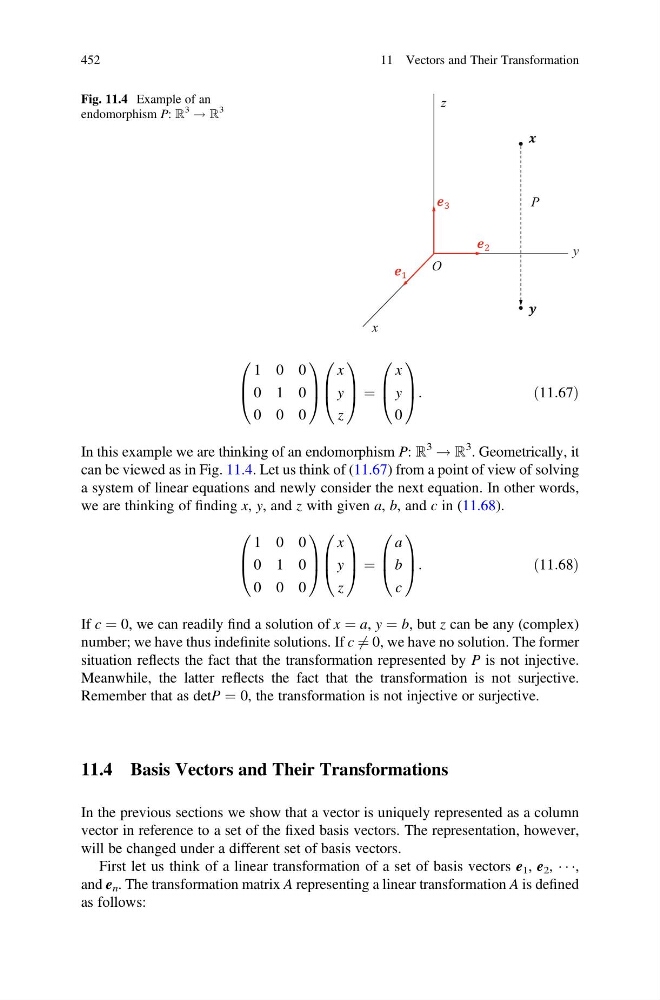
In this example we are thinking of an endomorphism P: ℝ
3
! ℝ
3 . Geometrically, it
can be viewed as in Fig. 11.4. Let us think of (11.67) from a point of view of solving
a system of linear equations and newly consider the next equation. In other words,
we are thinking of finding x, y, and z with given a, b, and c in (11.68).
1 0 0
0 1 0
0 0 0
0
B
@
1
C
A
x
y
z
0
B
@
1
C
A ¼
a
b
c
0
B
@
1
C
A:
ð11:68Þ
If c ¼ 0, we can readily find a solution of x ¼ a, y ¼ b, but z can be any (complex)
number; we have thus indefinite solutions. If c 6 ¼ 0, we have no solution. The former
situation reflects the fact that the transformation represented by P is not injective.
Meanwhile, the latter reflects the fact that the transformation is not surjective.
Remember that as detP ¼ 0, the transformation is not injective or surjective.
11.4 Basis Vectors and Their Transformations
In the previous sections we show that a vector is uniquely represented as a column
vector in reference to a set of the fixed basis vectors. The representation, however,
will be changed under a different set of basis vectors.
First let us think of a linear transformation of a set of basis vectors e 1 , e 2 , Á Á Á,
and e n . The transformation matrix A representing a linear transformation A is defined
as follows:
y
x
z
O
P
Fig. 11.4 Example of an
endomorphism P: ℝ
3 ! ℝ
3
452
11 Vectors and Their Transformation
0 1 0
0 0 0
0
B
@
1
C
A
x
y
z
0
B
@
1
C
A ¼
x
y
0
0
B
@
1
C
A:
ð11:67Þ
In this example we are thinking of an endomorphism P: ℝ
3
! ℝ
3 . Geometrically, it
can be viewed as in Fig. 11.4. Let us think of (11.67) from a point of view of solving
a system of linear equations and newly consider the next equation. In other words,
we are thinking of finding x, y, and z with given a, b, and c in (11.68).
1 0 0
0 1 0
0 0 0
0
B
@
1
C
A
x
y
z
0
B
@
1
C
A ¼
a
b
c
0
B
@
1
C
A:
ð11:68Þ
If c ¼ 0, we can readily find a solution of x ¼ a, y ¼ b, but z can be any (complex)
number; we have thus indefinite solutions. If c 6 ¼ 0, we have no solution. The former
situation reflects the fact that the transformation represented by P is not injective.
Meanwhile, the latter reflects the fact that the transformation is not surjective.
Remember that as detP ¼ 0, the transformation is not injective or surjective.
11.4 Basis Vectors and Their Transformations
In the previous sections we show that a vector is uniquely represented as a column
vector in reference to a set of the fixed basis vectors. The representation, however,
will be changed under a different set of basis vectors.
First let us think of a linear transformation of a set of basis vectors e 1 , e 2 , Á Á Á,
and e n . The transformation matrix A representing a linear transformation A is defined
as follows:
y
x
z
O
P
Fig. 11.4 Example of an
endomorphism P: ℝ
3 ! ℝ
3
452
11 Vectors and Their Transformation