

solution
x 1
⋮
x n
0
B
@
1
C
A for a given
y 1
⋮
y n
0
B
@
1
C
A, we must have det A 6 ¼ 0. Conversely, det A ¼ 0
is equivalent to that (11.62) has indefinite solutions or has no solution. As far as the
matrix algebra is concerned, (11.61) is symbolically described by omitting a parenthesis as
Ax ¼ y:
ð11:64Þ
However, when the vector transformation is explicitly taken into account, the full
representation of (11.61) should be borne in mind.
The relations (11.60) and (11.64) can be considered as a set of simultaneous
equations. A necessary and sufficient condition for (11.64) to have a unique solution
x for a given y is det A 6 ¼ 0. In that case, the solution x of (11.64) can be symbolically
expressed as
x = A
À1
y,
ð11:65Þ
where A
À1 represents an inverse matrix of A.
Example 11.3 Think of three-dimensional rotation by θ in ℝ
3 around the z-axis.
The relevant transformation matrix is
R ¼
cos θ À sin θ 0
sin θ
cos θ 0
0
0
1
0
B
@
1
C
A:
As detR ¼ 1 6 ¼ 0, the transformation is bijective. This means that for
8
y 2 ℝ
3 there is
always a corresponding x 2 ℝ
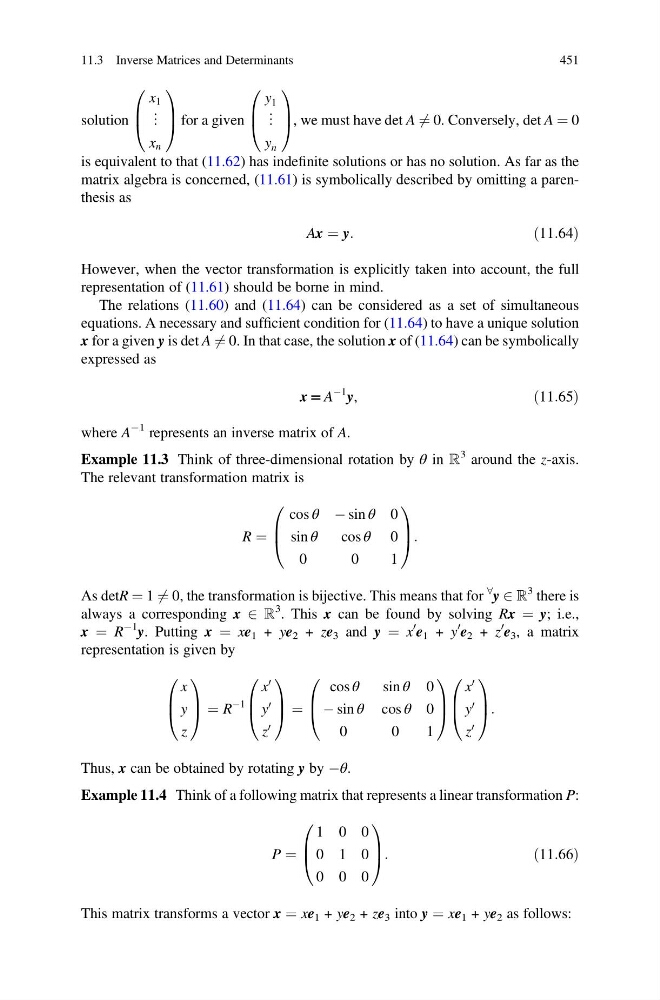
3 . This x can be found by solving Rx ¼ y; i.e.,
x ¼ R
À1
y. Putting x ¼ xe 1 + ye 2 + ze 3 and y ¼ x
0
e 1 + y
0
e 2 + z
0
e 3 , a matrix
representation is given by
x
y
z
0
B
@
1
C
A ¼ R
À1
x
0
y
0
z
0
0
B
@
1
C
A ¼
cos θ
sin θ 0
À sin θ cos θ 0
0
0
1
0
B
@
1
C
A
x
0
y
0
z
0
0
B
@
1
C
A:
Thus, x can be obtained by rotating y by Àθ.
Example 11.4 Think of a following matrix that represents a linear transformation P:
P ¼
1 0 0
0 1 0
0 0 0
0
B
@
1
C
A:
ð11:66Þ
This matrix transforms a vector x ¼ xe 1 + ye 2 + ze 3 into y ¼ xe 1 + ye 2 as follows:
11.3 Inverse Matrices and Determinants
451
x 1
⋮
x n
0
B
@
1
C
A for a given
y 1
⋮
y n
0
B
@
1
C
A, we must have det A 6 ¼ 0. Conversely, det A ¼ 0
is equivalent to that (11.62) has indefinite solutions or has no solution. As far as the
matrix algebra is concerned, (11.61) is symbolically described by omitting a parenthesis as
Ax ¼ y:
ð11:64Þ
However, when the vector transformation is explicitly taken into account, the full
representation of (11.61) should be borne in mind.
The relations (11.60) and (11.64) can be considered as a set of simultaneous
equations. A necessary and sufficient condition for (11.64) to have a unique solution
x for a given y is det A 6 ¼ 0. In that case, the solution x of (11.64) can be symbolically
expressed as
x = A
À1
y,
ð11:65Þ
where A
À1 represents an inverse matrix of A.
Example 11.3 Think of three-dimensional rotation by θ in ℝ
3 around the z-axis.
The relevant transformation matrix is
R ¼
cos θ À sin θ 0
sin θ
cos θ 0
0
0
1
0
B
@
1
C
A:
As detR ¼ 1 6 ¼ 0, the transformation is bijective. This means that for
8
y 2 ℝ
3 there is
always a corresponding x 2 ℝ
3 . This x can be found by solving Rx ¼ y; i.e.,
x ¼ R
À1
y. Putting x ¼ xe 1 + ye 2 + ze 3 and y ¼ x
0
e 1 + y
0
e 2 + z
0
e 3 , a matrix
representation is given by
x
y
z
0
B
@
1
C
A ¼ R
À1
x
0
y
0
z
0
0
B
@
1
C
A ¼
cos θ
sin θ 0
À sin θ cos θ 0
0
0
1
0
B
@
1
C
A
x
0
y
0
z
0
0
B
@
1
C
A:
Thus, x can be obtained by rotating y by Àθ.
Example 11.4 Think of a following matrix that represents a linear transformation P:
P ¼
1 0 0
0 1 0
0 0 0
0
B
@
1
C
A:
ð11:66Þ
This matrix transforms a vector x ¼ xe 1 + ye 2 + ze 3 into y ¼ xe 1 + ye 2 as follows:
11.3 Inverse Matrices and Determinants
451