

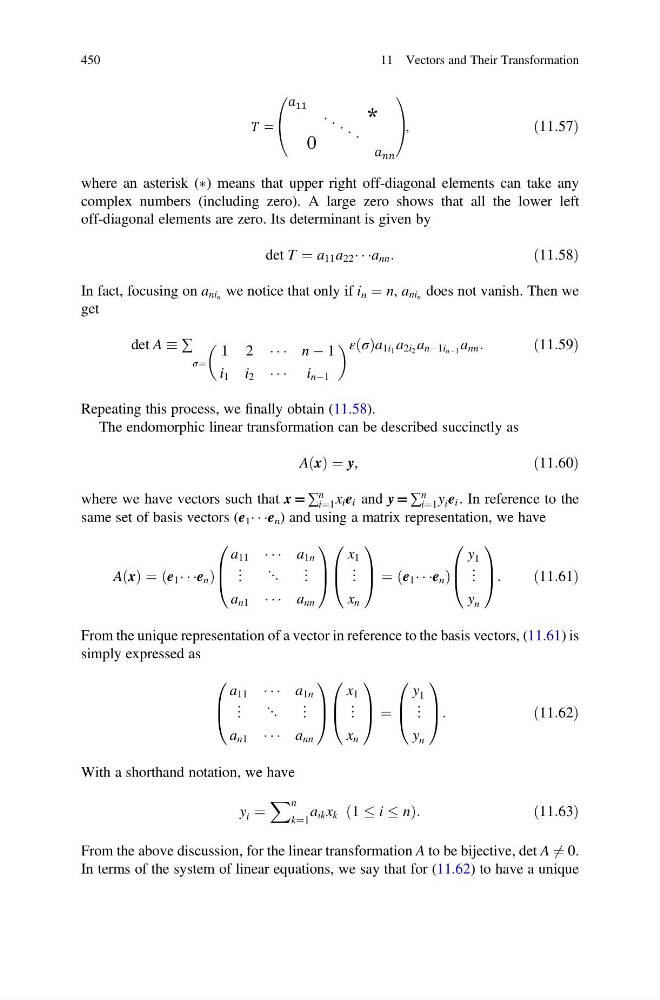
=
,
*
0
ð11:57Þ
where an asterisk (Ã) means that upper right off-diagonal elements can take any
complex numbers (including zero). A large zero shows that all the lower left
off-diagonal elements are zero. Its determinant is given by
det T ¼ a 11 a 22 Á Á Áa nn :
ð11:58Þ
In fact, focusing on a ni n we notice that only if i n ¼ n, a ni n does not vanish. Then we
get
det A ∑
σ¼
1 2 Á Á Á n À 1
i 1 i 2 Á Á Á i nÀ1
ε σ
ð Þa 1i 1 a 2i 2 a nÀ1i nÀ1 a nn :
ð11:59Þ
Repeating this process, we finally obtain (11.58).
The endomorphic linear transformation can be described succinctly as
A x
ð Þ ¼ y,
ð11:60Þ
where we have vectors such that x = ∑
n
i¼1 x i e i and y = ∑
n
i¼1 y i e i . In reference to the
same set of basis vectors (e 1 Á Á Áe n ) and using a matrix representation, we have
A x
ð Þ ¼ e 1 Á Á Áe n
ð
Þ
a 11 Á Á Á a 1n
⋮ ⋱ ⋮
a n1 Á Á Á a nn
0
B
@
1
C
A
x 1
⋮
x n
0
B
@
1
C
A ¼ e 1 Á Á Áe n
ð
Þ
y 1
⋮
y n
0
B
@
1
C
A:
ð11:61Þ
From the unique representation of a vector in reference to the basis vectors, (11.61) is
simply expressed as
a 11 Á Á Á a 1n
⋮ ⋱ ⋮
a n1 Á Á Á a nn
0
B
@
1
C
A
x 1
⋮
x n
0
B
@
1
C
A ¼
y 1
⋮
y n
0
B
@
1
C
A:
ð11:62Þ
With a shorthand notation, we have
y i ¼
X n
k¼1
a ik x k 1 i n
ð
Þ :
ð11:63Þ
From the above discussion, for the linear transformation A to be bijective, det A 6 ¼ 0.
In terms of the system of linear equations, we say that for (11.62) to have a unique
450
11 Vectors and Their Transformation
,
*
0
ð11:57Þ
where an asterisk (Ã) means that upper right off-diagonal elements can take any
complex numbers (including zero). A large zero shows that all the lower left
off-diagonal elements are zero. Its determinant is given by
det T ¼ a 11 a 22 Á Á Áa nn :
ð11:58Þ
In fact, focusing on a ni n we notice that only if i n ¼ n, a ni n does not vanish. Then we
get
det A ∑
σ¼
1 2 Á Á Á n À 1
i 1 i 2 Á Á Á i nÀ1
ε σ
ð Þa 1i 1 a 2i 2 a nÀ1i nÀ1 a nn :
ð11:59Þ
Repeating this process, we finally obtain (11.58).
The endomorphic linear transformation can be described succinctly as
A x
ð Þ ¼ y,
ð11:60Þ
where we have vectors such that x = ∑
n
i¼1 x i e i and y = ∑
n
i¼1 y i e i . In reference to the
same set of basis vectors (e 1 Á Á Áe n ) and using a matrix representation, we have
A x
ð Þ ¼ e 1 Á Á Áe n
ð
Þ
a 11 Á Á Á a 1n
⋮ ⋱ ⋮
a n1 Á Á Á a nn
0
B
@
1
C
A
x 1
⋮
x n
0
B
@
1
C
A ¼ e 1 Á Á Áe n
ð
Þ
y 1
⋮
y n
0
B
@
1
C
A:
ð11:61Þ
From the unique representation of a vector in reference to the basis vectors, (11.61) is
simply expressed as
a 11 Á Á Á a 1n
⋮ ⋱ ⋮
a n1 Á Á Á a nn
0
B
@
1
C
A
x 1
⋮
x n
0
B
@
1
C
A ¼
y 1
⋮
y n
0
B
@
1
C
A:
ð11:62Þ
With a shorthand notation, we have
y i ¼
X n
k¼1
a ik x k 1 i n
ð
Þ :
ð11:63Þ
From the above discussion, for the linear transformation A to be bijective, det A 6 ¼ 0.
In terms of the system of linear equations, we say that for (11.62) to have a unique
450
11 Vectors and Their Transformation