

∑
n
k¼1 A
À1
À
Á
mk
∑ j6 ¼m A kj c j ¼ ∑ j6 ¼m δ mj c j ¼ 0:
ð11:54Þ
From (11.52) and (11.53), on the other hand, we obtain
X n
k¼1
A
À1
À
Á
mk
X
j6 ¼m
A kj c j ¼ A
À1
À
Á
ik
A
ð Þ km
n
o
i¼m
¼ 1:
ð11:55Þ
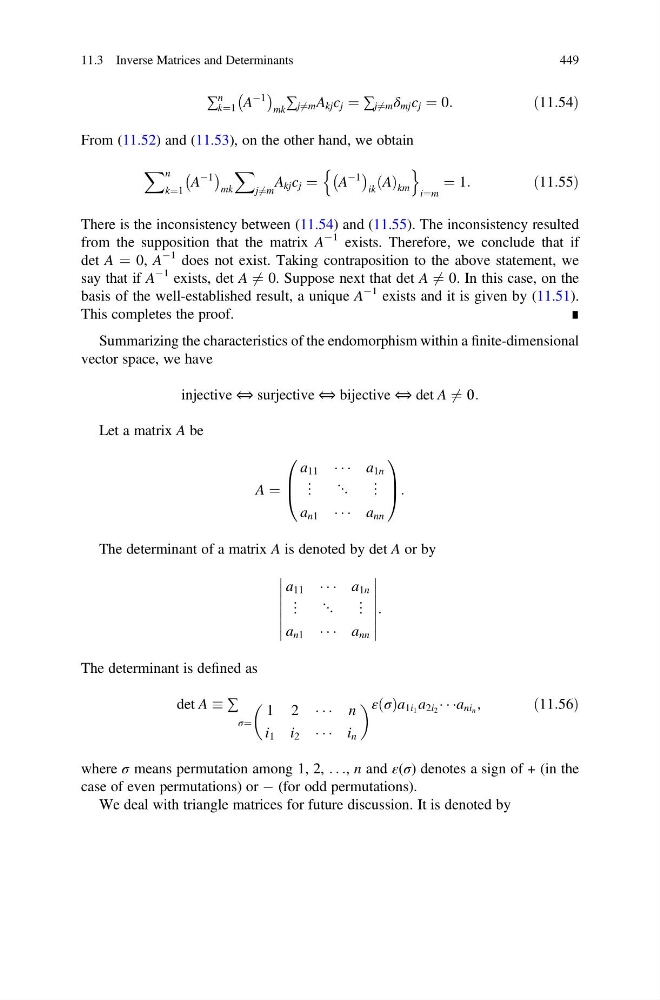
There is the inconsistency between (11.54) and (11.55). The inconsistency resulted
from the supposition that the matrix A
À1 exists. Therefore, we conclude that if
det A ¼ 0, A
À1 does not exist. Taking contraposition to the above statement, we
say that if A
À1 exists, det A 6 ¼ 0. Suppose next that det A 6 ¼ 0. In this case, on the
basis of the well-established result, a unique A
À1 exists and it is given by (11.51).
This completes the proof.
∎
Summarizing the characteristics of the endomorphism within a finite-dimensional
vector space, we have
injective ⟺ surjective ⟺ bijective ⟺ det A 6 ¼ 0:
Let a matrix A be
A ¼
a 11 Á Á Á a 1n
⋮ ⋱ ⋮
a n1 Á Á Á a nn
0
B
@
1
C
A:
The determinant of a matrix A is denoted by det A or by
a 11 Á Á Á a 1n
⋮ ⋱ ⋮
a n1 Á Á Á a nn
:
The determinant is defined as
det A ∑
σ¼
1 2 Á Á Á n
i 1 i 2 Á Á Á i n
ε σ
ð Þa 1i 1 a 2i 2 Á Á Áa ni n ,
ð11:56Þ
where σ means permutation among 1, 2, . . ., n and ε(σ) denotes a sign of + (in the
case of even permutations) or À (for odd permutations).
We deal with triangle matrices for future discussion. It is denoted by
11.3 Inverse Matrices and Determinants
449
n
k¼1 A
À1
À
Á
mk
∑ j6 ¼m A kj c j ¼ ∑ j6 ¼m δ mj c j ¼ 0:
ð11:54Þ
From (11.52) and (11.53), on the other hand, we obtain
X n
k¼1
A
À1
À
Á
mk
X
j6 ¼m
A kj c j ¼ A
À1
À
Á
ik
A
ð Þ km
n
o
i¼m
¼ 1:
ð11:55Þ
There is the inconsistency between (11.54) and (11.55). The inconsistency resulted
from the supposition that the matrix A
À1 exists. Therefore, we conclude that if
det A ¼ 0, A
À1 does not exist. Taking contraposition to the above statement, we
say that if A
À1 exists, det A 6 ¼ 0. Suppose next that det A 6 ¼ 0. In this case, on the
basis of the well-established result, a unique A
À1 exists and it is given by (11.51).
This completes the proof.
∎
Summarizing the characteristics of the endomorphism within a finite-dimensional
vector space, we have
injective ⟺ surjective ⟺ bijective ⟺ det A 6 ¼ 0:
Let a matrix A be
A ¼
a 11 Á Á Á a 1n
⋮ ⋱ ⋮
a n1 Á Á Á a nn
0
B
@
1
C
A:
The determinant of a matrix A is denoted by det A or by
a 11 Á Á Á a 1n
⋮ ⋱ ⋮
a n1 Á Á Á a nn
:
The determinant is defined as
det A ∑
σ¼
1 2 Á Á Á n
i 1 i 2 Á Á Á i n
ε σ
ð Þa 1i 1 a 2i 2 Á Á Áa ni n ,
ð11:56Þ
where σ means permutation among 1, 2, . . ., n and ε(σ) denotes a sign of + (in the
case of even permutations) or À (for odd permutations).
We deal with triangle matrices for future discussion. It is denoted by
11.3 Inverse Matrices and Determinants
449