

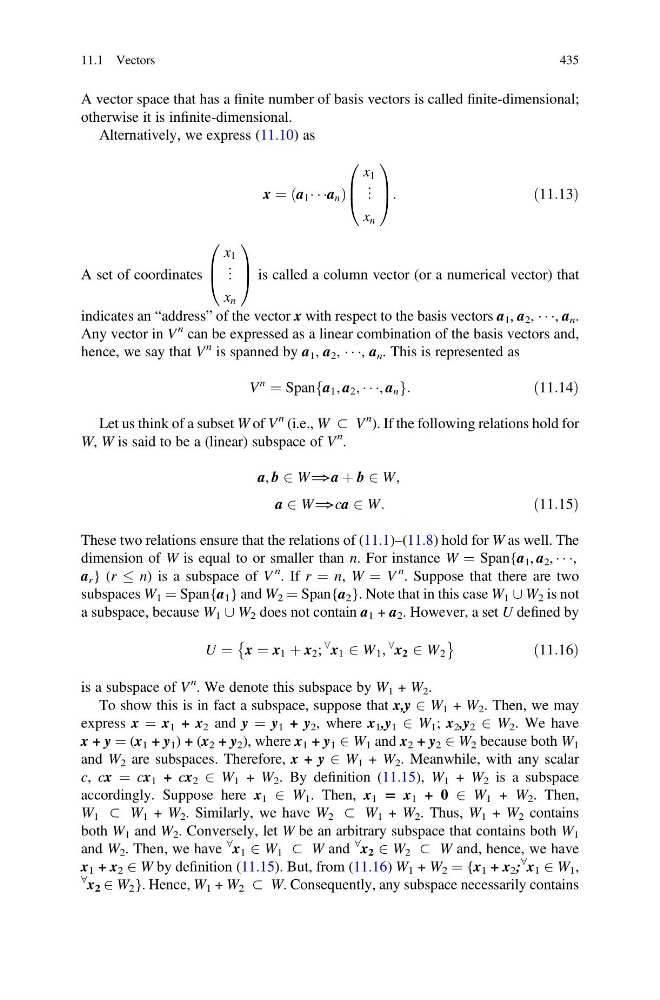
A vector space that has a finite number of basis vectors is called finite-dimensional;
otherwise it is infinite-dimensional.
Alternatively, we express (11.10) as
x ¼ a 1 Á Á Áa n
ð
Þ
x 1
⋮
x n
0
B
@
1
C
A:
ð11:13Þ
A set of coordinates
x 1
⋮
x n
0
B
@
1
C
A is called a column vector (or a numerical vector) that
indicates an “address” of the vector x with respect to the basis vectors a 1 , a 2 , Á Á Á, a n .
Any vector in V
n can be expressed as a linear combination of the basis vectors and,
hence, we say that V
n is spanned by a 1 , a 2 , Á Á Á, a n . This is represented as
V
n
¼ Span a 1 , a 2 , Á Á Á, a n
f
g :
ð11:14Þ
Let us think of a subset W of V
n (i.e., W ⊂ V
n ). If the following relations hold for
W, W is said to be a (linear) subspace of V
n .
a, b 2 W⟹a þ b 2 W,
a 2 W⟹ca 2 W:
ð11:15Þ
These two relations ensure that the relations of (11.1)–(11.8) hold for W as well. The
dimension of W is equal to or smaller than n. For instance W ¼ Span{a 1 , a 2 , Á Á Á,
a r } (r
n) is a subspace of V
n . If r ¼ n, W ¼ V
n . Suppose that there are two
subspaces W 1 ¼ Span{a 1 } and W 2 ¼ Span{a 2 }. Note that in this case W 1 [ W 2 is not
a subspace, because W 1 [ W 2 does not contain a 1 + a 2 . However, a set U defined by
U ¼ x ¼ x 1 þ x 2 ;
8
x 1 2 W 1 ,
8
x 2 2 W 2
È
É
ð11:16Þ
is a subspace of V
n . We denote this subspace by W 1 + W 2 .
To show this is in fact a subspace, suppose that x,y 2 W 1 + W 2 . Then, we may
express x ¼ x 1 + x 2 and y ¼ y 1 + y 2 , where x 1 ,y 1 2 W 1 ; x 2 ,y 2 2 W 2 . We have
x + y ¼ (x 1 + y 1 ) + (x 2 + y 2 ), where x 1 + y 1 2 W 1 and x 2 + y 2 2 W 2 because both W 1
and W 2 are subspaces. Therefore, x + y 2 W 1 + W 2 . Meanwhile, with any scalar
c, cx ¼ cx 1 + cx 2 2 W 1 + W 2 . By definition (11.15), W 1 + W 2 is a subspace
accordingly. Suppose here x 1 2 W 1 . Then, x 1 = x 1 + 0 2 W 1 + W 2 . Then,
W 1 ⊂ W 1 + W 2 . Similarly, we have W 2 ⊂ W 1 + W 2 . Thus, W 1 + W 2 contains
both W 1 and W 2 . Conversely, let W be an arbitrary subspace that contains both W 1
and W 2 . Then, we have
8
x 1 2 W 1 ⊂ W and
8
x 2 2 W 2 ⊂ W and, hence, we have
x 1 + x 2 2 W by definition (11.15). But, from (11.16) W 1 + W 2 ¼ {x 1 + x 2 ;
8
x 1 2 W 1 ,
8
x 2 2 W 2 }. Hence, W 1 + W 2 ⊂ W. Consequently, any subspace necessarily contains
11.1 Vectors
435
otherwise it is infinite-dimensional.
Alternatively, we express (11.10) as
x ¼ a 1 Á Á Áa n
ð
Þ
x 1
⋮
x n
0
B
@
1
C
A:
ð11:13Þ
A set of coordinates
x 1
⋮
x n
0
B
@
1
C
A is called a column vector (or a numerical vector) that
indicates an “address” of the vector x with respect to the basis vectors a 1 , a 2 , Á Á Á, a n .
Any vector in V
n can be expressed as a linear combination of the basis vectors and,
hence, we say that V
n is spanned by a 1 , a 2 , Á Á Á, a n . This is represented as
V
n
¼ Span a 1 , a 2 , Á Á Á, a n
f
g :
ð11:14Þ
Let us think of a subset W of V
n (i.e., W ⊂ V
n ). If the following relations hold for
W, W is said to be a (linear) subspace of V
n .
a, b 2 W⟹a þ b 2 W,
a 2 W⟹ca 2 W:
ð11:15Þ
These two relations ensure that the relations of (11.1)–(11.8) hold for W as well. The
dimension of W is equal to or smaller than n. For instance W ¼ Span{a 1 , a 2 , Á Á Á,
a r } (r
n) is a subspace of V
n . If r ¼ n, W ¼ V
n . Suppose that there are two
subspaces W 1 ¼ Span{a 1 } and W 2 ¼ Span{a 2 }. Note that in this case W 1 [ W 2 is not
a subspace, because W 1 [ W 2 does not contain a 1 + a 2 . However, a set U defined by
U ¼ x ¼ x 1 þ x 2 ;
8
x 1 2 W 1 ,
8
x 2 2 W 2
È
É
ð11:16Þ
is a subspace of V
n . We denote this subspace by W 1 + W 2 .
To show this is in fact a subspace, suppose that x,y 2 W 1 + W 2 . Then, we may
express x ¼ x 1 + x 2 and y ¼ y 1 + y 2 , where x 1 ,y 1 2 W 1 ; x 2 ,y 2 2 W 2 . We have
x + y ¼ (x 1 + y 1 ) + (x 2 + y 2 ), where x 1 + y 1 2 W 1 and x 2 + y 2 2 W 2 because both W 1
and W 2 are subspaces. Therefore, x + y 2 W 1 + W 2 . Meanwhile, with any scalar
c, cx ¼ cx 1 + cx 2 2 W 1 + W 2 . By definition (11.15), W 1 + W 2 is a subspace
accordingly. Suppose here x 1 2 W 1 . Then, x 1 = x 1 + 0 2 W 1 + W 2 . Then,
W 1 ⊂ W 1 + W 2 . Similarly, we have W 2 ⊂ W 1 + W 2 . Thus, W 1 + W 2 contains
both W 1 and W 2 . Conversely, let W be an arbitrary subspace that contains both W 1
and W 2 . Then, we have
8
x 1 2 W 1 ⊂ W and
8
x 2 2 W 2 ⊂ W and, hence, we have
x 1 + x 2 2 W by definition (11.15). But, from (11.16) W 1 + W 2 ¼ {x 1 + x 2 ;
8
x 1 2 W 1 ,
8
x 2 2 W 2 }. Hence, W 1 + W 2 ⊂ W. Consequently, any subspace necessarily contains
11.1 Vectors
435