

W 1 + W 2 . This implies that W 1 + W 2 is the smallest subspace that contains both W 1
and W 2 .
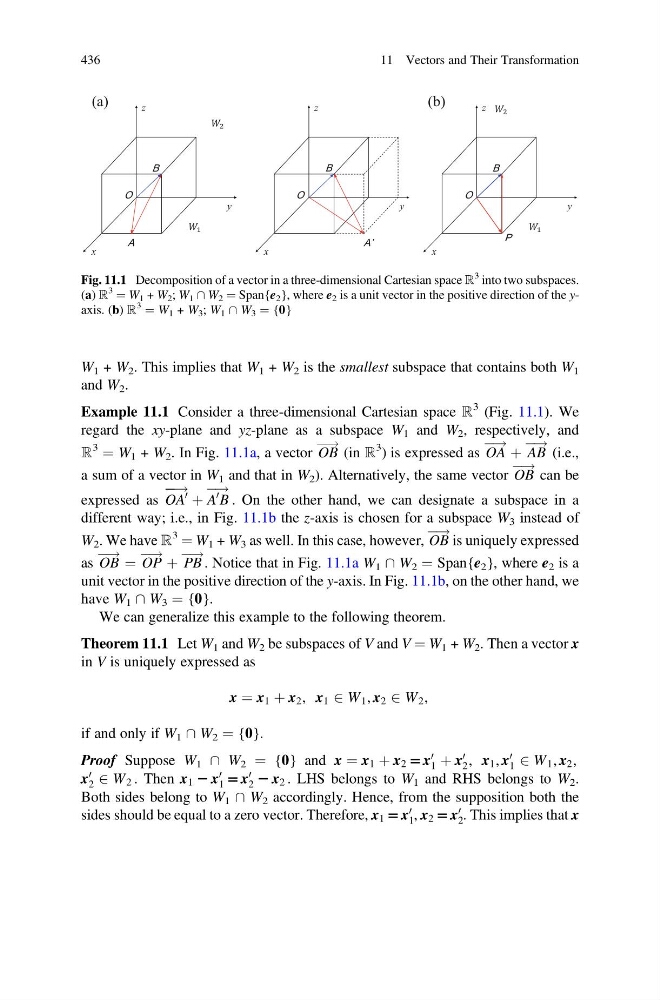
Example 11.1 Consider a three-dimensional Cartesian space ℝ
3 (Fig. 11.1). We
regard the xy-plane and yz-plane as a subspace W 1 and W 2 , respectively, and
ℝ
3
¼ W 1 + W 2 . In Fig. 11.1a, a vector OB
! (in ℝ
3 ) is expressed as OA
! þ AB
! (i.e.,
a sum of a vector in W 1 and that in W 2 ). Alternatively, the same vector OB
! can be
expressed as OA
0
! þ A
0 B
!
. On the other hand, we can designate a subspace in a
different way; i.e., in Fig. 11.1b the z-axis is chosen for a subspace W 3 instead of
W 2 . We have ℝ
3
¼ W 1 + W 3 as well. In this case, however, OB
! is uniquely expressed
as OB
! ¼ OP
! þ PB
! . Notice that in Fig. 11.1a W 1 \ W 2 ¼ Span{e 2 }, where e 2 is a
unit vector in the positive direction of the y-axis. In Fig. 11.1b, on the other hand, we
have W 1 \ W 3 ¼ {0}.
We can generalize this example to the following theorem.
Theorem 11.1 Let W 1 and W 2 be subspaces of V and V ¼ W 1 + W 2 . Then a vector x
in V is uniquely expressed as
x ¼ x 1 þ x 2 , x 1 2 W 1 , x 2 2 W 2 ,
if and only if W 1 \ W 2 ¼ {0}.
Proof Suppose W 1 \ W 2 ¼ {0} and x ¼ x 1 þ x 2 = x
0
1 þ x
0
2 , x 1 , x
0
1 2 W 1 , x 2 ,
x
0
2 2 W 2 . Then x 1 2 x
0
1 = x
0
2 2 x 2 . LHS belongs to W 1 and RHS belongs to W 2 .
Both sides belong to W 1 \ W 2 accordingly. Hence, from the supposition both the
sides should be equal to a zero vector. Therefore, x 1 = x
0
1 , x 2 = x
0
2 . This implies that x
y
x
z
2
%
$
(a)
y
x
z
%
$ಬ
2
y
x
z
2
%
3
(b)
Fig. 11.1 Decomposition of a vector in a three-dimensional Cartesian space ℝ
3 into two subspaces.
(a) ℝ
3 ¼ W 1 + W 2 ; W 1 \ W 2 ¼ Span{e 2 }, where e 2 is a unit vector in the positive direction of the yaxis. (b) ℝ
3 ¼ W 1 + W 3 ; W 1 \ W 3 ¼ {0}
436
11 Vectors and Their Transformation
and W 2 .
Example 11.1 Consider a three-dimensional Cartesian space ℝ
3 (Fig. 11.1). We
regard the xy-plane and yz-plane as a subspace W 1 and W 2 , respectively, and
ℝ
3
¼ W 1 + W 2 . In Fig. 11.1a, a vector OB
! (in ℝ
3 ) is expressed as OA
! þ AB
! (i.e.,
a sum of a vector in W 1 and that in W 2 ). Alternatively, the same vector OB
! can be
expressed as OA
0
! þ A
0 B
!
. On the other hand, we can designate a subspace in a
different way; i.e., in Fig. 11.1b the z-axis is chosen for a subspace W 3 instead of
W 2 . We have ℝ
3
¼ W 1 + W 3 as well. In this case, however, OB
! is uniquely expressed
as OB
! ¼ OP
! þ PB
! . Notice that in Fig. 11.1a W 1 \ W 2 ¼ Span{e 2 }, where e 2 is a
unit vector in the positive direction of the y-axis. In Fig. 11.1b, on the other hand, we
have W 1 \ W 3 ¼ {0}.
We can generalize this example to the following theorem.
Theorem 11.1 Let W 1 and W 2 be subspaces of V and V ¼ W 1 + W 2 . Then a vector x
in V is uniquely expressed as
x ¼ x 1 þ x 2 , x 1 2 W 1 , x 2 2 W 2 ,
if and only if W 1 \ W 2 ¼ {0}.
Proof Suppose W 1 \ W 2 ¼ {0} and x ¼ x 1 þ x 2 = x
0
1 þ x
0
2 , x 1 , x
0
1 2 W 1 , x 2 ,
x
0
2 2 W 2 . Then x 1 2 x
0
1 = x
0
2 2 x 2 . LHS belongs to W 1 and RHS belongs to W 2 .
Both sides belong to W 1 \ W 2 accordingly. Hence, from the supposition both the
sides should be equal to a zero vector. Therefore, x 1 = x
0
1 , x 2 = x
0
2 . This implies that x
y
x
z
2
%
$
(a)
y
x
z
%
$ಬ
2
y
x
z
2
%
3
(b)
Fig. 11.1 Decomposition of a vector in a three-dimensional Cartesian space ℝ
3 into two subspaces.
(a) ℝ
3 ¼ W 1 + W 2 ; W 1 \ W 2 ¼ Span{e 2 }, where e 2 is a unit vector in the positive direction of the yaxis. (b) ℝ
3 ¼ W 1 + W 3 ; W 1 \ W 3 ¼ {0}
436
11 Vectors and Their Transformation