

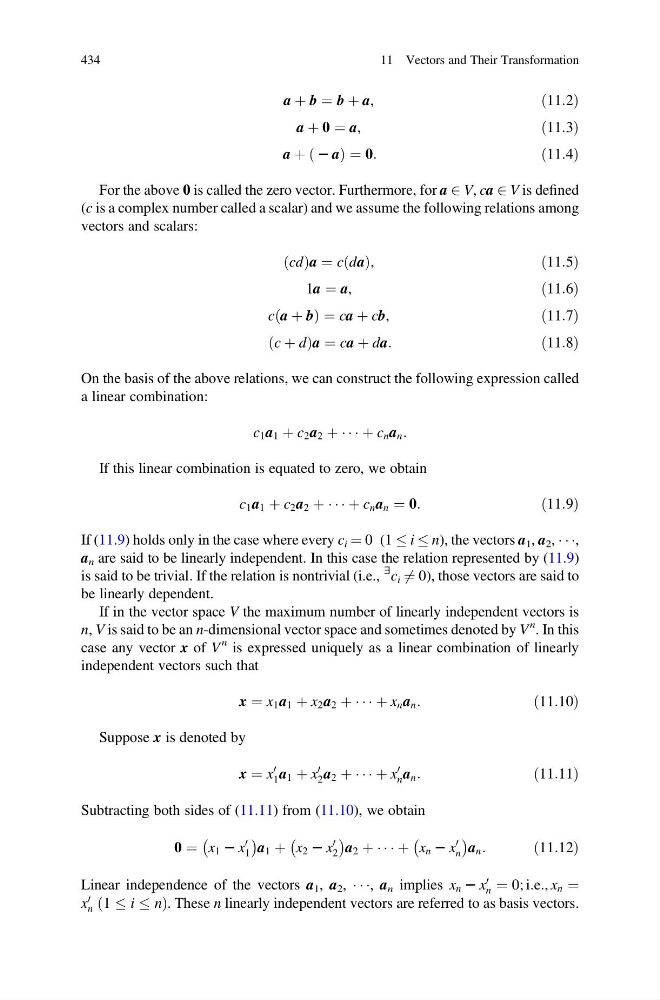
a þ b ¼ b þ a,
ð11:2Þ
a þ 0 ¼ a,
ð11:3Þ
a þ 2 a
ð
Þ ¼ 0:
ð11:4Þ
For the above 0 is called the zero vector. Furthermore, for a 2 V, ca 2 V is defined
(c is a complex number called a scalar) and we assume the following relations among
vectors and scalars:
cd
ð Þa ¼ c da
ð Þ,
ð11:5Þ
1a ¼ a,
ð11:6Þ
c a þ b
ð
Þ¼ca þ cb,
ð11:7Þ
c þ d
ð
Þa ¼ ca þ da:
ð11:8Þ
On the basis of the above relations, we can construct the following expression called
a linear combination:
c 1 a 1 þ c 2 a 2 þ Á Á Á þ c n a n :
If this linear combination is equated to zero, we obtain
c 1 a 1 þ c 2 a 2 þ Á Á Á þ c n a n ¼ 0:
ð11:9Þ
If (11.9) holds only in the case where every c i ¼ 0 (1 i n), the vectors a 1 , a 2 , Á Á Á,
a n are said to be linearly independent. In this case the relation represented by (11.9)
is said to be trivial. If the relation is nontrivial (i.e.,
∃ c i 6 ¼ 0), those vectors are said to
be linearly dependent.
If in the vector space V the maximum number of linearly independent vectors is
n, V is said to be an n-dimensional vector space and sometimes denoted by V
n . In this
case any vector x of V
n is expressed uniquely as a linear combination of linearly
independent vectors such that
x ¼ x 1 a 1 þ x 2 a 2 þ Á Á Á þ x n a n :
ð11:10Þ
Suppose x is denoted by
x ¼ x
0
1 a 1 þ x
0
2 a 2 þ Á Á Á þ x
0
n a n :
ð11:11Þ
Subtracting both sides of (11.11) from (11.10), we obtain
0 ¼ x 1 2 x
0
1
À
Á a 1 þ x 2 2 x
0
2
À
Á a 2 þ Á Á Á þ x n 2 x
0
n
À
Á
a n :
ð11:12Þ
Linear independence of the vectors a 1 , a 2 , Á Á Á, a n implies x n 2 x
0
n ¼ 0; i:e:, x n ¼
x
0
n 1 i n
ð
Þ . These n linearly independent vectors are referred to as basis vectors.
434
11 Vectors and Their Transformation
ð11:2Þ
a þ 0 ¼ a,
ð11:3Þ
a þ 2 a
ð
Þ ¼ 0:
ð11:4Þ
For the above 0 is called the zero vector. Furthermore, for a 2 V, ca 2 V is defined
(c is a complex number called a scalar) and we assume the following relations among
vectors and scalars:
cd
ð Þa ¼ c da
ð Þ,
ð11:5Þ
1a ¼ a,
ð11:6Þ
c a þ b
ð
Þ¼ca þ cb,
ð11:7Þ
c þ d
ð
Þa ¼ ca þ da:
ð11:8Þ
On the basis of the above relations, we can construct the following expression called
a linear combination:
c 1 a 1 þ c 2 a 2 þ Á Á Á þ c n a n :
If this linear combination is equated to zero, we obtain
c 1 a 1 þ c 2 a 2 þ Á Á Á þ c n a n ¼ 0:
ð11:9Þ
If (11.9) holds only in the case where every c i ¼ 0 (1 i n), the vectors a 1 , a 2 , Á Á Á,
a n are said to be linearly independent. In this case the relation represented by (11.9)
is said to be trivial. If the relation is nontrivial (i.e.,
∃ c i 6 ¼ 0), those vectors are said to
be linearly dependent.
If in the vector space V the maximum number of linearly independent vectors is
n, V is said to be an n-dimensional vector space and sometimes denoted by V
n . In this
case any vector x of V
n is expressed uniquely as a linear combination of linearly
independent vectors such that
x ¼ x 1 a 1 þ x 2 a 2 þ Á Á Á þ x n a n :
ð11:10Þ
Suppose x is denoted by
x ¼ x
0
1 a 1 þ x
0
2 a 2 þ Á Á Á þ x
0
n a n :
ð11:11Þ
Subtracting both sides of (11.11) from (11.10), we obtain
0 ¼ x 1 2 x
0
1
À
Á a 1 þ x 2 2 x
0
2
À
Á a 2 þ Á Á Á þ x n 2 x
0
n
À
Á
a n :
ð11:12Þ
Linear independence of the vectors a 1 , a 2 , Á Á Á, a n implies x n 2 x
0
n ¼ 0; i:e:, x n ¼
x
0
n 1 i n
ð
Þ . These n linearly independent vectors are referred to as basis vectors.
434
11 Vectors and Their Transformation