

Z s
r
dx v
à L x u
ð ÞÀ L x
{ v
Â
à à u
h
i
¼ av
à du
dx
À u
d av
Ã
ð Þ
dx
þ buv
Ã
! s
r
:
ð10:62Þ
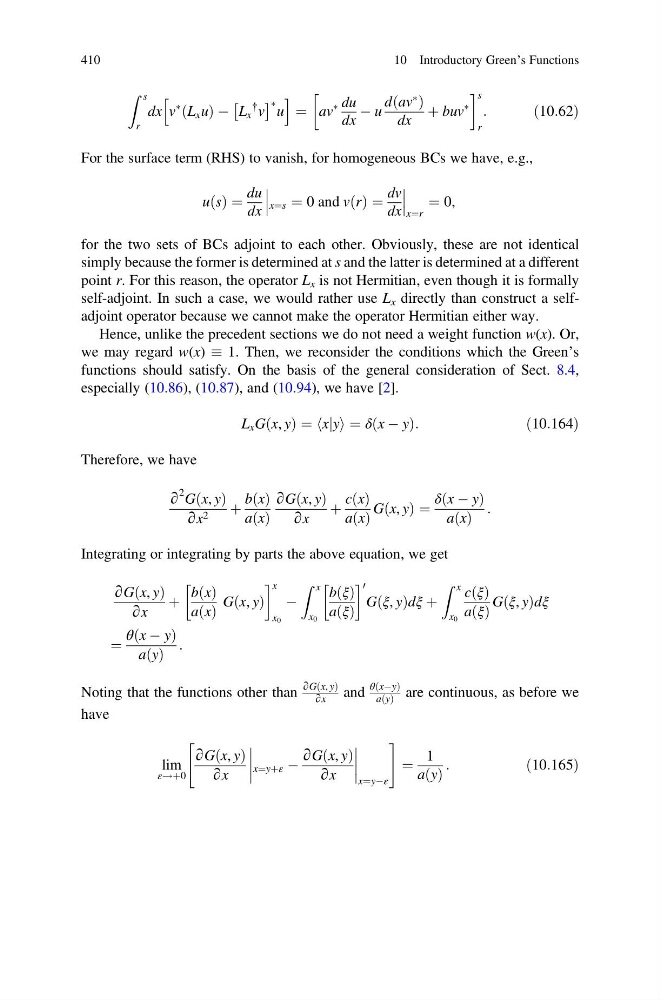
For the surface term (RHS) to vanish, for homogeneous BCs we have, e.g.,
u s
ð Þ ¼
du
dx
x¼s ¼ 0 and v r
ð Þ ¼
dv
dx
x¼r
¼ 0,
for the two sets of BCs adjoint to each other. Obviously, these are not identical
simply because the former is determined at s and the latter is determined at a different
point r. For this reason, the operator L x is not Hermitian, even though it is formally
self-adjoint. In such a case, we would rather use L x directly than construct a selfadjoint operator because we cannot make the operator Hermitian either way.
Hence, unlike the precedent sections we do not need a weight function w(x). Or,
we may regard w(x) 1. Then, we reconsider the conditions which the Green’s
functions should satisfy. On the basis of the general consideration of Sect. 8.4,
especially (10.86), (10.87), and (10.94), we have [2].
L x G x, y
ð Þ ¼ xjy
h i ¼ δ x À y
ð
Þ:
ð10:164Þ
Therefore, we have
∂
2 G x, y
ð Þ
∂x 2 þ
b x
ð Þ
a x
ð Þ
∂G x, y
ð Þ
∂x
þ
c x
ð Þ
a x
ð Þ
G x, y
ð Þ ¼
δ x À y
ð
Þ
a x
ð Þ
:
Integrating or integrating by parts the above equation, we get
∂G x, y
ð Þ
∂x
þ
b x
ð Þ
a x
ð Þ
G x, y
ð Þ
! x
x 0
À
Z x
x 0
b ξ
ð Þ
a ξ
ð Þ
! 0
G ξ, y
ð Þdξ þ
Z x
x 0
c ξ
ð Þ
a ξ
ð Þ
G ξ, y
ð Þdξ
¼
θ x À y
ð
Þ
a y
ð Þ
:
Noting that the functions other than
∂G x, y
ð Þ
∂x
and
θ xÀy
ð
Þ
a y
ð Þ are continuous, as before we
have
lim
ε!þ0
∂G x, y
ð Þ
∂x
x¼yþε À
∂G x, y
ð Þ
∂x
x¼yÀε
"
#
¼
1
a y
ð Þ
:
ð10:165Þ
410
10 Introductory Green’s Functions
r
dx v
à L x u
ð ÞÀ L x
{ v
Â
à à u
h
i
¼ av
à du
dx
À u
d av
Ã
ð Þ
dx
þ buv
Ã
! s
r
:
ð10:62Þ
For the surface term (RHS) to vanish, for homogeneous BCs we have, e.g.,
u s
ð Þ ¼
du
dx
x¼s ¼ 0 and v r
ð Þ ¼
dv
dx
x¼r
¼ 0,
for the two sets of BCs adjoint to each other. Obviously, these are not identical
simply because the former is determined at s and the latter is determined at a different
point r. For this reason, the operator L x is not Hermitian, even though it is formally
self-adjoint. In such a case, we would rather use L x directly than construct a selfadjoint operator because we cannot make the operator Hermitian either way.
Hence, unlike the precedent sections we do not need a weight function w(x). Or,
we may regard w(x) 1. Then, we reconsider the conditions which the Green’s
functions should satisfy. On the basis of the general consideration of Sect. 8.4,
especially (10.86), (10.87), and (10.94), we have [2].
L x G x, y
ð Þ ¼ xjy
h i ¼ δ x À y
ð
Þ:
ð10:164Þ
Therefore, we have
∂
2 G x, y
ð Þ
∂x 2 þ
b x
ð Þ
a x
ð Þ
∂G x, y
ð Þ
∂x
þ
c x
ð Þ
a x
ð Þ
G x, y
ð Þ ¼
δ x À y
ð
Þ
a x
ð Þ
:
Integrating or integrating by parts the above equation, we get
∂G x, y
ð Þ
∂x
þ
b x
ð Þ
a x
ð Þ
G x, y
ð Þ
! x
x 0
À
Z x
x 0
b ξ
ð Þ
a ξ
ð Þ
! 0
G ξ, y
ð Þdξ þ
Z x
x 0
c ξ
ð Þ
a ξ
ð Þ
G ξ, y
ð Þdξ
¼
θ x À y
ð
Þ
a y
ð Þ
:
Noting that the functions other than
∂G x, y
ð Þ
∂x
and
θ xÀy
ð
Þ
a y
ð Þ are continuous, as before we
have
lim
ε!þ0
∂G x, y
ð Þ
∂x
x¼yþε À
∂G x, y
ð Þ
∂x
x¼yÀε
"
#
¼
1
a y
ð Þ
:
ð10:165Þ
410
10 Introductory Green’s Functions