

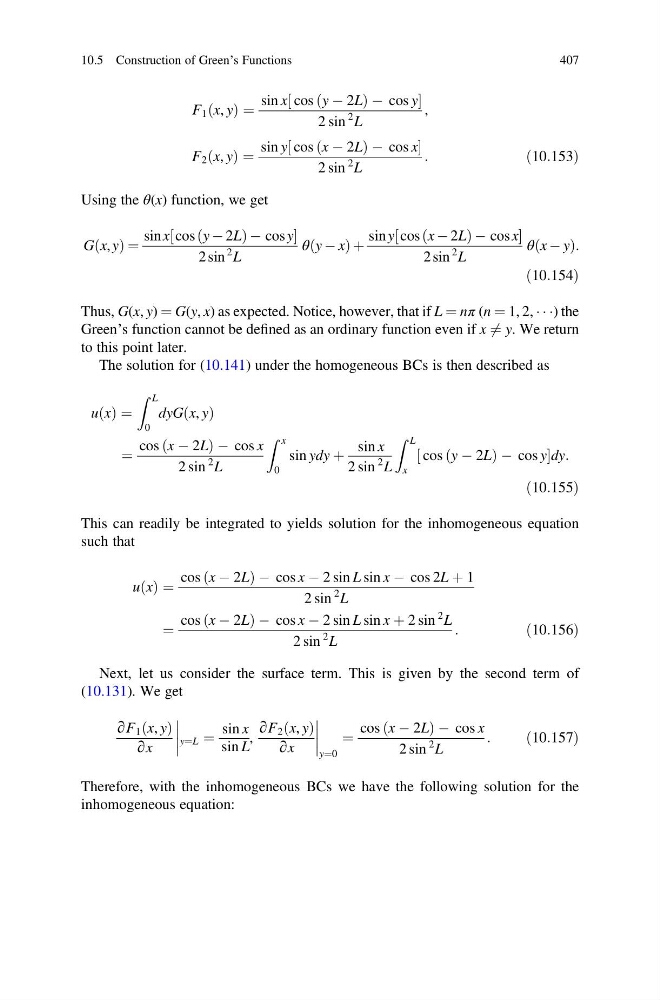
F 1 x, y
ð Þ ¼
sin x cos y À 2L
ð
ÞÀ cos y
½
2 sin
2 L
,
F 2 x, y
ð Þ ¼
sin y cos x À 2L
ð
ÞÀ cos x
½
2 sin
2 L
:
ð10:153Þ
Using the θ(x) function, we get
G x, y
ð Þ¼
sin x cos y À 2L
ð
ÞÀcos y
½
2 sin
2 L
θ y À x
ð
Þþ
sin y cos x À 2L
ð
ÞÀcos x
½
2 sin
2 L
θ x À y
ð
Þ:
ð10:154Þ
Thus, G(x, y) ¼ G(y, x) as expected. Notice, however, that if L ¼ nπ (n ¼ 1, 2, Á Á Á) the
Green’s function cannot be defined as an ordinary function even if x 6 ¼ y. We return
to this point later.
The solution for (10.141) under the homogeneous BCs is then described as
u x
ð Þ ¼
Z L
0
dyG x, y
ð Þ
¼
cos x À 2L
ð
ÞÀ cos x
2 sin
2 L
Z x
0
sin ydy þ
sin x
2 sin
2 L
Z L
x
cos y À 2L
ð
ÞÀ cos y
½
dy:
ð10:155Þ
This can readily be integrated to yields solution for the inhomogeneous equation
such that
u x
ð Þ ¼
cos x À 2L
ð
ÞÀ cos x À 2 sin L sin x À cos 2L þ 1
2 sin
2 L
¼
cos x À 2L
ð
ÞÀ cos x À 2 sin L sin x þ 2 sin
2 L
2 sin
2 L
:
ð10:156Þ
Next, let us consider the surface term. This is given by the second term of
(10.131). We get
∂F 1 x, y
ð Þ
∂x
y¼L ¼
sin x
sin L
,
∂F 2 x, y
ð Þ
∂x
y¼0
¼
cos x À 2L
ð
ÞÀ cos x
2 sin
2 L
:
ð10:157Þ
Therefore, with the inhomogeneous BCs we have the following solution for the
inhomogeneous equation:
10.5 Construction of Green’s Functions
407
ð Þ ¼
sin x cos y À 2L
ð
ÞÀ cos y
½
2 sin
2 L
,
F 2 x, y
ð Þ ¼
sin y cos x À 2L
ð
ÞÀ cos x
½
2 sin
2 L
:
ð10:153Þ
Using the θ(x) function, we get
G x, y
ð Þ¼
sin x cos y À 2L
ð
ÞÀcos y
½
2 sin
2 L
θ y À x
ð
Þþ
sin y cos x À 2L
ð
ÞÀcos x
½
2 sin
2 L
θ x À y
ð
Þ:
ð10:154Þ
Thus, G(x, y) ¼ G(y, x) as expected. Notice, however, that if L ¼ nπ (n ¼ 1, 2, Á Á Á) the
Green’s function cannot be defined as an ordinary function even if x 6 ¼ y. We return
to this point later.
The solution for (10.141) under the homogeneous BCs is then described as
u x
ð Þ ¼
Z L
0
dyG x, y
ð Þ
¼
cos x À 2L
ð
ÞÀ cos x
2 sin
2 L
Z x
0
sin ydy þ
sin x
2 sin
2 L
Z L
x
cos y À 2L
ð
ÞÀ cos y
½
dy:
ð10:155Þ
This can readily be integrated to yields solution for the inhomogeneous equation
such that
u x
ð Þ ¼
cos x À 2L
ð
ÞÀ cos x À 2 sin L sin x À cos 2L þ 1
2 sin
2 L
¼
cos x À 2L
ð
ÞÀ cos x À 2 sin L sin x þ 2 sin
2 L
2 sin
2 L
:
ð10:156Þ
Next, let us consider the surface term. This is given by the second term of
(10.131). We get
∂F 1 x, y
ð Þ
∂x
y¼L ¼
sin x
sin L
,
∂F 2 x, y
ð Þ
∂x
y¼0
¼
cos x À 2L
ð
ÞÀ cos x
2 sin
2 L
:
ð10:157Þ
Therefore, with the inhomogeneous BCs we have the following solution for the
inhomogeneous equation:
10.5 Construction of Green’s Functions
407