

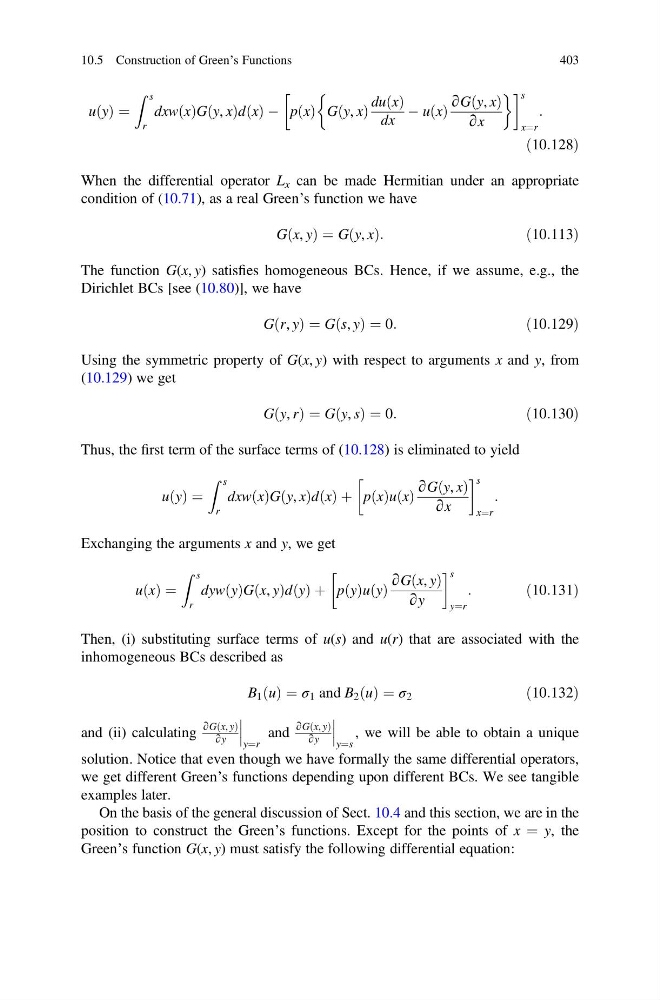
u y
ð Þ ¼
Z s
r
dxw x
ð ÞG y, x
ð Þd x
ð Þ À p x
ð Þ G y, x
ð Þ
du x
ð Þ
dx
À u x
ð Þ
∂G y, x
ð Þ
∂x
&
' ! s
x¼r
:
ð10:128Þ
When the differential operator L x can be made Hermitian under an appropriate
condition of (10.71), as a real Green’s function we have
G x, y
ð Þ ¼ G y, x
ð Þ:
ð10:113Þ
The function G(x, y) satisfies homogeneous BCs. Hence, if we assume, e.g., the
Dirichlet BCs [see (10.80)], we have
G r, y
ð Þ ¼ G s, y
ð Þ ¼ 0:
ð10:129Þ
Using the symmetric property of G(x, y) with respect to arguments x and y, from
(10.129) we get
G y, r
ð Þ ¼ G y, s
ð Þ ¼ 0:
ð10:130Þ
Thus, the first term of the surface terms of (10.128) is eliminated to yield
u y
ð Þ ¼
Z s
r
dxw x
ð ÞG y, x
ð Þd x
ð Þ þ p x
ð Þu x
ð Þ
∂G y, x
ð Þ
∂x
! s
x¼r
:
Exchanging the arguments x and y, we get
u x
ð Þ ¼
Z s
r
dyw y
ð ÞG x, y
ð Þd y
ð Þ þ p y
ð Þu y
ð Þ
∂G x, y
ð Þ
∂y
! s
y¼r
:
ð10:131Þ
Then, (i) substituting surface terms of u(s) and u(r) that are associated with the
inhomogeneous BCs described as
B 1 u
ð Þ ¼ σ 1 and B 2 u
ð Þ ¼ σ 2
ð10:132Þ
and (ii) calculating
∂G x, y
ð Þ
∂y
y¼r
and
∂G x, y
ð Þ
∂y
y¼s
, we will be able to obtain a unique
solution. Notice that even though we have formally the same differential operators,
we get different Green’s functions depending upon different BCs. We see tangible
examples later.
On the basis of the general discussion of Sect. 10.4 and this section, we are in the
position to construct the Green’s functions. Except for the points of x ¼ y, the
Green’s function G(x, y) must satisfy the following differential equation:
10.5 Construction of Green’s Functions
403
ð Þ ¼
Z s
r
dxw x
ð ÞG y, x
ð Þd x
ð Þ À p x
ð Þ G y, x
ð Þ
du x
ð Þ
dx
À u x
ð Þ
∂G y, x
ð Þ
∂x
&
' ! s
x¼r
:
ð10:128Þ
When the differential operator L x can be made Hermitian under an appropriate
condition of (10.71), as a real Green’s function we have
G x, y
ð Þ ¼ G y, x
ð Þ:
ð10:113Þ
The function G(x, y) satisfies homogeneous BCs. Hence, if we assume, e.g., the
Dirichlet BCs [see (10.80)], we have
G r, y
ð Þ ¼ G s, y
ð Þ ¼ 0:
ð10:129Þ
Using the symmetric property of G(x, y) with respect to arguments x and y, from
(10.129) we get
G y, r
ð Þ ¼ G y, s
ð Þ ¼ 0:
ð10:130Þ
Thus, the first term of the surface terms of (10.128) is eliminated to yield
u y
ð Þ ¼
Z s
r
dxw x
ð ÞG y, x
ð Þd x
ð Þ þ p x
ð Þu x
ð Þ
∂G y, x
ð Þ
∂x
! s
x¼r
:
Exchanging the arguments x and y, we get
u x
ð Þ ¼
Z s
r
dyw y
ð ÞG x, y
ð Þd y
ð Þ þ p y
ð Þu y
ð Þ
∂G x, y
ð Þ
∂y
! s
y¼r
:
ð10:131Þ
Then, (i) substituting surface terms of u(s) and u(r) that are associated with the
inhomogeneous BCs described as
B 1 u
ð Þ ¼ σ 1 and B 2 u
ð Þ ¼ σ 2
ð10:132Þ
and (ii) calculating
∂G x, y
ð Þ
∂y
y¼r
and
∂G x, y
ð Þ
∂y
y¼s
, we will be able to obtain a unique
solution. Notice that even though we have formally the same differential operators,
we get different Green’s functions depending upon different BCs. We see tangible
examples later.
On the basis of the general discussion of Sect. 10.4 and this section, we are in the
position to construct the Green’s functions. Except for the points of x ¼ y, the
Green’s function G(x, y) must satisfy the following differential equation:
10.5 Construction of Green’s Functions
403