

a x
ð Þ
d
2 u
dx 2 þ b x
ð Þ
du
dx
þ c x
ð Þu ¼ d x
ð Þ,
ð10:2Þ
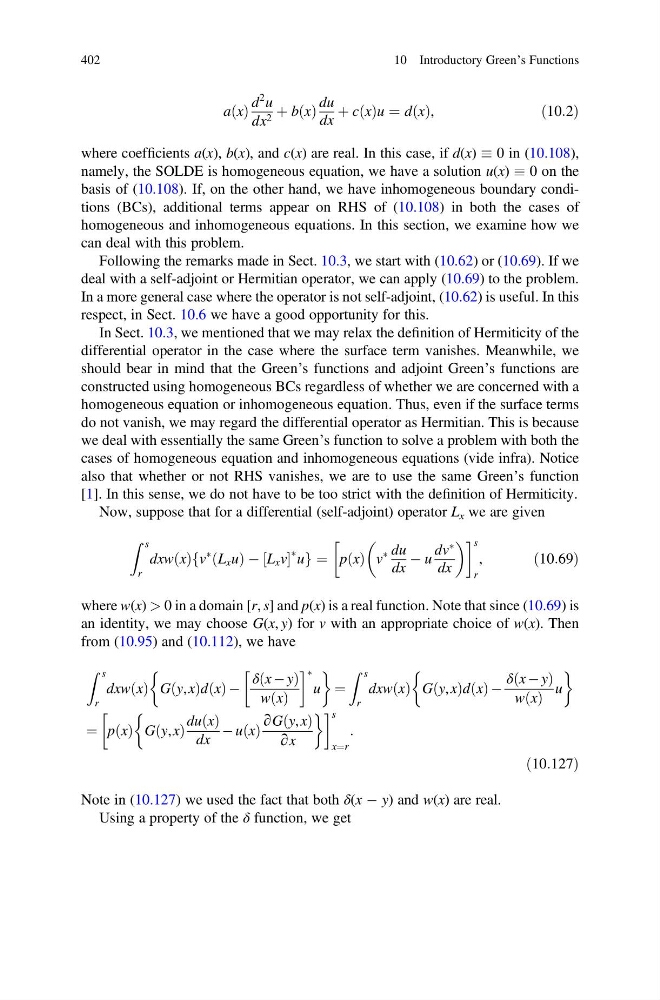
where coefficients a(x), b(x), and c(x) are real. In this case, if d(x) 0 in (10.108),
namely, the SOLDE is homogeneous equation, we have a solution u(x) 0 on the
basis of (10.108). If, on the other hand, we have inhomogeneous boundary conditions (BCs), additional terms appear on RHS of (10.108) in both the cases of
homogeneous and inhomogeneous equations. In this section, we examine how we
can deal with this problem.
Following the remarks made in Sect. 10.3, we start with (10.62) or (10.69). If we
deal with a self-adjoint or Hermitian operator, we can apply (10.69) to the problem.
In a more general case where the operator is not self-adjoint, (10.62) is useful. In this
respect, in Sect. 10.6 we have a good opportunity for this.
In Sect. 10.3, we mentioned that we may relax the definition of Hermiticity of the
differential operator in the case where the surface term vanishes. Meanwhile, we
should bear in mind that the Green’s functions and adjoint Green’s functions are
constructed using homogeneous BCs regardless of whether we are concerned with a
homogeneous equation or inhomogeneous equation. Thus, even if the surface terms
do not vanish, we may regard the differential operator as Hermitian. This is because
we deal with essentially the same Green’s function to solve a problem with both the
cases of homogeneous equation and inhomogeneous equations (vide infra). Notice
also that whether or not RHS vanishes, we are to use the same Green’s function
[1]. In this sense, we do not have to be too strict with the definition of Hermiticity.
Now, suppose that for a differential (self-adjoint) operator L x we are given
Z s
r
dxw x
ð Þ v
à L x u
ð ÞÀ L x v
½
à u
f
g ¼ p x
ð Þ v
à du
dx
À u
dv
Ã
dx
! s
r
,
ð10:69Þ
where w(x) > 0 in a domain [r, s] and p(x) is a real function. Note that since (10.69) is
an identity, we may choose G(x, y) for v with an appropriate choice of w(x). Then
from (10.95) and (10.112), we have
Z s
r
dxw x
ð Þ G y,x
ð Þd x
ð ÞÀ
δ x À y
ð
Þ
w x
ð Þ
! Ã
u
&
'
¼
Z s
r
dxw x
ð Þ G y, x
ð Þd x
ð ÞÀ
δ x À y
ð
Þ
w x
ð Þ
u
&
'
¼ p x
ð Þ G y,x
ð Þ
du x
ð Þ
dx
À u x
ð Þ
∂G y, x
ð Þ
∂x
&
' ! s
x¼r
:
ð10:127Þ
Note in (10.127) we used the fact that both δ(x À y) and w(x) are real.
Using a property of the δ function, we get
402
10 Introductory Green’s Functions
ð Þ
d
2 u
dx 2 þ b x
ð Þ
du
dx
þ c x
ð Þu ¼ d x
ð Þ,
ð10:2Þ
where coefficients a(x), b(x), and c(x) are real. In this case, if d(x) 0 in (10.108),
namely, the SOLDE is homogeneous equation, we have a solution u(x) 0 on the
basis of (10.108). If, on the other hand, we have inhomogeneous boundary conditions (BCs), additional terms appear on RHS of (10.108) in both the cases of
homogeneous and inhomogeneous equations. In this section, we examine how we
can deal with this problem.
Following the remarks made in Sect. 10.3, we start with (10.62) or (10.69). If we
deal with a self-adjoint or Hermitian operator, we can apply (10.69) to the problem.
In a more general case where the operator is not self-adjoint, (10.62) is useful. In this
respect, in Sect. 10.6 we have a good opportunity for this.
In Sect. 10.3, we mentioned that we may relax the definition of Hermiticity of the
differential operator in the case where the surface term vanishes. Meanwhile, we
should bear in mind that the Green’s functions and adjoint Green’s functions are
constructed using homogeneous BCs regardless of whether we are concerned with a
homogeneous equation or inhomogeneous equation. Thus, even if the surface terms
do not vanish, we may regard the differential operator as Hermitian. This is because
we deal with essentially the same Green’s function to solve a problem with both the
cases of homogeneous equation and inhomogeneous equations (vide infra). Notice
also that whether or not RHS vanishes, we are to use the same Green’s function
[1]. In this sense, we do not have to be too strict with the definition of Hermiticity.
Now, suppose that for a differential (self-adjoint) operator L x we are given
Z s
r
dxw x
ð Þ v
à L x u
ð ÞÀ L x v
½
à u
f
g ¼ p x
ð Þ v
à du
dx
À u
dv
Ã
dx
! s
r
,
ð10:69Þ
where w(x) > 0 in a domain [r, s] and p(x) is a real function. Note that since (10.69) is
an identity, we may choose G(x, y) for v with an appropriate choice of w(x). Then
from (10.95) and (10.112), we have
Z s
r
dxw x
ð Þ G y,x
ð Þd x
ð ÞÀ
δ x À y
ð
Þ
w x
ð Þ
! Ã
u
&
'
¼
Z s
r
dxw x
ð Þ G y, x
ð Þd x
ð ÞÀ
δ x À y
ð
Þ
w x
ð Þ
u
&
'
¼ p x
ð Þ G y,x
ð Þ
du x
ð Þ
dx
À u x
ð Þ
∂G y, x
ð Þ
∂x
&
' ! s
x¼r
:
ð10:127Þ
Note in (10.127) we used the fact that both δ(x À y) and w(x) are real.
Using a property of the δ function, we get
402
10 Introductory Green’s Functions