

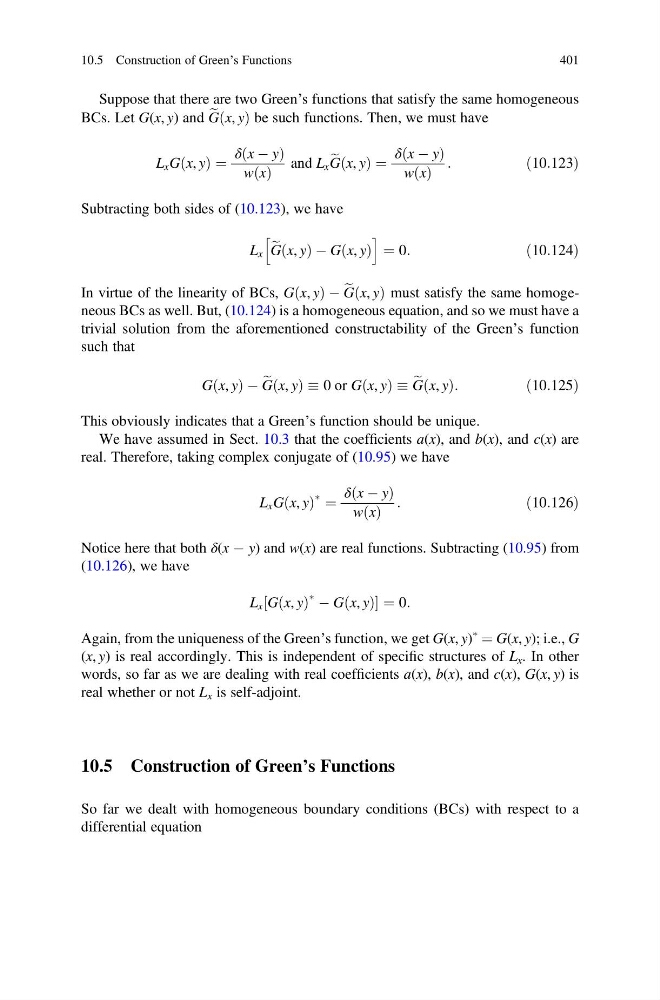
Suppose that there are two Green’s functions that satisfy the same homogeneous
BCs. Let G(x, y) and e
G x, y
ð Þ be such functions. Then, we must have
L x G x, y
ð Þ ¼
δ x À y
ð
Þ
w x
ð Þ
and L x e
G x, y
ð Þ ¼
δ x À y
ð
Þ
w x
ð Þ
:
ð10:123Þ
Subtracting both sides of (10.123), we have
L x e
G x, y
ð ÞÀG x, y
ð Þ
h
i
¼ 0:
ð10:124Þ
In virtue of the linearity of BCs, G x, y
ð ÞÀ e
G x, y
ð Þ must satisfy the same homogeneous BCs as well. But, (10.124) is a homogeneous equation, and so we must have a
trivial solution from the aforementioned constructability of the Green’s function
such that
G x, y
ð ÞÀ e
G x, y
ð Þ 0 or G x, y
ð Þ e
G x, y
ð Þ:
ð10:125Þ
This obviously indicates that a Green’s function should be unique.
We have assumed in Sect. 10.3 that the coefficients a(x), and b(x), and c(x) are
real. Therefore, taking complex conjugate of (10.95) we have
L x G x, y
ð Þ
à ¼
δ x À y
ð
Þ
w x
ð Þ
:
ð10:126Þ
Notice here that both δ(x À y) and w(x) are real functions. Subtracting (10.95) from
(10.126), we have
L x G x, y
ð Þ
à À G x, y
ð Þ
½
¼ 0:
Again, from the uniqueness of the Green’s function, we get G(x, y)
à ¼ G(x, y); i.e., G
(x, y) is real accordingly. This is independent of specific structures of L x . In other
words, so far as we are dealing with real coefficients a(x), b(x), and c(x), G(x, y) is
real whether or not L x is self-adjoint.
10.5 Construction of Green’s Functions
So far we dealt with homogeneous boundary conditions (BCs) with respect to a
differential equation
10.5 Construction of Green’s Functions
401
BCs. Let G(x, y) and e
G x, y
ð Þ be such functions. Then, we must have
L x G x, y
ð Þ ¼
δ x À y
ð
Þ
w x
ð Þ
and L x e
G x, y
ð Þ ¼
δ x À y
ð
Þ
w x
ð Þ
:
ð10:123Þ
Subtracting both sides of (10.123), we have
L x e
G x, y
ð ÞÀG x, y
ð Þ
h
i
¼ 0:
ð10:124Þ
In virtue of the linearity of BCs, G x, y
ð ÞÀ e
G x, y
ð Þ must satisfy the same homogeneous BCs as well. But, (10.124) is a homogeneous equation, and so we must have a
trivial solution from the aforementioned constructability of the Green’s function
such that
G x, y
ð ÞÀ e
G x, y
ð Þ 0 or G x, y
ð Þ e
G x, y
ð Þ:
ð10:125Þ
This obviously indicates that a Green’s function should be unique.
We have assumed in Sect. 10.3 that the coefficients a(x), and b(x), and c(x) are
real. Therefore, taking complex conjugate of (10.95) we have
L x G x, y
ð Þ
à ¼
δ x À y
ð
Þ
w x
ð Þ
:
ð10:126Þ
Notice here that both δ(x À y) and w(x) are real functions. Subtracting (10.95) from
(10.126), we have
L x G x, y
ð Þ
à À G x, y
ð Þ
½
¼ 0:
Again, from the uniqueness of the Green’s function, we get G(x, y)
à ¼ G(x, y); i.e., G
(x, y) is real accordingly. This is independent of specific structures of L x . In other
words, so far as we are dealing with real coefficients a(x), b(x), and c(x), G(x, y) is
real whether or not L x is self-adjoint.
10.5 Construction of Green’s Functions
So far we dealt with homogeneous boundary conditions (BCs) with respect to a
differential equation
10.5 Construction of Green’s Functions
401