

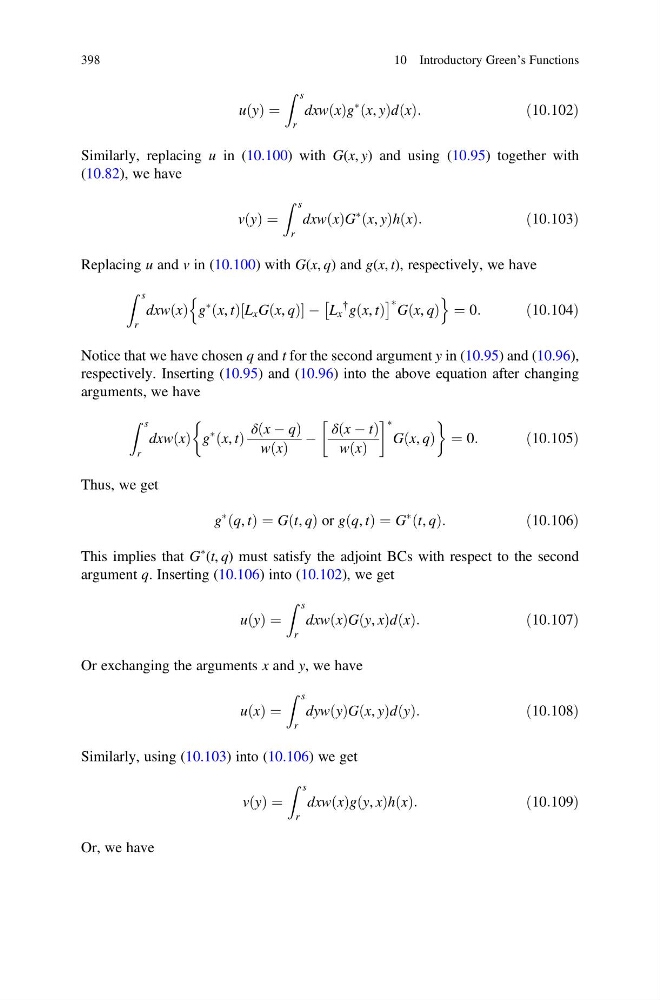
u y
ð Þ ¼
Z s
r
dxw x
ð Þg
à x, y
ð Þd x
ð Þ:
ð10:102Þ
Similarly, replacing u in (10.100) with G(x, y) and using (10.95) together with
(10.82), we have
v y
ð Þ ¼
Z s
r
dxw x
ð ÞG
à x, y
ð Þh x
ð Þ:
ð10:103Þ
Replacing u and v in (10.100) with G(x, q) and g(x, t), respectively, we have
Z s
r
dxw x
ð Þ g
à x, t
ð Þ L x G x, q
ð Þ
½
À L x
{ g x, t
ð Þ
Â
à à G x, q
ð Þ
n
o
¼ 0:
ð10:104Þ
Notice that we have chosen q and t for the second argument y in (10.95) and (10.96),
respectively. Inserting (10.95) and (10.96) into the above equation after changing
arguments, we have
Z s
r
dxw x
ð Þ g
à x, t
ð Þ
δ x À q
ð
Þ
w x
ð Þ
À
δ x À t
ð
Þ
w x
ð Þ
! Ã
G x, q
ð Þ
&
'
¼ 0:
ð10:105Þ
Thus, we get
g
à q, t
ð Þ ¼ G t, q
ð Þ or g q, t
ð Þ ¼ G
à t, q
ð Þ:
ð10:106Þ
This implies that G
à (t, q) must satisfy the adjoint BCs with respect to the second
argument q. Inserting (10.106) into (10.102), we get
u y
ð Þ ¼
Z s
r
dxw x
ð ÞG y, x
ð Þd x
ð Þ:
ð10:107Þ
Or exchanging the arguments x and y, we have
u x
ð Þ ¼
Z s
r
dyw y
ð ÞG x, y
ð Þd y
ð Þ:
ð10:108Þ
Similarly, using (10.103) into (10.106) we get
v y
ð Þ ¼
Z s
r
dxw x
ð Þg y, x
ð Þh x
ð Þ:
ð10:109Þ
Or, we have
398
10 Introductory Green’s Functions
ð Þ ¼
Z s
r
dxw x
ð Þg
à x, y
ð Þd x
ð Þ:
ð10:102Þ
Similarly, replacing u in (10.100) with G(x, y) and using (10.95) together with
(10.82), we have
v y
ð Þ ¼
Z s
r
dxw x
ð ÞG
à x, y
ð Þh x
ð Þ:
ð10:103Þ
Replacing u and v in (10.100) with G(x, q) and g(x, t), respectively, we have
Z s
r
dxw x
ð Þ g
à x, t
ð Þ L x G x, q
ð Þ
½
À L x
{ g x, t
ð Þ
Â
à à G x, q
ð Þ
n
o
¼ 0:
ð10:104Þ
Notice that we have chosen q and t for the second argument y in (10.95) and (10.96),
respectively. Inserting (10.95) and (10.96) into the above equation after changing
arguments, we have
Z s
r
dxw x
ð Þ g
à x, t
ð Þ
δ x À q
ð
Þ
w x
ð Þ
À
δ x À t
ð
Þ
w x
ð Þ
! Ã
G x, q
ð Þ
&
'
¼ 0:
ð10:105Þ
Thus, we get
g
à q, t
ð Þ ¼ G t, q
ð Þ or g q, t
ð Þ ¼ G
à t, q
ð Þ:
ð10:106Þ
This implies that G
à (t, q) must satisfy the adjoint BCs with respect to the second
argument q. Inserting (10.106) into (10.102), we get
u y
ð Þ ¼
Z s
r
dxw x
ð ÞG y, x
ð Þd x
ð Þ:
ð10:107Þ
Or exchanging the arguments x and y, we have
u x
ð Þ ¼
Z s
r
dyw y
ð ÞG x, y
ð Þd y
ð Þ:
ð10:108Þ
Similarly, using (10.103) into (10.106) we get
v y
ð Þ ¼
Z s
r
dxw x
ð Þg y, x
ð Þh x
ð Þ:
ð10:109Þ
Or, we have
398
10 Introductory Green’s Functions