

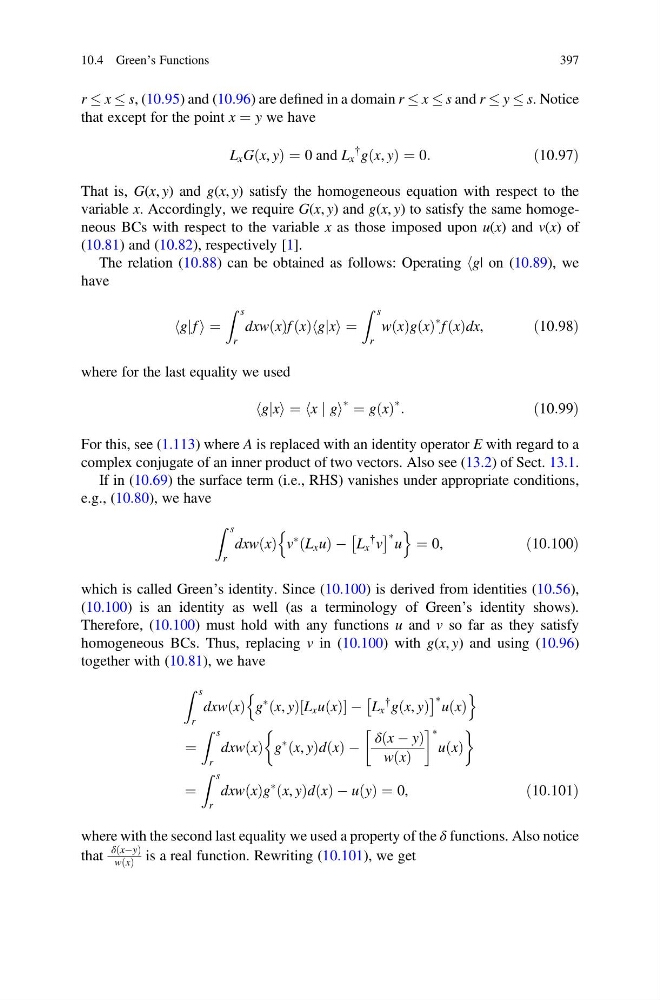
r x s, (10.95) and (10.96) are defined in a domain r x s and r y s. Notice
that except for the point x ¼ y we have
L x G x, y
ð Þ ¼ 0 and L x
{ g x, y
ð Þ ¼ 0:
ð10:97Þ
That is, G(x, y) and g(x, y) satisfy the homogeneous equation with respect to the
variable x. Accordingly, we require G(x, y) and g(x, y) to satisfy the same homogeneous BCs with respect to the variable x as those imposed upon u(x) and v(x) of
(10.81) and (10.82), respectively [1].
The relation (10.88) can be obtained as follows: Operating hg| on (10.89), we
have
gjf
h i ¼
Z s
r
dxw x
ð Þf x
ð Þ gjx
h i ¼
Z s
r
w x
ð Þg x
ð Þ
à f x
ð Þdx,
ð10:98Þ
where for the last equality we used
gjx
h i ¼ x
h j gi
à ¼ g x
ð Þ
à :
ð10:99Þ
For this, see (1.113) where A is replaced with an identity operator E with regard to a
complex conjugate of an inner product of two vectors. Also see (13.2) of Sect. 13.1.
If in (10.69) the surface term (i.e., RHS) vanishes under appropriate conditions,
e.g., (10.80), we have
Z s
r
dxw x
ð Þ v
à L x u
ð ÞÀ L x
{ v
Â
à à u
n
o
¼ 0,
ð10:100Þ
which is called Green’s identity. Since (10.100) is derived from identities (10.56),
(10.100) is an identity as well (as a terminology of Green’s identity shows).
Therefore, (10.100) must hold with any functions u and v so far as they satisfy
homogeneous BCs. Thus, replacing v in (10.100) with g(x, y) and using (10.96)
together with (10.81), we have
Z s
r
dxw x
ð Þ g
à x, y
ð Þ L x u x
ð Þ
½
À L x
{ g x, y
ð Þ
Â
à à u x
ð Þ
n
o
¼
Z s
r
dxw x
ð Þ g
à x, y
ð Þd x
ð Þ À
δ x À y
ð
Þ
w x
ð Þ
! Ã
u x
ð Þ
&
'
¼
Z s
r
dxw x
ð Þg
à x, y
ð Þd x
ð Þ À u y
ð Þ ¼ 0,
ð10:101Þ
where with the second last equality we used a property of the δ functions. Also notice
that
δ xÀy
ð
Þ
w x
ð Þ is a real function. Rewriting (10.101), we get
10.4 Green’s Functions
397
that except for the point x ¼ y we have
L x G x, y
ð Þ ¼ 0 and L x
{ g x, y
ð Þ ¼ 0:
ð10:97Þ
That is, G(x, y) and g(x, y) satisfy the homogeneous equation with respect to the
variable x. Accordingly, we require G(x, y) and g(x, y) to satisfy the same homogeneous BCs with respect to the variable x as those imposed upon u(x) and v(x) of
(10.81) and (10.82), respectively [1].
The relation (10.88) can be obtained as follows: Operating hg| on (10.89), we
have
gjf
h i ¼
Z s
r
dxw x
ð Þf x
ð Þ gjx
h i ¼
Z s
r
w x
ð Þg x
ð Þ
à f x
ð Þdx,
ð10:98Þ
where for the last equality we used
gjx
h i ¼ x
h j gi
à ¼ g x
ð Þ
à :
ð10:99Þ
For this, see (1.113) where A is replaced with an identity operator E with regard to a
complex conjugate of an inner product of two vectors. Also see (13.2) of Sect. 13.1.
If in (10.69) the surface term (i.e., RHS) vanishes under appropriate conditions,
e.g., (10.80), we have
Z s
r
dxw x
ð Þ v
à L x u
ð ÞÀ L x
{ v
Â
à à u
n
o
¼ 0,
ð10:100Þ
which is called Green’s identity. Since (10.100) is derived from identities (10.56),
(10.100) is an identity as well (as a terminology of Green’s identity shows).
Therefore, (10.100) must hold with any functions u and v so far as they satisfy
homogeneous BCs. Thus, replacing v in (10.100) with g(x, y) and using (10.96)
together with (10.81), we have
Z s
r
dxw x
ð Þ g
à x, y
ð Þ L x u x
ð Þ
½
À L x
{ g x, y
ð Þ
Â
à à u x
ð Þ
n
o
¼
Z s
r
dxw x
ð Þ g
à x, y
ð Þd x
ð Þ À
δ x À y
ð
Þ
w x
ð Þ
! Ã
u x
ð Þ
&
'
¼
Z s
r
dxw x
ð Þg
à x, y
ð Þd x
ð Þ À u y
ð Þ ¼ 0,
ð10:101Þ
where with the second last equality we used a property of the δ functions. Also notice
that
δ xÀy
ð
Þ
w x
ð Þ is a real function. Rewriting (10.101), we get
10.4 Green’s Functions
397