

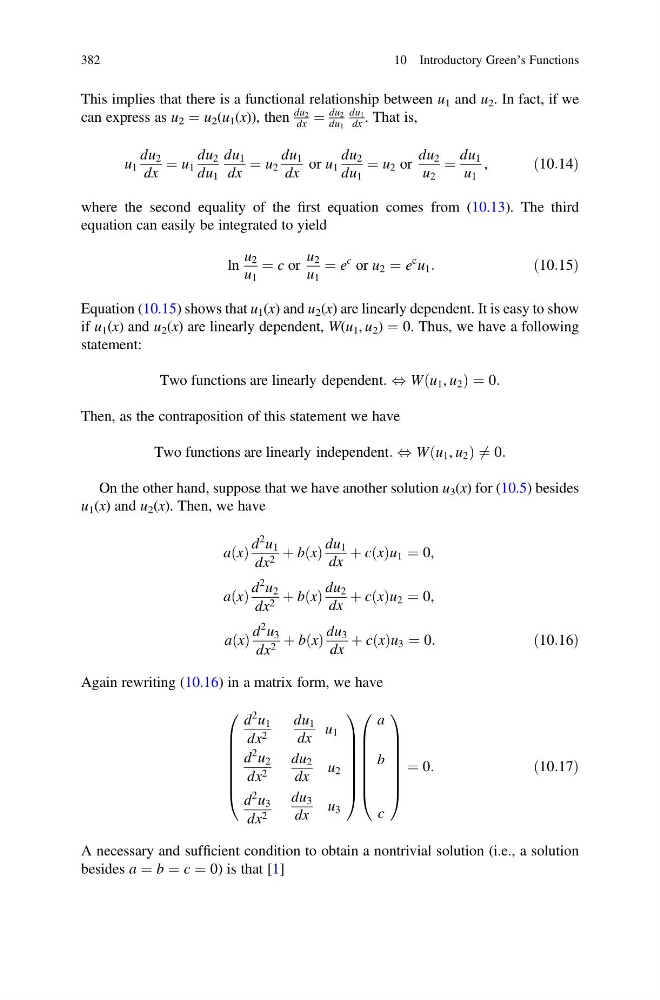
This implies that there is a functional relationship between u 1 and u 2 . In fact, if we
can express as u 2 ¼ u 2 (u 1 (x)), then
du 2
dx ¼
du 2
du 1
du 1
dx . That is,
u 1
du 2
dx
¼ u 1
du 2
du 1
du 1
dx
¼ u 2
du 1
dx
or u 1
du 2
du 1
¼ u 2 or
du 2
u 2
¼
du 1
u 1
,
ð10:14Þ
where the second equality of the first equation comes from (10.13). The third
equation can easily be integrated to yield
ln
u 2
u 1
¼ c or
u 2
u 1
¼ e
c or u 2 ¼ e
c u 1 :
ð10:15Þ
Equation (10.15) shows that u 1 (x) and u 2 (x) are linearly dependent. It is easy to show
if u 1 (x) and u 2 (x) are linearly dependent, W(u 1 , u 2 ) ¼ 0. Thus, we have a following
statement:
Two functions are linearly dependent: , W u 1 , u 2
ð
Þ¼0:
Then, as the contraposition of this statement we have
Two functions are linearly independent: , W u 1 , u 2
ð
Þ6 ¼ 0:
On the other hand, suppose that we have another solution u 3 (x) for (10.5) besides
u 1 (x) and u 2 (x). Then, we have
a x
ð Þ
d
2 u 1
dx 2 þ b x
ð Þ
du 1
dx
þ c x
ð Þu 1 ¼ 0,
a x
ð Þ
d
2 u 2
dx 2 þ b x
ð Þ
du 2
dx
þ c x
ð Þu 2 ¼ 0,
a x
ð Þ
d
2 u 3
dx 2 þ b x
ð Þ
du 3
dx
þ c x
ð Þu 3 ¼ 0:
ð10:16Þ
Again rewriting (10.16) in a matrix form, we have
d
2 u 1
dx 2
du 1
dx
u 1
d
2 u 2
dx 2
d
2 u 3
dx 2
du 2
dx
u 2
du 3
dx
u 3
0
B
B
B
B
B
B
@
1
C
C
C
C
C
C
A
a
b
c
0
B
B
B
B
B
B
@
1
C
C
C
C
C
C
A
¼ 0:
ð10:17Þ
A necessary and sufficient condition to obtain a nontrivial solution (i.e., a solution
besides a ¼ b ¼ c ¼ 0) is that [1]
382
10 Introductory Green’s Functions
can express as u 2 ¼ u 2 (u 1 (x)), then
du 2
dx ¼
du 2
du 1
du 1
dx . That is,
u 1
du 2
dx
¼ u 1
du 2
du 1
du 1
dx
¼ u 2
du 1
dx
or u 1
du 2
du 1
¼ u 2 or
du 2
u 2
¼
du 1
u 1
,
ð10:14Þ
where the second equality of the first equation comes from (10.13). The third
equation can easily be integrated to yield
ln
u 2
u 1
¼ c or
u 2
u 1
¼ e
c or u 2 ¼ e
c u 1 :
ð10:15Þ
Equation (10.15) shows that u 1 (x) and u 2 (x) are linearly dependent. It is easy to show
if u 1 (x) and u 2 (x) are linearly dependent, W(u 1 , u 2 ) ¼ 0. Thus, we have a following
statement:
Two functions are linearly dependent: , W u 1 , u 2
ð
Þ¼0:
Then, as the contraposition of this statement we have
Two functions are linearly independent: , W u 1 , u 2
ð
Þ6 ¼ 0:
On the other hand, suppose that we have another solution u 3 (x) for (10.5) besides
u 1 (x) and u 2 (x). Then, we have
a x
ð Þ
d
2 u 1
dx 2 þ b x
ð Þ
du 1
dx
þ c x
ð Þu 1 ¼ 0,
a x
ð Þ
d
2 u 2
dx 2 þ b x
ð Þ
du 2
dx
þ c x
ð Þu 2 ¼ 0,
a x
ð Þ
d
2 u 3
dx 2 þ b x
ð Þ
du 3
dx
þ c x
ð Þu 3 ¼ 0:
ð10:16Þ
Again rewriting (10.16) in a matrix form, we have
d
2 u 1
dx 2
du 1
dx
u 1
d
2 u 2
dx 2
d
2 u 3
dx 2
du 2
dx
u 2
du 3
dx
u 3
0
B
B
B
B
B
B
@
1
C
C
C
C
C
C
A
a
b
c
0
B
B
B
B
B
B
@
1
C
C
C
C
C
C
A
¼ 0:
ð10:17Þ
A necessary and sufficient condition to obtain a nontrivial solution (i.e., a solution
besides a ¼ b ¼ c ¼ 0) is that [1]
382
10 Introductory Green’s Functions