

d
2 u 1
dx 2
du 1
dx
u 1
d
2 u 2
dx 2
d
2 u 3
dx 2
du 2
dx
u 2
du 3
dx
u 3
¼ 0:
ð10:18Þ
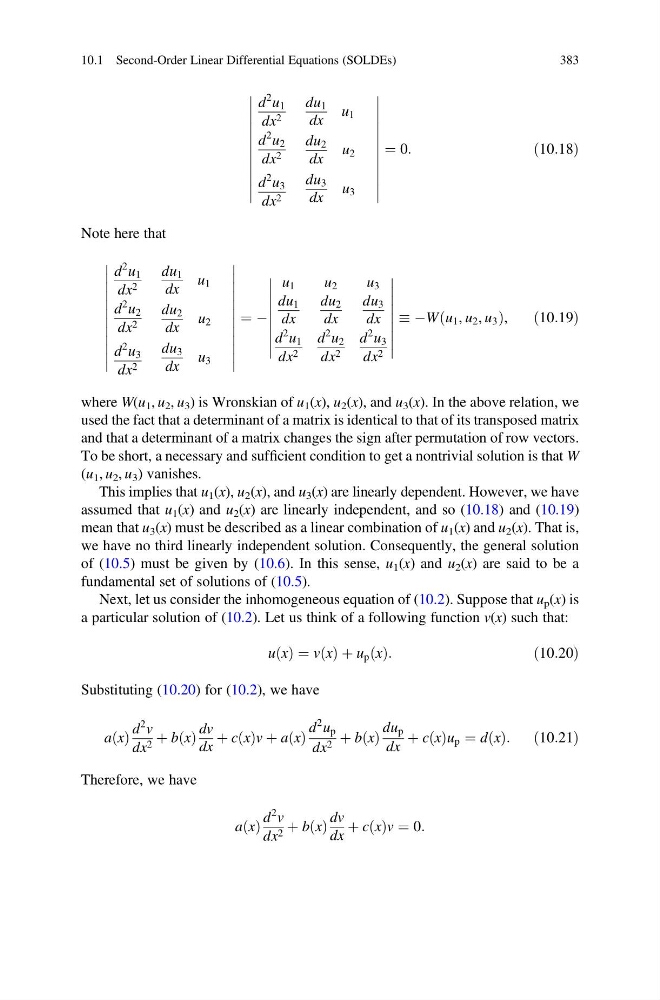
Note here that
d
2 u 1
dx 2
du 1
dx
u 1
d
2 u 2
dx 2
d
2 u 3
dx 2
du 2
dx
u 2
du 3
dx
u 3
¼ À
u 1
u 2
u 3
du 1
dx
du 2
dx
du 3
dx
d
2 u 1
dx 2
d
2 u 2
dx 2
d
2 u 3
dx 2
ÀW u 1 , u 2 , u 3
ð
Þ ,
ð10:19Þ
where W(u 1 , u 2 , u 3 ) is Wronskian of u 1 (x), u 2 (x), and u 3 (x). In the above relation, we
used the fact that a determinant of a matrix is identical to that of its transposed matrix
and that a determinant of a matrix changes the sign after permutation of row vectors.
To be short, a necessary and sufficient condition to get a nontrivial solution is that W
(u 1 , u 2 , u 3 ) vanishes.
This implies that u 1 (x), u 2 (x), and u 3 (x) are linearly dependent. However, we have
assumed that u 1 (x) and u 2 (x) are linearly independent, and so (10.18) and (10.19)
mean that u 3 (x) must be described as a linear combination of u 1 (x) and u 2 (x). That is,
we have no third linearly independent solution. Consequently, the general solution
of (10.5) must be given by (10.6). In this sense, u 1 (x) and u 2 (x) are said to be a
fundamental set of solutions of (10.5).
Next, let us consider the inhomogeneous equation of (10.2). Suppose that u p (x) is
a particular solution of (10.2). Let us think of a following function v(x) such that:
u x
ð Þ ¼ v x
ð Þ þ u p x
ð Þ:
ð10:20Þ
Substituting (10.20) for (10.2), we have
a x
ð Þ
d
2 v
dx 2 þ b x
ð Þ
dv
dx
þ c x
ð Þv þ a x
ð Þ
d
2 u p
dx 2 þ b x
ð Þ
du p
dx
þ c x
ð Þu p ¼ d x
ð Þ:
ð10:21Þ
Therefore, we have
a x
ð Þ
d
2 v
dx 2 þ b x
ð Þ
dv
dx
þ c x
ð Þv ¼ 0:
10.1 Second-Order Linear Differential Equations (SOLDEs)
383
2 u 1
dx 2
du 1
dx
u 1
d
2 u 2
dx 2
d
2 u 3
dx 2
du 2
dx
u 2
du 3
dx
u 3
¼ 0:
ð10:18Þ
Note here that
d
2 u 1
dx 2
du 1
dx
u 1
d
2 u 2
dx 2
d
2 u 3
dx 2
du 2
dx
u 2
du 3
dx
u 3
¼ À
u 1
u 2
u 3
du 1
dx
du 2
dx
du 3
dx
d
2 u 1
dx 2
d
2 u 2
dx 2
d
2 u 3
dx 2
ÀW u 1 , u 2 , u 3
ð
Þ ,
ð10:19Þ
where W(u 1 , u 2 , u 3 ) is Wronskian of u 1 (x), u 2 (x), and u 3 (x). In the above relation, we
used the fact that a determinant of a matrix is identical to that of its transposed matrix
and that a determinant of a matrix changes the sign after permutation of row vectors.
To be short, a necessary and sufficient condition to get a nontrivial solution is that W
(u 1 , u 2 , u 3 ) vanishes.
This implies that u 1 (x), u 2 (x), and u 3 (x) are linearly dependent. However, we have
assumed that u 1 (x) and u 2 (x) are linearly independent, and so (10.18) and (10.19)
mean that u 3 (x) must be described as a linear combination of u 1 (x) and u 2 (x). That is,
we have no third linearly independent solution. Consequently, the general solution
of (10.5) must be given by (10.6). In this sense, u 1 (x) and u 2 (x) are said to be a
fundamental set of solutions of (10.5).
Next, let us consider the inhomogeneous equation of (10.2). Suppose that u p (x) is
a particular solution of (10.2). Let us think of a following function v(x) such that:
u x
ð Þ ¼ v x
ð Þ þ u p x
ð Þ:
ð10:20Þ
Substituting (10.20) for (10.2), we have
a x
ð Þ
d
2 v
dx 2 þ b x
ð Þ
dv
dx
þ c x
ð Þv þ a x
ð Þ
d
2 u p
dx 2 þ b x
ð Þ
du p
dx
þ c x
ð Þu p ¼ d x
ð Þ:
ð10:21Þ
Therefore, we have
a x
ð Þ
d
2 v
dx 2 þ b x
ð Þ
dv
dx
þ c x
ð Þv ¼ 0:
10.1 Second-Order Linear Differential Equations (SOLDEs)
383