

a 1 f 1 x
ð Þ þ a 2 f 2 x
ð Þ þ Á Á Á þ a n f n x
ð Þ ¼ 0,
ð10:7Þ
where a 1 , a 2 , Á Á Á, and a n are constants. If a 1 ¼ a 2 ¼ Á Á Á ¼ a n ¼ 0, (10.7) always
holds. In this case, (10.7) is said to be a trivial linear relation. If f 1 (x), f 2 (x), Á Á Á, and
f n (x) satisfy a nontrivial linear relation, f 1 (x), f 2 (x), Á Á Á, and f n (x) are said to be linearly
dependent. That is, the nontrivial expression means that in (10.7) at least one of a 1 ,
a 2 , Á Á Á, and a n is nonzero. Suppose that a n 6 ¼ 0. Then, from (10.7), f n (x) is expressed
as
f n x
ð Þ ¼ À
a 1
a n
f 1 x
ð Þ À
a 2
a n
f 2 x
ð Þ À Á Á Á À
a nÀ1
a n
f nÀ1 x
ð Þ:
ð10:8Þ
If f 1 (x), f 2 (x), Á Á Á, and f n (x) are not linearly dependent, they are called linearly
independent. In other words, the statement that f 1 (x), f 2 (x), Á Á Á, and f n (x) are linearly
independent is equivalent to that (10.7) holds if and only if a 1 ¼ a 2 ¼ Á Á Á ¼ a n ¼ 0.
We will have relevant discussion in Part III.
Now suppose that with the above two linearly independent functions u 1 (x) and
u 2 (x), we have
a 1 u 1 x
ð Þ þ a 2 u 2 x
ð Þ ¼ 0:
ð10:9Þ
Differentiating (10.9), we have
a 1
du 1 x
ð Þ
dx
þ a 2
du 2 x
ð Þ
dx
¼ 0:
ð10:10Þ
Expressing (10.9) and (10.10) in a matrix form, we get
u 1 x
ð Þ
u 2 x
ð Þ
du 1 x
ð Þ
dx
du 2 x
ð Þ
dx
0
@
1
A
a 1
a 2
¼ 0:
ð10:11Þ
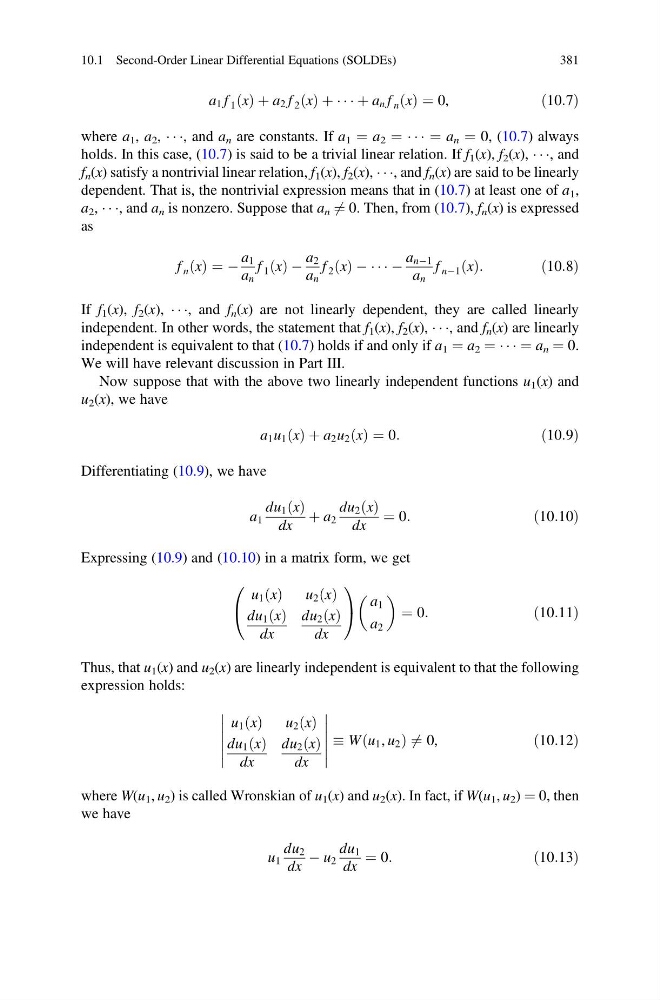
Thus, that u 1 (x) and u 2 (x) are linearly independent is equivalent to that the following
expression holds:
u 1 x
ð Þ
u 2 x
ð Þ
du 1 x
ð Þ
dx
du 2 x
ð Þ
dx
W u 1 , u 2
ð
Þ6 ¼ 0,
ð10:12Þ
where W(u 1 , u 2 ) is called Wronskian of u 1 (x) and u 2 (x). In fact, if W(u 1 , u 2 ) ¼ 0, then
we have
u 1
du 2
dx
À u 2
du 1
dx
¼ 0:
ð10:13Þ
10.1 Second-Order Linear Differential Equations (SOLDEs)
381
ð Þ þ a 2 f 2 x
ð Þ þ Á Á Á þ a n f n x
ð Þ ¼ 0,
ð10:7Þ
where a 1 , a 2 , Á Á Á, and a n are constants. If a 1 ¼ a 2 ¼ Á Á Á ¼ a n ¼ 0, (10.7) always
holds. In this case, (10.7) is said to be a trivial linear relation. If f 1 (x), f 2 (x), Á Á Á, and
f n (x) satisfy a nontrivial linear relation, f 1 (x), f 2 (x), Á Á Á, and f n (x) are said to be linearly
dependent. That is, the nontrivial expression means that in (10.7) at least one of a 1 ,
a 2 , Á Á Á, and a n is nonzero. Suppose that a n 6 ¼ 0. Then, from (10.7), f n (x) is expressed
as
f n x
ð Þ ¼ À
a 1
a n
f 1 x
ð Þ À
a 2
a n
f 2 x
ð Þ À Á Á Á À
a nÀ1
a n
f nÀ1 x
ð Þ:
ð10:8Þ
If f 1 (x), f 2 (x), Á Á Á, and f n (x) are not linearly dependent, they are called linearly
independent. In other words, the statement that f 1 (x), f 2 (x), Á Á Á, and f n (x) are linearly
independent is equivalent to that (10.7) holds if and only if a 1 ¼ a 2 ¼ Á Á Á ¼ a n ¼ 0.
We will have relevant discussion in Part III.
Now suppose that with the above two linearly independent functions u 1 (x) and
u 2 (x), we have
a 1 u 1 x
ð Þ þ a 2 u 2 x
ð Þ ¼ 0:
ð10:9Þ
Differentiating (10.9), we have
a 1
du 1 x
ð Þ
dx
þ a 2
du 2 x
ð Þ
dx
¼ 0:
ð10:10Þ
Expressing (10.9) and (10.10) in a matrix form, we get
u 1 x
ð Þ
u 2 x
ð Þ
du 1 x
ð Þ
dx
du 2 x
ð Þ
dx
0
@
1
A
a 1
a 2
¼ 0:
ð10:11Þ
Thus, that u 1 (x) and u 2 (x) are linearly independent is equivalent to that the following
expression holds:
u 1 x
ð Þ
u 2 x
ð Þ
du 1 x
ð Þ
dx
du 2 x
ð Þ
dx
W u 1 , u 2
ð
Þ6 ¼ 0,
ð10:12Þ
where W(u 1 , u 2 ) is called Wronskian of u 1 (x) and u 2 (x). In fact, if W(u 1 , u 2 ) ¼ 0, then
we have
u 1
du 2
dx
À u 2
du 1
dx
¼ 0:
ð10:13Þ
10.1 Second-Order Linear Differential Equations (SOLDEs)
381