

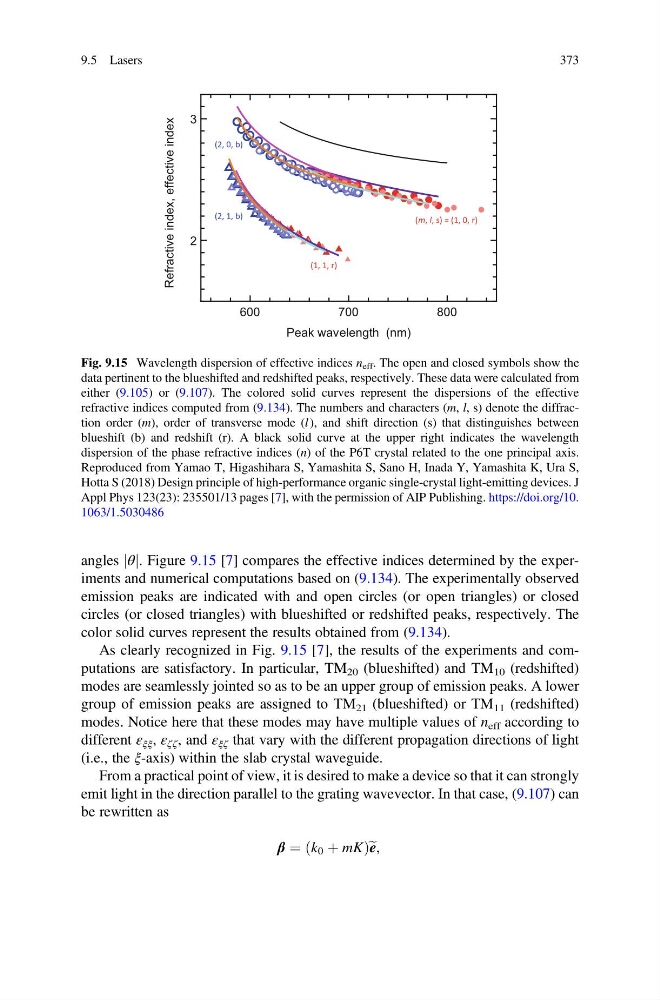
angles jθj. Figure 9.15 [7] compares the effective indices determined by the experiments and numerical computations based on (9.134). The experimentally observed
emission peaks are indicated with and open circles (or open triangles) or closed
circles (or closed triangles) with blueshifted or redshifted peaks, respectively. The
color solid curves represent the results obtained from (9.134).
As clearly recognized in Fig. 9.15 [7], the results of the experiments and computations are satisfactory. In particular, TM 20 (blueshifted) and TM 10 (redshifted)
modes are seamlessly jointed so as to be an upper group of emission peaks. A lower
group of emission peaks are assigned to TM 21 (blueshifted) or TM 11 (redshifted)
modes. Notice here that these modes may have multiple values of n eff according to
different ε ξξ , ε ζζ , and ε ξζ that vary with the different propagation directions of light
(i.e., the ξ-axis) within the slab crystal waveguide.
From a practical point of view, it is desired to make a device so that it can strongly
emit light in the direction parallel to the grating wavevector. In that case, (9.107) can
be rewritten as
β ¼ k 0 þ mK
ð
Þ e e,
600
700
800
2
3
Refractive index, effective index
Peak wavelength (nm)
(m, l, s) = (1, 0, r)
(1, 1, r)
(2, 0, b)
(2, 1, b)
Fig. 9.15 Wavelength dispersion of effective indices n eff . The open and closed symbols show the
data pertinent to the blueshifted and redshifted peaks, respectively. These data were calculated from
either (9.105) or (9.107). The colored solid curves represent the dispersions of the effective
refractive indices computed from (9.134). The numbers and characters (m, l, s) denote the diffraction order (m), order of transverse mode (l ), and shift direction (s) that distinguishes between
blueshift (b) and redshift (r). A black solid curve at the upper right indicates the wavelength
dispersion of the phase refractive indices (n) of the P6T crystal related to the one principal axis.
Reproduced from Yamao T, Higashihara S, Yamashita S, Sano H, Inada Y, Yamashita K, Ura S,
Hotta S (2018) Design principle of high-performance organic single-crystal light-emitting devices. J
Appl Phys 123(23): 235501/13 pages [7], with the permission of AIP Publishing. https://doi.org/10.
1063/1.5030486
9.5 Lasers
373
emission peaks are indicated with and open circles (or open triangles) or closed
circles (or closed triangles) with blueshifted or redshifted peaks, respectively. The
color solid curves represent the results obtained from (9.134).
As clearly recognized in Fig. 9.15 [7], the results of the experiments and computations are satisfactory. In particular, TM 20 (blueshifted) and TM 10 (redshifted)
modes are seamlessly jointed so as to be an upper group of emission peaks. A lower
group of emission peaks are assigned to TM 21 (blueshifted) or TM 11 (redshifted)
modes. Notice here that these modes may have multiple values of n eff according to
different ε ξξ , ε ζζ , and ε ξζ that vary with the different propagation directions of light
(i.e., the ξ-axis) within the slab crystal waveguide.
From a practical point of view, it is desired to make a device so that it can strongly
emit light in the direction parallel to the grating wavevector. In that case, (9.107) can
be rewritten as
β ¼ k 0 þ mK
ð
Þ e e,
600
700
800
2
3
Refractive index, effective index
Peak wavelength (nm)
(m, l, s) = (1, 0, r)
(1, 1, r)
(2, 0, b)
(2, 1, b)
Fig. 9.15 Wavelength dispersion of effective indices n eff . The open and closed symbols show the
data pertinent to the blueshifted and redshifted peaks, respectively. These data were calculated from
either (9.105) or (9.107). The colored solid curves represent the dispersions of the effective
refractive indices computed from (9.134). The numbers and characters (m, l, s) denote the diffraction order (m), order of transverse mode (l ), and shift direction (s) that distinguishes between
blueshift (b) and redshift (r). A black solid curve at the upper right indicates the wavelength
dispersion of the phase refractive indices (n) of the P6T crystal related to the one principal axis.
Reproduced from Yamao T, Higashihara S, Yamashita S, Sano H, Inada Y, Yamashita K, Ura S,
Hotta S (2018) Design principle of high-performance organic single-crystal light-emitting devices. J
Appl Phys 123(23): 235501/13 pages [7], with the permission of AIP Publishing. https://doi.org/10.
1063/1.5030486
9.5 Lasers
373