

β
2
þ m
2 K
2
À 2mKβ cos φ ¼ k 0
2 ,
ð9:135Þ
where φ is an angle between mK and β (see Fig. 9.11). Inserting (9.104) into (9.135)
and solving the quadratic equation, we obtain n eff as a function of k 0 (or emission
wavelength). This implies that we can determine n eff from the experimental data.
Yet, the above process does not mean that we can determine n eff uniquely. It is
because there is still room for choice of a positive integer m. Using (9.125) that
restricts the values n eff , however, we can decide the most probable integer m. Thus,
we can compare n eff obtained from (9.134) with n eff determined from the
experiments.
As described above, we have explained two major factors of the out-coupling of
emission. In the above discussion, we assumed that the TM modes dominate.
Combining (9.107) and (9.134), we successfully assign individual emissions to the
specific TM ml modes, in which the indices m and l are longitudinal and transverse
modes with m associated with the grating. Note that m ! 1 and l ! 0. With the index
l, l ¼ 0 is allowed because the total internal reflection (Sects. 8.5 and 8.6) is
responsible.
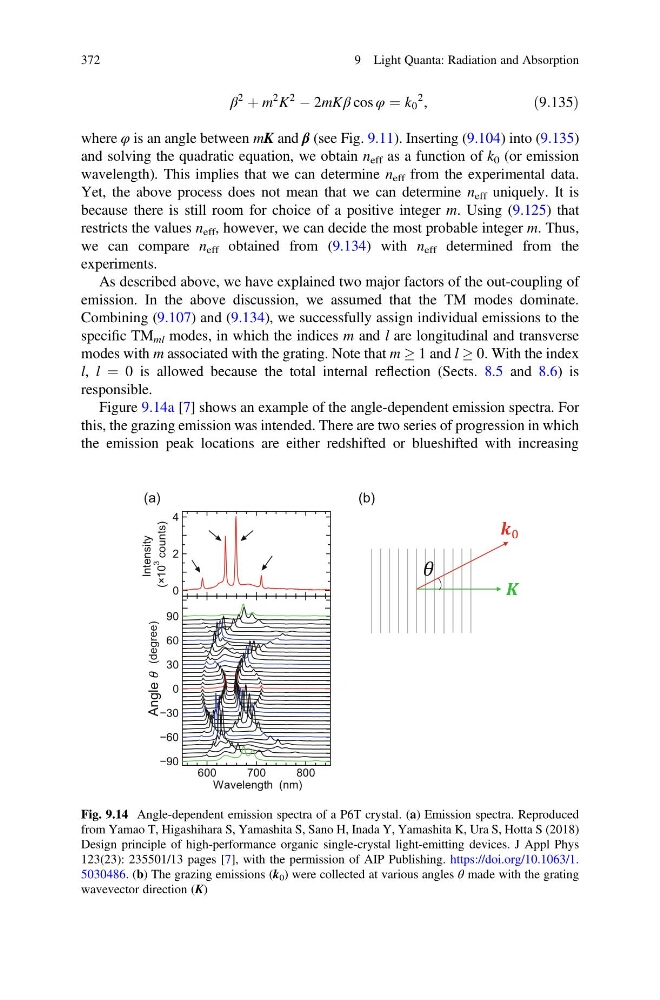
Figure 9.14a [7] shows an example of the angle-dependent emission spectra. For
this, the grazing emission was intended. There are two series of progression in which
the emission peak locations are either redshifted or blueshifted with increasing
600
700
800
−90
−60
−30
0
30
60
90
0
2
4
Wavelength (nm)
)
e
e
r
g
e
d
(
e
l
g
n
a
n
o
i
t
a
t
o
R
y
t
i
s
n
e
t
n
I
(×10
3
)
s
t
n
u
o
c
Angle
(a)
(b)
Fig. 9.14 Angle-dependent emission spectra of a P6T crystal. (a) Emission spectra. Reproduced
from Yamao T, Higashihara S, Yamashita S, Sano H, Inada Y, Yamashita K, Ura S, Hotta S (2018)
Design principle of high-performance organic single-crystal light-emitting devices. J Appl Phys
123(23): 235501/13 pages [7], with the permission of AIP Publishing. https://doi.org/10.1063/1.
5030486. (b) The grazing emissions (k 0 ) were collected at various angles θ made with the grating
wavevector direction (K)
372
9 Light Quanta: Radiation and Absorption
2
þ m
2 K
2
À 2mKβ cos φ ¼ k 0
2 ,
ð9:135Þ
where φ is an angle between mK and β (see Fig. 9.11). Inserting (9.104) into (9.135)
and solving the quadratic equation, we obtain n eff as a function of k 0 (or emission
wavelength). This implies that we can determine n eff from the experimental data.
Yet, the above process does not mean that we can determine n eff uniquely. It is
because there is still room for choice of a positive integer m. Using (9.125) that
restricts the values n eff , however, we can decide the most probable integer m. Thus,
we can compare n eff obtained from (9.134) with n eff determined from the
experiments.
As described above, we have explained two major factors of the out-coupling of
emission. In the above discussion, we assumed that the TM modes dominate.
Combining (9.107) and (9.134), we successfully assign individual emissions to the
specific TM ml modes, in which the indices m and l are longitudinal and transverse
modes with m associated with the grating. Note that m ! 1 and l ! 0. With the index
l, l ¼ 0 is allowed because the total internal reflection (Sects. 8.5 and 8.6) is
responsible.
Figure 9.14a [7] shows an example of the angle-dependent emission spectra. For
this, the grazing emission was intended. There are two series of progression in which
the emission peak locations are either redshifted or blueshifted with increasing
600
700
800
−90
−60
−30
0
30
60
90
0
2
4
Wavelength (nm)
)
e
e
r
g
e
d
(
e
l
g
n
a
n
o
i
t
a
t
o
R
y
t
i
s
n
e
t
n
I
(×10
3
)
s
t
n
u
o
c
Angle
(a)
(b)
Fig. 9.14 Angle-dependent emission spectra of a P6T crystal. (a) Emission spectra. Reproduced
from Yamao T, Higashihara S, Yamashita S, Sano H, Inada Y, Yamashita K, Ura S, Hotta S (2018)
Design principle of high-performance organic single-crystal light-emitting devices. J Appl Phys
123(23): 235501/13 pages [7], with the permission of AIP Publishing. https://doi.org/10.1063/1.
5030486. (b) The grazing emissions (k 0 ) were collected at various angles θ made with the grating
wavevector direction (K)
372
9 Light Quanta: Radiation and Absorption