

ε ζζ
ε ξξ ε ζζ À ε ξζ
2
k tan
kd
cos δ
þ ϕ s
¼
γ
e n
2
,
ð9:133Þ
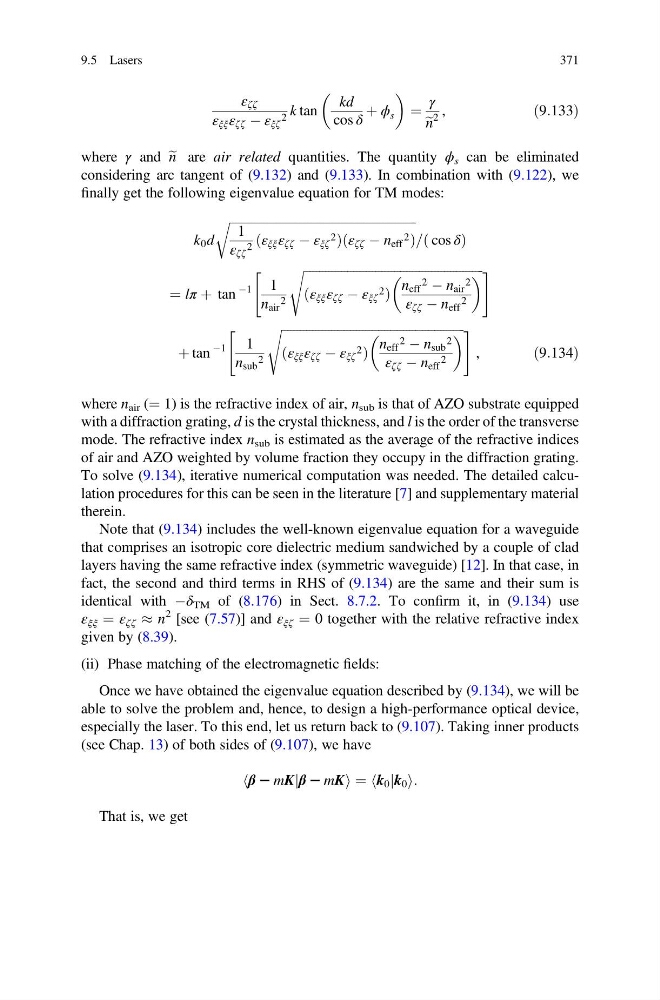
where γ and e n are air related quantities. The quantity ϕ s can be eliminated
considering arc tangent of (9.132) and (9.133). In combination with (9.122), we
finally get the following eigenvalue equation for TM modes:
k 0 d
ffiffiffiffiffiffiffiffiffiffiffiffiffiffiffiffiffiffiffiffiffiffiffiffiffiffiffiffiffiffiffiffiffiffiffiffiffiffiffiffiffiffiffiffiffiffiffiffiffiffiffiffiffiffiffiffiffiffiffiffi
1
ε ζζ
2
ε ξξ ε ζζ À ε ξζ
2
ð
Þε ζζ À n eff
2
ð
Þ
r
= cos δ
ð
Þ
¼ lπ þ tan
À1
1
n air
2
ffiffiffiffiffiffiffiffiffiffiffiffiffiffiffiffiffiffiffiffiffiffiffiffiffiffiffiffiffiffiffiffiffiffiffiffiffiffiffiffiffiffiffiffiffiffiffiffiffiffiffiffiffiffiffiffiffi ffi
ε ξξ ε ζζ À ε ξζ
2
ð
Þ
n eff
2 À n air
2
ε ζζ À n eff
2
s
"
#
þ tan
À1
1
n sub
2
ffiffiffiffiffiffiffiffiffiffiffiffiffiffiffiffiffiffiffiffiffiffiffiffiffiffiffiffiffiffiffiffiffiffiffiffiffiffiffiffiffiffiffiffiffiffiffiffiffiffiffiffiffiffiffiffiffiffi ffi
ε ξξ ε ζζ À ε ξζ
2
ð
Þ
n eff
2 À n sub
2
ε ζζ À n eff
2
s
"
#
,
ð9:134Þ
where n air (¼ 1) is the refractive index of air, n sub is that of AZO substrate equipped
with a diffraction grating, d is the crystal thickness, and l is the order of the transverse
mode. The refractive index n sub is estimated as the average of the refractive indices
of air and AZO weighted by volume fraction they occupy in the diffraction grating.
To solve (9.134), iterative numerical computation was needed. The detailed calculation procedures for this can be seen in the literature [7] and supplementary material
therein.
Note that (9.134) includes the well-known eigenvalue equation for a waveguide
that comprises an isotropic core dielectric medium sandwiched by a couple of clad
layers having the same refractive index (symmetric waveguide) [12]. In that case, in
fact, the second and third terms in RHS of (9.134) are the same and their sum is
identical with Àδ TM of (8.176) in Sect. 8.7.2. To confirm it, in (9.134) use
ε ξξ ¼ ε ζζ % n
2 [see (7.57)] and ε ξζ ¼ 0 together with the relative refractive index
given by (8.39).
(ii) Phase matching of the electromagnetic fields:
Once we have obtained the eigenvalue equation described by (9.134), we will be
able to solve the problem and, hence, to design a high-performance optical device,
especially the laser. To this end, let us return back to (9.107). Taking inner products
(see Chap. 13) of both sides of (9.107), we have
β 2 mKjβ 2 mK
h
i ¼ k 0 jk 0
h
i:
That is, we get
9.5 Lasers
371
ε ξξ ε ζζ À ε ξζ
2
k tan
kd
cos δ
þ ϕ s
¼
γ
e n
2
,
ð9:133Þ
where γ and e n are air related quantities. The quantity ϕ s can be eliminated
considering arc tangent of (9.132) and (9.133). In combination with (9.122), we
finally get the following eigenvalue equation for TM modes:
k 0 d
ffiffiffiffiffiffiffiffiffiffiffiffiffiffiffiffiffiffiffiffiffiffiffiffiffiffiffiffiffiffiffiffiffiffiffiffiffiffiffiffiffiffiffiffiffiffiffiffiffiffiffiffiffiffiffiffiffiffiffiffi
1
ε ζζ
2
ε ξξ ε ζζ À ε ξζ
2
ð
Þε ζζ À n eff
2
ð
Þ
r
= cos δ
ð
Þ
¼ lπ þ tan
À1
1
n air
2
ffiffiffiffiffiffiffiffiffiffiffiffiffiffiffiffiffiffiffiffiffiffiffiffiffiffiffiffiffiffiffiffiffiffiffiffiffiffiffiffiffiffiffiffiffiffiffiffiffiffiffiffiffiffiffiffiffi ffi
ε ξξ ε ζζ À ε ξζ
2
ð
Þ
n eff
2 À n air
2
ε ζζ À n eff
2
s
"
#
þ tan
À1
1
n sub
2
ffiffiffiffiffiffiffiffiffiffiffiffiffiffiffiffiffiffiffiffiffiffiffiffiffiffiffiffiffiffiffiffiffiffiffiffiffiffiffiffiffiffiffiffiffiffiffiffiffiffiffiffiffiffiffiffiffiffi ffi
ε ξξ ε ζζ À ε ξζ
2
ð
Þ
n eff
2 À n sub
2
ε ζζ À n eff
2
s
"
#
,
ð9:134Þ
where n air (¼ 1) is the refractive index of air, n sub is that of AZO substrate equipped
with a diffraction grating, d is the crystal thickness, and l is the order of the transverse
mode. The refractive index n sub is estimated as the average of the refractive indices
of air and AZO weighted by volume fraction they occupy in the diffraction grating.
To solve (9.134), iterative numerical computation was needed. The detailed calculation procedures for this can be seen in the literature [7] and supplementary material
therein.
Note that (9.134) includes the well-known eigenvalue equation for a waveguide
that comprises an isotropic core dielectric medium sandwiched by a couple of clad
layers having the same refractive index (symmetric waveguide) [12]. In that case, in
fact, the second and third terms in RHS of (9.134) are the same and their sum is
identical with Àδ TM of (8.176) in Sect. 8.7.2. To confirm it, in (9.134) use
ε ξξ ¼ ε ζζ % n
2 [see (7.57)] and ε ξζ ¼ 0 together with the relative refractive index
given by (8.39).
(ii) Phase matching of the electromagnetic fields:
Once we have obtained the eigenvalue equation described by (9.134), we will be
able to solve the problem and, hence, to design a high-performance optical device,
especially the laser. To this end, let us return back to (9.107). Taking inner products
(see Chap. 13) of both sides of (9.107), we have
β 2 mKjβ 2 mK
h
i ¼ k 0 jk 0
h
i:
That is, we get
9.5 Lasers
371