

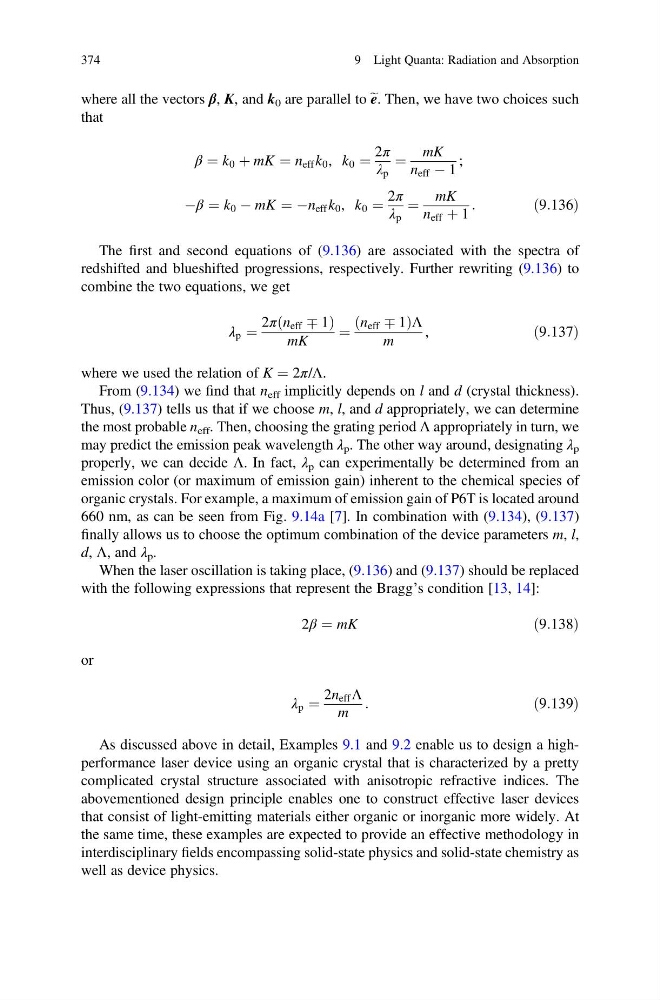
where all the vectors β, K, and k 0 are parallel to e e. Then, we have two choices such
that
β ¼ k 0 þ mK ¼ n eff k 0 , k 0 ¼
2π
λ p
¼
mK
n eff À 1
;
Àβ ¼ k 0 À mK ¼ Àn eff k 0 , k 0 ¼
2π
λ p
¼
mK
n eff þ 1
:
ð9:136Þ
The first and second equations of (9.136) are associated with the spectra of
redshifted and blueshifted progressions, respectively. Further rewriting (9.136) to
combine the two equations, we get
λ p ¼
2π n eff Ç 1
ð
Þ
mK
¼
n eff Ç 1
ð
Þ Λ
m
,
ð9:137Þ
where we used the relation of K ¼ 2π/Λ.
From (9.134) we find that n eff implicitly depends on l and d (crystal thickness).
Thus, (9.137) tells us that if we choose m, l, and d appropriately, we can determine
the most probable n eff . Then, choosing the grating period Λ appropriately in turn, we
may predict the emission peak wavelength λ p . The other way around, designating λ p
properly, we can decide Λ. In fact, λ p can experimentally be determined from an
emission color (or maximum of emission gain) inherent to the chemical species of
organic crystals. For example, a maximum of emission gain of P6T is located around
660 nm, as can be seen from Fig. 9.14a [7]. In combination with (9.134), (9.137)
finally allows us to choose the optimum combination of the device parameters m, l,
d, Λ, and λ p .
When the laser oscillation is taking place, (9.136) and (9.137) should be replaced
with the following expressions that represent the Bragg’s condition [13, 14]:
2β ¼ mK
ð9:138Þ
or
λ p ¼
2n eff Λ
m
:
ð9:139Þ
As discussed above in detail, Examples 9.1 and 9.2 enable us to design a highperformance laser device using an organic crystal that is characterized by a pretty
complicated crystal structure associated with anisotropic refractive indices. The
abovementioned design principle enables one to construct effective laser devices
that consist of light-emitting materials either organic or inorganic more widely. At
the same time, these examples are expected to provide an effective methodology in
interdisciplinary fields encompassing solid-state physics and solid-state chemistry as
well as device physics.
374
9 Light Quanta: Radiation and Absorption
that
β ¼ k 0 þ mK ¼ n eff k 0 , k 0 ¼
2π
λ p
¼
mK
n eff À 1
;
Àβ ¼ k 0 À mK ¼ Àn eff k 0 , k 0 ¼
2π
λ p
¼
mK
n eff þ 1
:
ð9:136Þ
The first and second equations of (9.136) are associated with the spectra of
redshifted and blueshifted progressions, respectively. Further rewriting (9.136) to
combine the two equations, we get
λ p ¼
2π n eff Ç 1
ð
Þ
mK
¼
n eff Ç 1
ð
Þ Λ
m
,
ð9:137Þ
where we used the relation of K ¼ 2π/Λ.
From (9.134) we find that n eff implicitly depends on l and d (crystal thickness).
Thus, (9.137) tells us that if we choose m, l, and d appropriately, we can determine
the most probable n eff . Then, choosing the grating period Λ appropriately in turn, we
may predict the emission peak wavelength λ p . The other way around, designating λ p
properly, we can decide Λ. In fact, λ p can experimentally be determined from an
emission color (or maximum of emission gain) inherent to the chemical species of
organic crystals. For example, a maximum of emission gain of P6T is located around
660 nm, as can be seen from Fig. 9.14a [7]. In combination with (9.134), (9.137)
finally allows us to choose the optimum combination of the device parameters m, l,
d, Λ, and λ p .
When the laser oscillation is taking place, (9.136) and (9.137) should be replaced
with the following expressions that represent the Bragg’s condition [13, 14]:
2β ¼ mK
ð9:138Þ
or
λ p ¼
2n eff Λ
m
:
ð9:139Þ
As discussed above in detail, Examples 9.1 and 9.2 enable us to design a highperformance laser device using an organic crystal that is characterized by a pretty
complicated crystal structure associated with anisotropic refractive indices. The
abovementioned design principle enables one to construct effective laser devices
that consist of light-emitting materials either organic or inorganic more widely. At
the same time, these examples are expected to provide an effective methodology in
interdisciplinary fields encompassing solid-state physics and solid-state chemistry as
well as device physics.
374
9 Light Quanta: Radiation and Absorption