

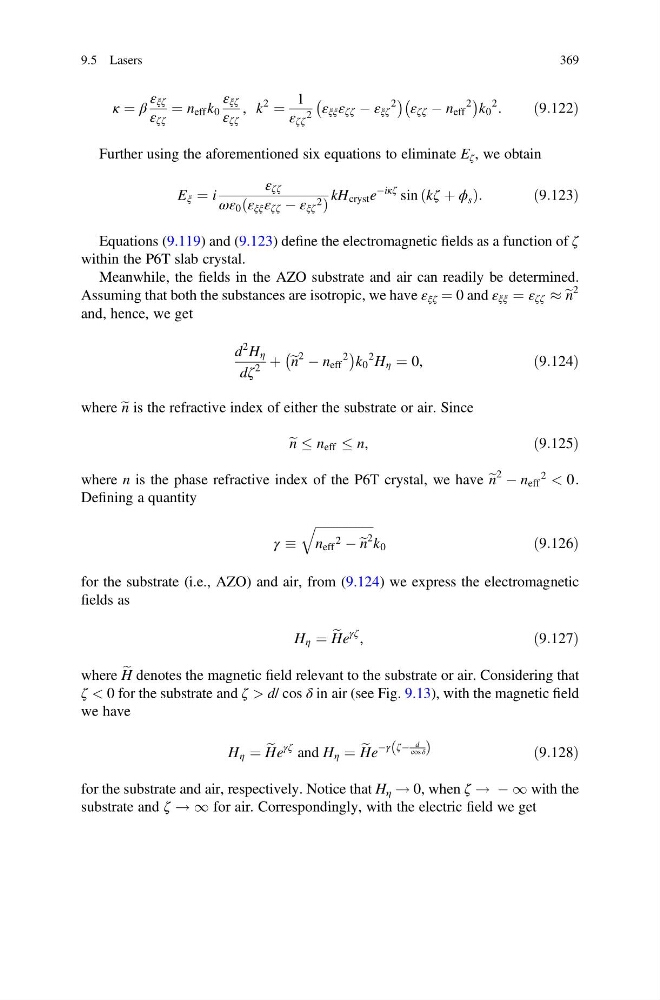
κ ¼ β
ε ξζ
ε ζζ
¼ n eff k 0
ε ξζ
ε ζζ
, k
2
¼
1
ε ζζ
2
ε ξξ ε ζζ À ε ξζ
2
À
Á ε ζζ À n eff
2
À
Á
k 0
2
:
ð9:122Þ
Further using the aforementioned six equations to eliminate E ζ , we obtain
E ξ ¼ i
ε ζζ
ωε 0 ε ξξ ε ζζ À ε ξζ
2
ð
Þ
kH cryst e
Àiκζ sin kζ þ ϕ s
ð
Þ :
ð9:123Þ
Equations (9.119) and (9.123) define the electromagnetic fields as a function of ζ
within the P6T slab crystal.
Meanwhile, the fields in the AZO substrate and air can readily be determined.
Assuming that both the substances are isotropic, we have ε ξζ ¼ 0 and ε ξξ ¼ ε ζζ % e n
2
and, hence, we get
d
2 H η
dζ
2
þ e n
2 À n eff
2
À
Á
k 0
2 H η ¼ 0,
ð9:124Þ
where e n is the refractive index of either the substrate or air. Since
e n n eff n,
ð9:125Þ
where n is the phase refractive index of the P6T crystal, we have e n
2 À n eff
2
< 0.
Defining a quantity
γ
ffiffiffiffiffiffiffiffiffiffiffiffiffiffiffiffiffiffiffi
n eff
2 À e n
2
q
k 0
ð9:126Þ
for the substrate (i.e., AZO) and air, from (9.124) we express the electromagnetic
fields as
H η ¼ e
He
γζ ,
ð9:127Þ
where e
H denotes the magnetic field relevant to the substrate or air. Considering that
ζ < 0 for the substrate and ζ > d/ cos δ in air (see Fig. 9.13), with the magnetic field
we have
H η ¼ e
He
γζ and H η ¼ e
He
Àγ ζÀ
d
cos δ
ð
Þ
ð9:128Þ
for the substrate and air, respectively. Notice that H η ! 0, when ζ ! À 1 with the
substrate and ζ ! 1 for air. Correspondingly, with the electric field we get
9.5 Lasers
369
ε ξζ
ε ζζ
¼ n eff k 0
ε ξζ
ε ζζ
, k
2
¼
1
ε ζζ
2
ε ξξ ε ζζ À ε ξζ
2
À
Á ε ζζ À n eff
2
À
Á
k 0
2
:
ð9:122Þ
Further using the aforementioned six equations to eliminate E ζ , we obtain
E ξ ¼ i
ε ζζ
ωε 0 ε ξξ ε ζζ À ε ξζ
2
ð
Þ
kH cryst e
Àiκζ sin kζ þ ϕ s
ð
Þ :
ð9:123Þ
Equations (9.119) and (9.123) define the electromagnetic fields as a function of ζ
within the P6T slab crystal.
Meanwhile, the fields in the AZO substrate and air can readily be determined.
Assuming that both the substances are isotropic, we have ε ξζ ¼ 0 and ε ξξ ¼ ε ζζ % e n
2
and, hence, we get
d
2 H η
dζ
2
þ e n
2 À n eff
2
À
Á
k 0
2 H η ¼ 0,
ð9:124Þ
where e n is the refractive index of either the substrate or air. Since
e n n eff n,
ð9:125Þ
where n is the phase refractive index of the P6T crystal, we have e n
2 À n eff
2
< 0.
Defining a quantity
γ
ffiffiffiffiffiffiffiffiffiffiffiffiffiffiffiffiffiffiffi
n eff
2 À e n
2
q
k 0
ð9:126Þ
for the substrate (i.e., AZO) and air, from (9.124) we express the electromagnetic
fields as
H η ¼ e
He
γζ ,
ð9:127Þ
where e
H denotes the magnetic field relevant to the substrate or air. Considering that
ζ < 0 for the substrate and ζ > d/ cos δ in air (see Fig. 9.13), with the magnetic field
we have
H η ¼ e
He
γζ and H η ¼ e
He
Àγ ζÀ
d
cos δ
ð
Þ
ð9:128Þ
for the substrate and air, respectively. Notice that H η ! 0, when ζ ! À 1 with the
substrate and ζ ! 1 for air. Correspondingly, with the electric field we get
9.5 Lasers
369