

Meanwhile, the electromagnetic waves that are propagating within the slab
crystal are described as
Φ ν exp i βξ À ωt
ð
Þ
½
,
ð9:117Þ
where Φ ν stands for either an electric field or a magnetic field with ν chosen from
ν ¼ 1, 2, 3 representing each component of the ξηζ-system. Inserting (9.117) into
(9.116) and separating the resulting equation into ξ, η, and ζ components, we obtain
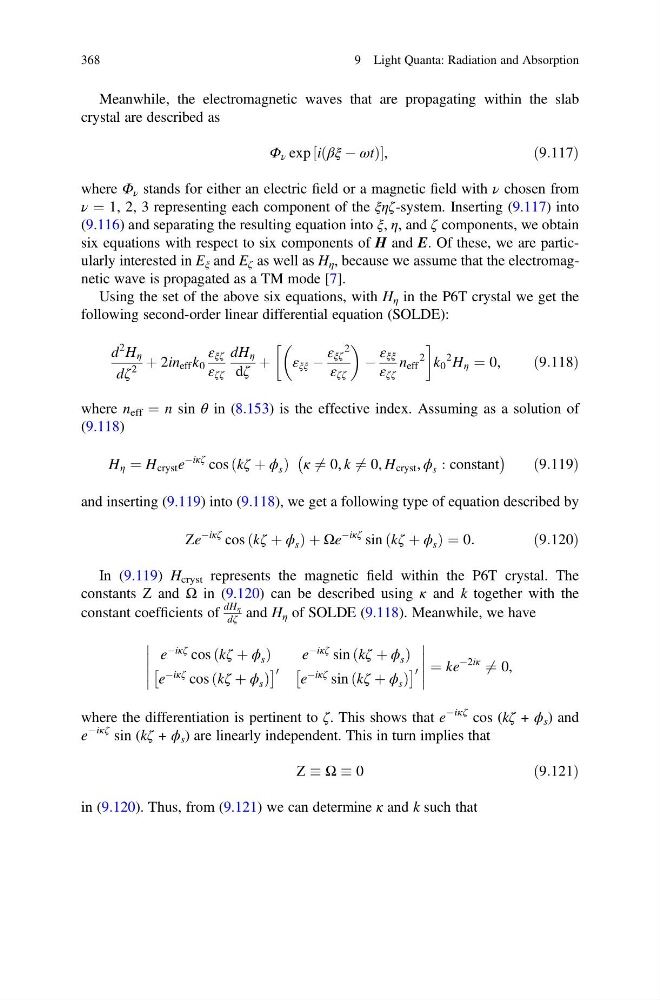
six equations with respect to six components of H and E. Of these, we are particularly interested in E ξ and E ζ as well as H η , because we assume that the electromagnetic wave is propagated as a TM mode [7].
Using the set of the above six equations, with H η in the P6T crystal we get the
following second-order linear differential equation (SOLDE):
d
2 H η
dζ
2
þ 2in eff k 0
ε ξζ
ε ζζ
dH η
dζ
þ ε ξξ À
ε ξζ
2
ε ζζ
À
ε ξξ
ε ζζ
n eff
2
!
k 0
2 H η ¼ 0,
ð9:118Þ
where n eff ¼ n sin θ in (8.153) is the effective index. Assuming as a solution of
(9.118)
H η ¼ H cryst e
Àiκζ cos kζ þ ϕ s
ð
Þ κ 6 ¼ 0, k 6 ¼ 0, H cryst , ϕ s : constant
À
Á
ð9:119Þ
and inserting (9.119) into (9.118), we get a following type of equation described by
Ζe
Àiκζ cos kζ þ ϕ s
ð
ÞþΩe
Àiκζ sin kζ þ ϕ s
ð
Þ¼0:
ð9:120Þ
In (9.119) H cryst represents the magnetic field within the P6T crystal. The
constants Ζ and Ω in (9.120) can be described using κ and k together with the
constant coefficients of
dH η
dζ and H η of SOLDE (9.118). Meanwhile, we have
e
Àiκζ cos kζ þ ϕ s
ð
Þ
e
Àiκζ sin kζ þ ϕ s
ð
Þ
e
Àiκζ cos kζ þ ϕ s
ð
Þ
Â
à 0 e
Àiκζ sin kζ þ ϕ s
ð
Þ
Â
à 0
¼ ke
À2iκ
6 ¼ 0,
where the differentiation is pertinent to ζ. This shows that e
Àiκζ cos (kζ + ϕ s ) and
e
Àiκζ sin (kζ + ϕ s ) are linearly independent. This in turn implies that
Ζ Ω 0
ð9:121Þ
in (9.120). Thus, from (9.121) we can determine κ and k such that
368
9 Light Quanta: Radiation and Absorption
crystal are described as
Φ ν exp i βξ À ωt
ð
Þ
½
,
ð9:117Þ
where Φ ν stands for either an electric field or a magnetic field with ν chosen from
ν ¼ 1, 2, 3 representing each component of the ξηζ-system. Inserting (9.117) into
(9.116) and separating the resulting equation into ξ, η, and ζ components, we obtain
six equations with respect to six components of H and E. Of these, we are particularly interested in E ξ and E ζ as well as H η , because we assume that the electromagnetic wave is propagated as a TM mode [7].
Using the set of the above six equations, with H η in the P6T crystal we get the
following second-order linear differential equation (SOLDE):
d
2 H η
dζ
2
þ 2in eff k 0
ε ξζ
ε ζζ
dH η
dζ
þ ε ξξ À
ε ξζ
2
ε ζζ
À
ε ξξ
ε ζζ
n eff
2
!
k 0
2 H η ¼ 0,
ð9:118Þ
where n eff ¼ n sin θ in (8.153) is the effective index. Assuming as a solution of
(9.118)
H η ¼ H cryst e
Àiκζ cos kζ þ ϕ s
ð
Þ κ 6 ¼ 0, k 6 ¼ 0, H cryst , ϕ s : constant
À
Á
ð9:119Þ
and inserting (9.119) into (9.118), we get a following type of equation described by
Ζe
Àiκζ cos kζ þ ϕ s
ð
ÞþΩe
Àiκζ sin kζ þ ϕ s
ð
Þ¼0:
ð9:120Þ
In (9.119) H cryst represents the magnetic field within the P6T crystal. The
constants Ζ and Ω in (9.120) can be described using κ and k together with the
constant coefficients of
dH η
dζ and H η of SOLDE (9.118). Meanwhile, we have
e
Àiκζ cos kζ þ ϕ s
ð
Þ
e
Àiκζ sin kζ þ ϕ s
ð
Þ
e
Àiκζ cos kζ þ ϕ s
ð
Þ
Â
à 0 e
Àiκζ sin kζ þ ϕ s
ð
Þ
Â
à 0
¼ ke
À2iκ
6 ¼ 0,
where the differentiation is pertinent to ζ. This shows that e
Àiκζ cos (kζ + ϕ s ) and
e
Àiκζ sin (kζ + ϕ s ) are linearly independent. This in turn implies that
Ζ Ω 0
ð9:121Þ
in (9.120). Thus, from (9.121) we can determine κ and k such that
368
9 Light Quanta: Radiation and Absorption